New Year Sale 2026! Hurry Up, Grab the Special Discount - Save 25% - Ends In 00:00:00 Coupon code: SAVE25
Welcome to Pass4Success

- Free Preparation Discussions

Juniper JN0-363 Exam - Topic 9 Question 61 Discussion

Actual exam question for Juniper's JN0-363 exam
Question #: 61
Topic #: 9
[All JN0-363 Questions]

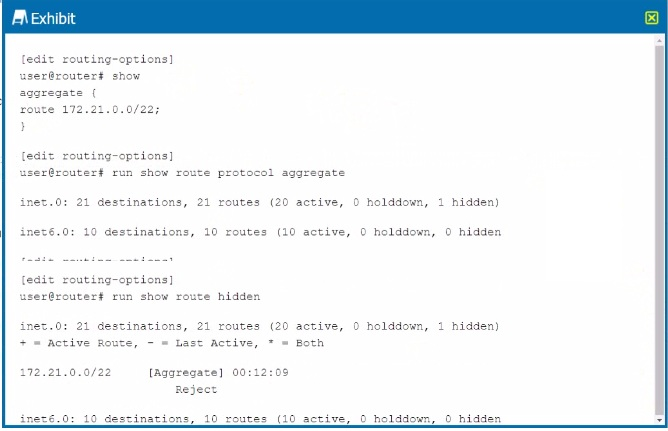
Exhibit.

Referring to the exhibit, you have configured an aggregate route that represents the 172.21.0.0/24, 172.21.1.0/24, and 172.21.2.0/24 networks. However, when you view the routing table, your new route hidden.

Which action would you perform to determine the problem?

Show Suggested Answer Hide Answer
Suggested Answer: D

The exhibit shows an aggregate route configuration for the network 172.21.0.0/22, which would summarize the specific networks 172.21.0.0/24, 172.21.1.0/24, and 172.21.2.0/24. For an aggregate route to be active, it must have contributing routes in the routing table. If the route is hidden, it usually means there are no contributing routes that are active or the policy applied to the aggregate does not match any of the specific routes. Therefore, the first step in troubleshooting would be to verify that there are indeed active contributing routes for the aggregate to be valid.


Juniper documentation on routing policies and aggregates: Junos OS Routing Policies, Firewall Filters, and Traffic Policers User Guide

Contribute your Thoughts:

0/2000 characters
Norah
2 months ago
Isn't the metric value important too?
upvoted 0 times
...
Linwood
2 months ago
I think it's more about the policy for aggregate routes.
upvoted 0 times
...
Azzie
3 months ago
Gotta check those contributing routes first!
upvoted 0 times
...
Alaine
3 months ago
Wait, why would the preference value matter here?
upvoted 0 times
...
Annelle
3 months ago
This seems off, are we sure about the aggregate setup?
upvoted 0 times
...
Kanisha
3 months ago
I vaguely recall something about preference values affecting route visibility, so option D could also be a possibility, but I'm not confident about that.
upvoted 0 times
...
Marlon
4 months ago
I practiced a similar question, and I think defining a metric for the aggregate route could be important too, so option C might be worth considering.
upvoted 0 times
...
Reed
4 months ago
I'm not entirely sure, but I feel like we might need to look at the policy settings for aggregate routes, which could be option B.
upvoted 0 times
...
Delbert
4 months ago
I think I remember that we need to check if the contributing routes are active first, so maybe option A is the right choice?
upvoted 0 times
...
Nell
4 months ago
This seems straightforward enough. I'll start by verifying the contributing routes, then move on to the other options if needed.
upvoted 0 times
...
Raymon
4 months ago
I think the key here is to methodically check each of the possible actions and see which one is most likely to resolve the issue.
upvoted 0 times
...
Donte
5 months ago
I'm a bit confused by this one. I'll need to make sure I understand the concept of aggregate routes and how they should be configured.
upvoted 0 times
...
Arlie
5 months ago
Okay, let's see. The question is asking about why the aggregate route is hidden, so I'll need to focus on verifying the configuration steps.
upvoted 0 times
...
Leanna
5 months ago
Hmm, this looks like a tricky one. I'll need to carefully review the exhibit and think through the possible actions.
upvoted 0 times
...
Daisy
7 months ago
Hmm, I think the answer is B. Gotta make sure that aggregate route policy is configured properly, you know?
upvoted 0 times
...
Callie
7 months ago
I think the answer is A.
upvoted 0 times
...

Save Cancel