
Free Preparation Discussions
 MENU
MENU
Guidewire ClaimCenter-Business-Analysts Exam - Topic 5 Question 9 Discussion
Topic #: 5
Whenever the Total Loss Calculator determines that a vehicle is a total loss, Succeed Insurance wants to create a custom history event with the exposure name and total loss score.
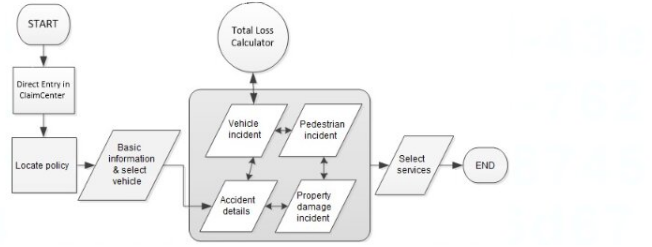
Which step in the claim setup process flow must be completed before the history event can be created?
250 to 350 words From Exact Extract of Guidewire ClaimCenter Business Analyst documentation:
In Guidewire ClaimCenter workflow analysis and configuration, defining the correct sequence of operations is critically dependent on Data Availability and Data Dependency.
The specific requirement here dictates that the custom history event must capture the Total Loss Score. In the context of the ClaimCenter object model and process flow, the Total Loss Score is an output value generated specifically by the Total Loss Calculator engine. Before this calculator runs, the score attribute is effectively null or non-existent.
Therefore, to satisfy the business requirement, the step that writes the history event must be placed after the step that generates the data it needs to record.
Process Logic: If the Business Analyst were to place the history event creation step before the Total Loss Calculator (Option B) or before the Vehicle Incident (Option D), the system would attempt to write a record containing a score that has not yet been calculated. This would result in either a system error or a history event with a blank/zero value, failing to meet the business requirement.
Dependency Chain: The workflow dependency is: Vehicle Data Entry -> Total Loss Calculation -> Score Generation -> History Event Creation.
Implementation Note: In a typical Guidewire implementation, this logic is often handled via 'Event Fired' rules or specific 'Exit Points' in the workflow. The system waits for the confirmation that the Total Loss calculation service has successfully returned a result. Once that transaction is committed and the score is persisted on the Vehicle or Exposure entity, the subsequent rule to generate the History Event can trigger successfully.
Consequently, Option C is the only viable placement in the process flow. It ensures that the prerequisite action (calculation) is complete and the required data payload (the score) is available for the subsequent action (logging the history event).
Tawanna
24 days agoAlbina
29 days agoValene
1 month ago