
Free Preparation Discussions
 MENU
MENU
Guidewire ClaimCenter-Business-Analysts Exam Questions
- Topic 1: Quality Analyst Basics: This domain covers quality assurance fundamentals including driving quality throughout development, integrating quality from inception, risk assessment and mitigation, test strategy selection, and defect management processes.
- Topic 2: Behavior Driven Development at Guidewire: This section introduces BDD methodology and its application in Guidewire implementations, focusing on collaborative development approaches and writing clear, testable requirements using BDD principles.
- Topic 3: InsuranceSuite Analyst Fundamentals: This domain covers InsuranceSuite platform fundamentals including user interface, data model, application logic, integration mechanisms, and hands-on workshop exercises for practical application.
- Topic 4: Claim Processes and Maintenance: This section focuses on end-to-end claims processes, organizational structure setup, line of business coverage configuration, claim intake procedures, and ongoing claim maintenance activities.
- Topic 5: Claim Center Data Model and Adjudication: This domain examines ClaimCenter's data model architecture, claim setup, adjudication processes, financial terminology and concepts, and payment creation procedures.
- Topic 6: Claim Center Financials Transactions: This section covers financial controls including payment approvals and holds, contact and vendor management, service request handling, and security framework with permissions and access control lists.
Free Guidewire ClaimCenter-Business-Analysts Exam Actual Questions
Note: Premium Questions for ClaimCenter-Business-Analysts were last updated On Oct. 16, 2026 (see below)
Whenever the Total Loss Calculator determines that a vehicle is a total loss, Succeed Insurance wants to create a custom history event with the exposure name and total loss score.
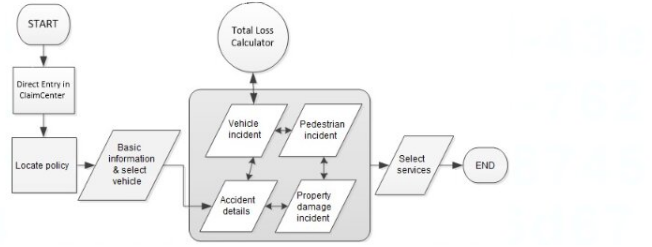
Which step in the claim setup process flow must be completed before the history event can be created?
250 to 350 words From Exact Extract of Guidewire ClaimCenter Business Analyst documentation:
In Guidewire ClaimCenter workflow analysis and configuration, defining the correct sequence of operations is critically dependent on Data Availability and Data Dependency.
The specific requirement here dictates that the custom history event must capture the Total Loss Score. In the context of the ClaimCenter object model and process flow, the Total Loss Score is an output value generated specifically by the Total Loss Calculator engine. Before this calculator runs, the score attribute is effectively null or non-existent.
Therefore, to satisfy the business requirement, the step that writes the history event must be placed after the step that generates the data it needs to record.
Process Logic: If the Business Analyst were to place the history event creation step before the Total Loss Calculator (Option B) or before the Vehicle Incident (Option D), the system would attempt to write a record containing a score that has not yet been calculated. This would result in either a system error or a history event with a blank/zero value, failing to meet the business requirement.
Dependency Chain: The workflow dependency is: Vehicle Data Entry -> Total Loss Calculation -> Score Generation -> History Event Creation.
Implementation Note: In a typical Guidewire implementation, this logic is often handled via 'Event Fired' rules or specific 'Exit Points' in the workflow. The system waits for the confirmation that the Total Loss calculation service has successfully returned a result. Once that transaction is committed and the score is persisted on the Vehicle or Exposure entity, the subsequent rule to generate the History Event can trigger successfully.
Consequently, Option C is the only viable placement in the process flow. It ensures that the prerequisite action (calculation) is complete and the required data payload (the score) is available for the subsequent action (logging the history event).
To help manage new user setup, Succeed Insurance would like all manager-level employees to be able to add new users to ClaimCenter. Some managers are already assigned the Community Admin role, which has a set of permissions for the administration of the ClaimCenter community model that includes the permission to create new users.
Where are two places the Business Analyst (BA) can go to view the permissions assigned to manager-level users? (Choose two.)
To view the detailed System Permissions (such as usercreate, claimview, etc.) associated with a specific user role (like 'Manager' or 'Community Admin'), a Business Analyst has two primary methods: one within the application UI and one via generated documentation.
Administration Menu > Users & Security > Roles (Option E): This is the direct User Interface method. By navigating to the Roles page in the Administration tab, the BA can select a specific role (e.g., 'Manager'). The detailed view of that role lists every system permission currently granted to it. This allows the BA to verify if the 'usercreate' permission is present.
Security Dictionary (Option B): For a comprehensive, searchable, and offline reference, the BA can access the Security Dictionary. This is a set of HTML files generated from the application's configuration (found in the build directory). It provides a complete matrix of all Roles, the Permissions assigned to them, and the Access Profiles configured in the system.
Why other options are incorrect:
Data Dictionary (A): This documents the Data Model (Entities and Typelists), not the security configuration.
Users (C): While this screen lists users and their assigned roles, it does not display the definitions (the specific list of permissions) of those roles.
Authority Limits (D): This screen manages Financial limits (dollar amounts for reserves/payments), not system access permissions.
A claim for an auto accident in Tampa, Florida has been reported and recorded in ClaimCenter. The ClaimCenter base product Global Claim Assignment Rule is utilized for automatic assignment to Adjusters regardless of complexity of claims.

What is the likely path of assignment for this claim?
Claim Assignment in Guidewire ClaimCenter follows a two-step logic: Global Assignment (finding the right Group) and Group Assignment (finding the right User).
Group Identification (Global Assignment): The first step relies on the geography of the loss. According to the provided organization table, the Southeastern Auto Adjusters group is responsible for 'Georgia, Florida, Alabama, South Carolina, North Carolina.' Since the accident occurred in Tampa, Florida, the Global Assignment rule will route the claim to the Southeastern Auto Adjusters group.
User Assignment (Group Assignment): The prompt specifies the use of 'automatic assignment... regardless of complexity.' In ClaimCenter's base configuration, the standard method for distributing claims automatically within a group is Round Robin (or Cyclical) assignment. This method assigns the claim to the next available adjuster in the list, ensuring an even distribution of volume without complex weighting calculations.
Why other options are incorrect:
Option B (Midwest): Incorrect geography. The Midwest group covers IL, MI, OH, IN, WI, not Florida.
Option C (Weighted Workload): While 'Dynamic Assignment' (workload balancing) is a feature, the standard 'automatic assignment' described implies a simple cyclical rotation (Round Robin). Weighted assignment is a more advanced configuration typically used when complexity is a factor (e.g., assigning fewer claims to junior adjusters).
Option D (Supervisor): Assigning to a Supervisor is a manual fallback or 'Assign to Supervisor' rule, usually triggered when no suitable adjuster is available or for complex exceptions. It is not the primary path for standard automatic assignment.
Succeed Insurance needs the ability to associate a primary hospital with an injury incident if the injured party received treatment. When treatment is needed, the primary hospital name should display on the injury incident screen along with other details about the injury and treatment received.
The primary hospital should be added to the injury incident in one of the following ways:
. Select the name from a list of medical care organizations already associated with the claim.
. Enter the contact details directly in the incident.
. Search the Address Book from the incident to locate a hospital.
Which two requirements must be documented to associate the primary hospital with the claim? (Choose two.)
To implement the functionality of associating a specific contact (the 'Primary Hospital') with an entity (the 'Injury Incident') in Guidewire ClaimCenter, two core configuration components are required:
A new primary hospital role (Option B): In ClaimCenter, the relationship between a Contact and a Claim (or Incident) is defined by a Role. While the contact itself might be a 'Medical Care Organization' (existing subtype), the context of its relationship to this specific incident is that it is the 'Primary Hospital'. Defining this role allows the system to distinguish this hospital from other medical providers on the same claim.
A new field on the incident screen (Option C): To allow the user to select, add, or view this contact, a UI element (specifically a Claim Contact Picker or Input widget) must be added to the Injury Incident screen. This field will be configured to store the relationship and allows the user to perform the required actions: selecting from existing contacts (filtered by the role), entering new ones, or searching the Address Book.
Why other options are incorrect:
A (New Subtype): The base product already includes the MedicalCareOrg contact subtype, which is sufficient to store hospital data. Creating a new subtype is unnecessary unless the data structure (fields) of a hospital is fundamentally different from other medical providers.
D (Address Book Field): Contacts in the Address Book are typically identified by tags or their Subtype, not by adding a custom field just to identify them as a vendor/hospital.
During claim intake and adjudication, Adjusters capture contact information for the insured and all claimants. To improve customer service and reduce the time required to reach these contacts to gather additional claim information, Succeed Insurance will capture the preferred contact method for all person contacts. The new field will be added to the contact details screen of the user interface (UI) as a drop-down list displaying all valid contact methods including email, mail, and phone.
Which version correctly lists the preferred contact methods in the Typelists tab of the Parties Involved User Story Card?

To correctly document a Typelist in a User Story Card, the Business Analyst must understand both the data structure (Codes vs. Names) and the configuration state (New vs. Modified).
Code Validity: In Guidewire, a Typecode (the value stored in the database) must be a unique identifier for each option in the list.
Option B correctly lists distinct codes: email, mail, and phone.
Options A and C are incorrect because they list the Typelist Name (PreferredContactMethod) as the Code for every single row. You cannot have multiple entries with the same primary key (Code) in one list.
Configuration State (New vs. Modified): The PreferredContactMethod typelist is a standard Base Product feature in Guidewire ClaimCenter. It already exists out-of-the-box.
Option B correctly identifies the Status as 'Modified'. When you add values to or configure an existing base typelist, you document it as 'Modified'.
Option D is incorrect because it lists the Status as 'New'. This would imply creating a brand new custom typelist (e.g., MyCustomList_Ext), which is not necessary for standard contact methods.
Therefore, Option B is the only version that has valid, unique codes and the correct configuration status.
- Select Question Types you want
- Set your Desired Pass Percentage
- Allocate Time (Hours : Minutes)
- Create Multiple Practice tests with Limited Questions
- Customer Support
Tiffany Edwards
20 days agoOlivia Mitchell
1 month agoLinda Parker
2 months agoEric Walker
2 months agoMonica Moore
3 months agoJoseph Garcia
3 months agoJames Cook
4 months agoPatricia Brown
4 months agoAmanda Bell
5 months agoJoshua Davis
5 months agoJessica Jones
6 months agoMark Brown
6 months agoGeorge Hernandez
6 months agoRobert Hill
6 months agoJohn Martin
5 months agoEdward Turner
5 months agoCaitlin
7 months agoRonna
7 months agoGerald
7 months agoDonette
7 months agoClemencia
8 months agoDiane
8 months agoAhmed
8 months agoEttie
8 months agoJacquelyne
9 months agoLavera
9 months ago