
Free Preparation Discussions
 MENU
MENU
WGU Data Management - Foundations (D426) Exam Questions
- Topic 1: Introduction to conceptual logical and physical data models: This section of the exam measures skills of Data Analysts and introduces the basic ideas behind conceptual, logical, and physical data models. It focuses on understanding how each model represents data at a different level, from high level business view to detailed database structure.
- Topic 2: Creating databases and tables in SQL enabled database systems: This section of the exam measures skills of Database Developers and covers setting up databases and tables using SQL in relational systems. It focuses on choosing table structures, defining columns, and preparing the database so that data can be stored and managed correctly.
- Topic 3: Normalizing relational databases: This section of the exam measures skills of Data Analysts and covers organizing data using normalization steps. It focuses on reducing redundancy, splitting data into related tables, and improving consistency in a relational database.
- Topic 4: Defining primary and foreign keys for data normalization: This section of the exam measures skills of Database Developers and explains how to identify and define primary and foreign keys. It focuses on using keys to connect tables, enforce relationships, and support normalized database design.
- Topic 5: Running SQL queries to create and manipulate data: This section of the exam measures skills of Data Analysts and focuses on using SQL statements to build and change data structures and records. It includes creating tables and running queries to insert, update, delete, and retrieve data.
- Topic 6: Attributes of databases tables and SQL commands: This section of the exam measures skills of Database Developers and explains the main features of databases and tables, along with basic SQL commands. It focuses on understanding rows, columns, data types, and how common SQL operations interact with these elements.
Free WGU Data Management - Foundations (D426) Exam Actual Questions
Note: Premium Questions for Data Management - Foundations (D426) were last updated On Oct. 08, 2026 (see below)
Which clause or statement in a CREATE statement ensures a certain range of data?
The CHECK constraint is used in SQL to enforce rules on a column's values. It ensures that data inserted into a table meets specified conditions, such as range restrictions or logical rules.
Example Usage:
sql
CREATE TABLE Employees (
ID INT PRIMARY KEY,
Name VARCHAR(50),
Salary INT CHECK (Salary BETWEEN 30000 AND 150000)
);
This constraint ensures that salary values fall between 30,000 and 150,000.
If an INSERT or UPDATE statement tries to set Salary = 20000, it fails because it does not meet the CHECK condition.
Why Other Options Are Incorrect:
Option B (FROM) (Incorrect): Used in SELECT statements, not for constraints.
Option C (WHERE) (Incorrect): Filters rows in queries but does not enforce constraints.
Option D (SET) (Incorrect): Used for updating records (UPDATE table_name SET column = value) but not for defining constraints.
Thus, CHECK is the correct answer, as it ensures that column values remain within an expected range.
Which SELECT statement uses valid syntax for SQL?
A valid SELECT statement in SQL follows this basic syntax:
sql
SELECT column1, column2
FROM table_name
WHERE condition;
The correct option D follows this syntax correctly.
Why Other Options Are Incorrect:
Option A (Incorrect): SQL does not use double quotes (') around column/table names unless explicitly required in some databases.
Option B (Incorrect): The WHERE clause must appear after the FROM clause.
Option C (Incorrect): ALL is not a valid keyword in standard SQL queries.
Thus, Option D follows the correct SQL syntax.
What is the last step in the logical design process for designing a database?
The logical design phase in database development focuses on structuring data efficiently to eliminate redundancy and ensure integrity. The final step in logical design is to apply normalization (normal forms) to optimize the database schema.
Steps in Logical Database Design:
Discover entities Identify real-world objects (e.g., Customers, Orders).
Determine cardinality Define relationships between entities (one-to-one, one-to-many).
Analyze data requirements Determine the attributes each entity needs.
Apply normal forms Eliminate redundancy and improve data consistency.
Example Usage:
After identifying entities like Students and Courses, applying 3rd Normal Form (3NF) ensures that data is organized without redundancy.
Why Other Options Are Incorrect:
Option A (Analyze data requirements) (Incorrect): Done earlier to define attributes.
Option C (Determine cardinality) (Incorrect): Done before normalization to establish relationships.
Option D (Discover entities) (Incorrect): Done at the beginning of database design.
Thus, the correct answer is Apply a normal form, as normalization is the last step in logical design.
Which main characteristic is used to differentiate between strong and weak entities in the process of database design?
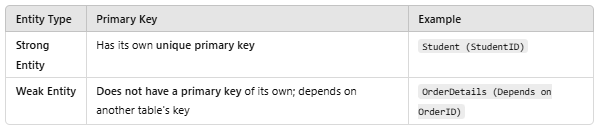
In database design, an entity is classified as strong or weak based on whether it has a primary key that uniquely identifies its records.
Differences Between Strong and Weak Entities:
CREATE TABLE Orders (
OrderID INT PRIMARY KEY,
CustomerID INT
);
CREATE TABLE OrderDetails (
OrderDetailID INT,
OrderID INT,
ProductID INT,
PRIMARY KEY (OrderDetailID, OrderID),
FOREIGN KEY (OrderID) REFERENCES Orders(OrderID)
);
Orders is a strong entity (has OrderID as its own primary key).
OrderDetails is a weak entity (depends on OrderID for uniqueness).
Why Other Options Are Incorrect:
Option A (Association) (Incorrect): Associations describe relationships but do not define strong/weak entities.
Option C (Foreign key) (Incorrect): Weak entities depend on foreign keys, but primary keys define their status.
Option D (Cardinality) (Incorrect): Cardinality defines relationship constraints but does not differentiate entity types.
Thus, the correct answer is Primary key, as it is the defining characteristic between strong and weak entities.
Which property of an entity can become a column in a table?
In database design, attributes of an entity become columns in a relational table.
Example Usage:
For an Employee entity, attributes might include:

CREATE TABLE Employees (
EmployeeID INT PRIMARY KEY,
Name VARCHAR(50),
Salary DECIMAL(10,2),
DepartmentID INT
);
Each attribute (e.g., Name, Salary) becomes a column in the table.
Why Other Options Are Incorrect:
Option A (Modality) (Incorrect): Describes optional vs. mandatory relationships, not table structure.
Option B (Uniqueness) (Incorrect): Ensures distinct values but is not a column property.
Option D (Non-null values) (Incorrect): Ensures that columns must contain data but does not define attributes.
Thus, the correct answer is Attribute, as attributes of entities become table columns.
- Select Question Types you want
- Set your Desired Pass Percentage
- Allocate Time (Hours : Minutes)
- Create Multiple Practice tests with Limited Questions
- Customer Support
Ashley Bell
26 days agoAdam Sanchez
1 month agoEdward Taylor
2 months agoAmanda Walker
2 months agoFrank Roberts
3 months agoNancy Anderson
3 months agoJoseph King
4 months agoEric Lee
4 months agoMelissa Hall
5 months agoMelissa Nguyen
5 months agoJeffrey Cooper
6 months agoMaria Mitchell
6 months agoKimberly Scott
5 months agoSteven Ramirez
5 months agoJustin Murphy
5 months agoAndrew Reed
6 months agoKristine
7 months agoFiliberto
7 months agoLino
7 months agoLouvenia
7 months agoCarmela
7 months agoKenda
8 months agoJoni
8 months agoYolande
8 months agoEugene
9 months agoGraciela
9 months agoJulieta
9 months agoGary
9 months agoQueenie
10 months agoHaydee
10 months agoLamonica
10 months agoGayla
10 months agoMyong
11 months agoJamal
11 months agoGolda
11 months agoPa
11 months ago