
New Year Sale 2026! Hurry Up, Grab the Special Discount - Save 25% - Ends In 00:00:00 Coupon code: SAVE25
Welcome to Pass4Success

- Free Preparation Discussions

Snowflake ARA-R01 Exam - Topic 2 Question 6 Discussion

Actual exam question for Snowflake's ARA-R01 exam
Question #: 6
Topic #: 2
[All ARA-R01 Questions]

A table, EMP_ TBL has three records as shown:
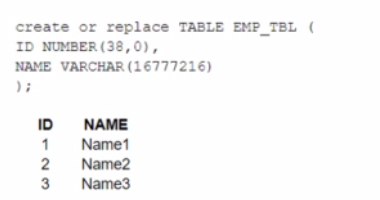
The following variables are set for the session:

Which SELECT statements will retrieve all three records? (Select TWO).

Show Suggested Answer Hide Answer
Suggested Answer: B, E

The correct answer is B and E because they use the correct syntax and values for the identifier function and the session variables.

The identifier function allows you to use a variable or expression as an identifier (such as a table name or column name) in a SQL statement. It takes a single argument and returns it as an identifier. For example, identifier($tbl_ref) returns EMP_TBL as an identifier.

The session variables are set using the SET command and can be referenced using the $ sign. For example, $var1 returns Name1 as a value.

Option A is incorrect because it uses Stbl_ref and Scol_ref, which are not valid session variables or identifiers. They should be $tbl_ref and $col_ref instead.

Option C is incorrect because it uses identifier<Stbl_ref>, which is not a valid syntax for the identifier function. It should be identifier($tbl_ref) instead.

Option D is incorrect because it uses Cvarl, var2, and var3, which are not valid session variables or values. They should be $var1, $var2, and $var3 instead.Reference:

Snowflake Documentation: Identifier Function

Snowflake Documentation: Session Variables

Snowflake Learning: SnowPro Advanced: Architect Exam Study Guide


Contribute your Thoughts:

0/2000 characters
Meaghan
3 months ago
I disagree, D looks wrong to me.
upvoted 0 times
...
Werner
3 months ago
Definitely surprised by how tricky this is!
upvoted 0 times
...
Luz
3 months ago
No way, A has a typo in 'Nam2'.
upvoted 0 times
...
Glory
4 months ago
I think A is also a valid choice.
upvoted 0 times
...
Talia
4 months ago
Option B and E should work!
upvoted 0 times
...
Mattie
4 months ago
I’m confused about the use of IN with the variables. I thought it was supposed to match the exact names, so maybe A and E are the right picks?
upvoted 0 times
...
Effie
4 months ago
I'm leaning towards C and D, but I can't recall if the identifier function works the same way in both cases.
upvoted 0 times
...
Luther
4 months ago
I remember practicing a similar question, and I feel like option E could be a good choice too, but I need to double-check the variable names.
upvoted 0 times
...
Agustin
5 months ago
I think options A and B might be correct, but I'm not entirely sure about the syntax for the identifiers.
upvoted 0 times
...
Earleen
5 months ago
This is a tricky one, but I'm going to carefully analyze each option and try to match them to the given data. I may need to do some additional research on the syntax, but I'm determined to get this right.
upvoted 0 times
...
Leonardo
5 months ago
I'm feeling pretty confident about this one. I just need to make sure I'm using the right identifiers and variable references in the query. I think options B and E are the correct answers.
upvoted 0 times
...
Latricia
5 months ago
Okay, I think I've got this. The key is to use the correct table and column names based on the information provided. Options B and E look the most promising to me.
upvoted 0 times
...
Antonio
5 months ago
Hmm, I'm a bit confused by the different table and column references in the options. I'll need to double-check the syntax and make sure I understand how the variables are being used.
upvoted 0 times
...
Daniela
5 months ago
This looks like a straightforward SQL query question. I'll need to carefully read through the options and match them to the given table and variables.
upvoted 0 times
...
Socorro
5 months ago
I've got this! First, I'll get the list of all ready nodes with `kubectl get nodes -o jsonpath='{range .items[*]}{@.metadata.name}{" "}{@.status.conditions[?(@.type=="Ready")].status}{"\n"}{end}'`. Then I'll filter out the tainted nodes with `kubectl get nodes -o jsonpath='{range .items[*]}{@.metadata.name}{" "}{@.spec.taints[?(@.effect=="NoSchedule")].key}{"\n"}{end}'`. Finally, I'll write the count to the file with `echo $(( $(wc -l < /tmp/ready_nodes.txt) - $(wc -l < /tmp/tainted_nodes.txt) )) > /opt/KUSC00402/kusc00402.txt`.
upvoted 0 times
...
Shonda
5 months ago
I've got a good strategy for this. I'll start by considering the bandwidth capabilities of the FC switches and the VSP G200 ports. Then I'll think about how the host HBA and multi-pathing software could impact performance.
upvoted 0 times
...
Maddie
5 months ago
Hmm, I'm not sure. The question mentions storing files, videos, and virtual disk images, so a key-value store might also work well for that type of unstructured data.
upvoted 0 times
...
Shayne
2 years ago
Yeah, I agree. E and B look like the best options. C is a bit confusing.
upvoted 0 times
...
Leana
2 years ago
I agree with E, and I believe B could also be correct since it uses 'identifier(Scol_ref)'.
upvoted 0 times
...
Roxane
2 years ago
E looks good to me. It uses the variables like $tb1_ref and $col_ref efficiently.
upvoted 0 times
...
Irma
2 years ago
But, doesn't C have a syntax issue with 'identifier'? Seems off.
upvoted 0 times
...
Esteban
2 years ago
I think C should work because it uses the session variables directly.
upvoted 0 times
...
Rasheeda
2 years ago
This exam question is tricky. Any thoughts on the correct SELECT statements?
upvoted 0 times
...
Eliseo
2 years ago
I agree with Georgeanna. Let's try option B first.
upvoted 0 times
...
Georgeanna
2 years ago
I'm not so sure. Option B looks like it could work too.
upvoted 0 times
...
Carlota
2 years ago
I think we need to use option A.
upvoted 0 times
...

Save Cancel