New Year Sale 2026! Hurry Up, Grab the Special Discount - Save 25% - Ends In 00:00:00 Coupon code: SAVE25
Welcome to Pass4Success

- Free Preparation Discussions

Salesforce Certified MuleSoft Developer (Mule-Dev-201) Exam - Topic 10 Question 34 Discussion

Actual exam question for Salesforce's Salesforce Certified MuleSoft Developer (Mule-Dev-201) exam
Question #: 34
Topic #: 10
[All Salesforce Certified MuleSoft Developer (Mule-Dev-201) Questions]

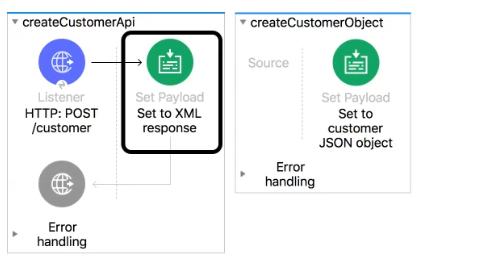
Refer to the exhibit.

What is the correct DataWeave expression for the Set Payload transformer to call the createCustomerObject flow with values for the first and last names of a new customer?

Show Suggested Answer Hide Answer
Suggested Answer: C

lookup(String, Any, Number)

This function enables you to execute a flow within a Mule app and retrieve the resulting payload.

It works in Mule apps that are running on Mule Runtime version 4.1.4 and later.

Similar to the Flow Reference component (recommended), the lookup function enables you to execute another flow within your app and to retrieve the resulting payload. It takes the flow's name and an input payload as parameters. For example, lookup('anotherFlow', payload) executes a flow named anotherFlow.

Correct answer is

lookup( 'createCustomerObject', {first: 'Aice, last: 'Green'})

MuleSoft Documentation Reference : https://docs.mulesoft.com/mule-runtime/4.3/dw-mule-functions-lookup


Contribute your Thoughts:

0/2000 characters
Bambi
2 months ago
C has a typo, should be 'lookup' not 'lookupf'.
upvoted 0 times
...
Cory
2 months ago
I disagree, A seems off with that lookup.
upvoted 0 times
...
Kanisha
3 months ago
Wait, is it really that simple? I thought it would be more complex.
upvoted 0 times
...
King
3 months ago
Definitely B! The object format is spot on.
upvoted 0 times
...
Kris
3 months ago
I think the correct answer is D. Looks straightforward.
upvoted 0 times
...
Sherill
3 months ago
I’m confused about the syntax in option A; it looks off with the extra characters. I think I’ll skip that one.
upvoted 0 times
...
Chauncey
3 months ago
I practiced a similar question, and I feel like option D looks correct since it has the right syntax for calling a function with two string parameters.
upvoted 0 times
...
Almeta
4 months ago
I'm not entirely sure, but I remember something about using curly braces for objects in DataWeave. That makes me lean towards option B.
upvoted 0 times
...
Bobbye
4 months ago
I think the expression needs to use a map or object format for the parameters, so maybe B or C?
upvoted 0 times
...
Kaycee
4 months ago
Ah, I see the trick here is using the correct syntax for the createCustomerObject function call. Option B looks like the winner to me.
upvoted 0 times
...
Yuette
4 months ago
This is a good opportunity to apply what I've learned about DataWeave transformations. I'll carefully analyze each option and eliminate the incorrect ones before selecting the right answer.
upvoted 0 times
...
Gerald
4 months ago
I'm a bit confused by the different function calls in the options. I'll need to double-check the DataWeave documentation to make sure I understand the right way to pass arguments to createCustomerObject.
upvoted 0 times
...
Dorthy
5 months ago
Okay, I think I've got this. The correct expression is option B - createCustomerObject({ first: 'Alice', last: 'Green' }).
upvoted 0 times
...
Leonor
5 months ago
Hmm, this looks like a tricky DataWeave question. I'll need to carefully review the options and think through the syntax.
upvoted 0 times
...

Save Cancel