Here you can find all the free questions related with Proofpoint Certified Threat Protection Analyst Exam (PPAN01) exam. You can also find on this page links to recently updated premium files with which you can practice for actual Proofpoint Certified Threat Protection Analyst Exam . These premium versions are provided as PPAN01 exam practice tests, both as desktop software and browser based application, you can use whatever suits your style. Feel free to try the Certified Threat Protection Analyst Exam premium files for free, Good luck with your Proofpoint Certified Threat Protection Analyst Exam .
Question No: 1
MultipleChoice
Which option best is a useful training exercise for security analysts?
Options
Answer AExplanation
An incident response tabletop (A) is a structured scenario-based exercise where analysts practice decision-making, communications, evidence handling, and coordinated response under realistic constraints. In Proofpoint-focused IR, tabletops are particularly valuable because email-led incidents require cross-team handoffs: SOC triage (TAP), mail admin actions (policy changes, Smart Search validation), post-delivery remediation (TRAP quarantine/pull), identity containment (password resets, token revocation, MFA), and business escalation (finance verification for BEC). Tabletop drills validate that playbooks are executable, escalation contacts are correct, and the team can meet response SLAs (time-to-triage, time-to-contain). They also expose tooling gaps (missing mailbox audit logs, insufficient retention, lack of automation for retroactive search/pull). Updating SOPs is important but is documentation work, not a training exercise by itself. Vulnerability scanning and port scanning are security assessment activities and can support overall security posture, but they do not train analysts on the incident response lifecycle behaviors (triage, containment coordination, post-incident lessons learned) that drive effective real-world response.
Question No: 2
MultipleChoice
An analyst is reviewing the Threat Response Quarantines card for a message in TAP Dashboard, as shown in the exhibit.
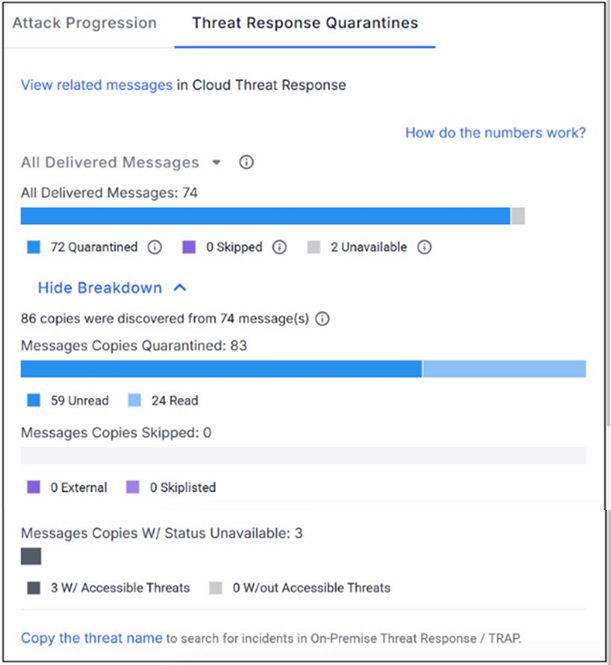
Why might a message be flagged with status ''unavailable''?
Options
Answer AExplanation
In Proofpoint Threat Response / post-delivery remediation workflows, a quarantine action depends on the message still existing in the target mailbox (Inbox or other folders where the connector searches). A status of ''unavailable'' commonly indicates the system could not locate the message to apply the action---most often because it was deleted or otherwise removed before quarantine occurred (A). This can happen if the user manually deletes it, an automated mailbox rule moves it to Deleted Items and empties it, retention policies purge it, or another remediation tool removes it first. From an IR containment perspective, ''unavailable'' is important because it changes the response plan: if the message cannot be pulled, you must pivot to containment through other controls (blocklist URLs/domains, disable sender delivery, enforce URL Defense blocking, reset credentials if interaction occurred) and expand scoping (search for duplicates in other mailboxes). Best practice is to correlate ''unavailable'' with click telemetry (Impacted users), authentication results, and mailbox audit logs to confirm whether exposure occurred and whether compensating actions are required to prevent recurrence.
Question No: 3
MultipleChoice
Which two tasks are considered frequent and high-priority when actively reviewing the threat landscape? (Select two.)
Options


Answer C, EExplanation
Active threat landscape review is an operational detection-and-analysis function: it focuses on what is happening now, what is likely to impact the environment, and what telemetry indicates elevated risk. Monitoring current threats and vulnerabilities (C) keeps analysts aligned to emergent campaigns (new phishing kits, BEC lures, malware droppers, supplier compromise patterns) and to exposure shifts (fresh CVEs that enable email-to-endpoint execution chains, new MFA-bypass trends, OAuth consent abuse). Reviewing monitoring data for risk-based decisions (E) is the day-to-day SOC activity that converts signals into priorities: TAP Threats/People views (Intended/At Risk/Impacted, clicks, severity), message traces (Smart Search), and threat response outcomes (quarantines/pulls). These two tasks directly reduce time-to-detect and time-to-contain by ensuring analysts focus on threats with user interaction, VIP targeting, and campaign spread. The other options are valuable but not ''frequent and high-priority'' in active landscape review: training content updates are periodic program work, pen tests are annual/episodic, and archiving is compliance-driven rather than real-time threat prioritization.
