New Year Sale 2026! Hurry Up, Grab the Special Discount - Save 25% - Ends In 00:00:00 Coupon code: SAVE25
Welcome to Pass4Success

- Free Preparation Discussions

Nutanix NCP-MCI Exam - Topic 1 Question 11 Discussion

Actual exam question for Nutanix's NCP-MCI exam
Question #: 11
Topic #: 1
[All NCP-MCI Questions]

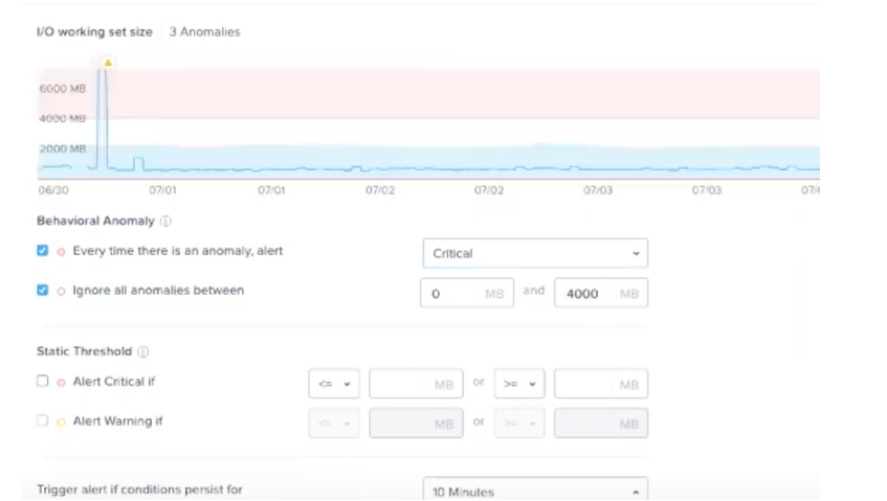
Refer to Exhibit:

Which statement is true?

Show Suggested Answer Hide Answer
Suggested Answer: B

A) This statement is incorrect because there is no static threshold set to trigger a critical alert at 6000 MB. The graph shows a peak that goes above 6000 MB, but the alert configuration below does not specify a static threshold at this value.

B) This is the correct statement. The configuration under 'Behavioral Anomaly' is set to alert every time there is an anomaly, with a critical level alert set to trigger when the I/O working set size is between 0 MB and 4000 MB. The graph illustrates that the anomalies (highlighted in pink) occur when the working set size exceeds the normal range (blue band). Therefore, any anomaly detected above 4000 MB would trigger a critical alert.

C) This statement is incorrect because there is no indication that a warning alert is configured to trigger after 3 anomalies. The exhibit does not show any configuration that specifies an alert based on the number of anomalies.

D) This statement is incorrect as there's no indication that a warning alert will be triggered based on the I/O working set size exceeding the blue band. The alert settings are configured to ignore anomalies below 4000 MB and to trigger a critical alert for anomalies above this threshold.

The settings displayed in the exhibit are typically part of Nutanix's Prism infrastructure management platform, which can set various thresholds for performance metrics and trigger alerts based on those thresholds. The behavior is defined in the Prism documentation where the alert configuration is outlined.


Contribute your Thoughts:

0/2000 characters
Carey
3 months ago
C is interesting, but I thought it was 5 anomalies, not 3.
upvoted 0 times
...
Asuncion
3 months ago
Wait, are we sure about the blue band thing?
upvoted 0 times
...
German
3 months ago
I disagree, D makes more sense to me.
upvoted 0 times
...
Tiara
4 months ago
I think B is correct, anomalies above 4000 MB sound right.
upvoted 0 times
...
Valene
4 months ago
A critical alert triggers over 6000 MB.
upvoted 0 times
...
Susy
4 months ago
I feel like option C is close to what we studied, but I can't recall the exact number of anomalies needed for a warning alert.
upvoted 0 times
...
Carole
4 months ago
I’m a bit confused about the differences between critical and warning alerts. Was it 4000 MB for critical or warning?
upvoted 0 times
...
Eun
4 months ago
I remember practicing a question about alerts, and I think option D might be correct since it mentions the blue band.
upvoted 0 times
...
Desiree
5 months ago
I think option A sounds familiar, but I’m not entirely sure if the threshold is actually 6000 MB.
upvoted 0 times
...
Dorethea
5 months ago
I've got a strategy - I'll eliminate the options that don't match the information provided, then choose the best fit.
upvoted 0 times
...
Almeta
5 months ago
I'm not sure about this one, the wording is a bit tricky. I'll have to think it through step-by-step.
upvoted 0 times
...
Lajuana
5 months ago
Okay, the key is to focus on the specific details in the question and match them to the answer choices.
upvoted 0 times
...
Kayleigh
5 months ago
Hmm, I'm a bit confused by the different alert thresholds mentioned. Let me re-read the options carefully.
upvoted 0 times
...
Thersa
5 months ago
This question seems straightforward, I think I can figure it out.
upvoted 0 times
...
Meaghan
5 months ago
This looks like a straightforward question on NIST publications related to Certification and Accreditation (C&A). I'll review the list and check which ones are correct.
upvoted 0 times
...
Tiara
5 months ago
The answer is B and D. The ports must have the same speed and duplex, and auto-negotiation must be off or limited. This ensures the ports are compatible for the LAG.
upvoted 0 times
...
Marylyn
5 months ago
I'm not sure if I should think of this as a problem or not. The Planning Director may have a point about not needing every request to go public. Still, I can't shake the feeling that it undermines the public's role.
upvoted 0 times
...
Marva
5 months ago
I can't recall if extracting the backed-up file is part of the restore process, but it feels like the wrong approach to restoring a backup.
upvoted 0 times
...
Blair
2 years ago
I bet the correct answer is hidden in the image somewhere, like a secret message from the test writers. *adjusts tin foil hat*
upvoted 0 times
Rebbecca
2 years ago
No, I believe it's A) A critical alert will be triggered if I/O working set size goes over 6000 MB.
upvoted 0 times
...
Laurene
2 years ago
I think the answer is D) A warning alert will be triggered if I/O working set size goes over the blue band.
upvoted 0 times
...
...
Ling
2 years ago
Option C is just silly. Who wants to wait for 3 anomalies before getting a warning? I'll go with Option D - simple and straightforward.
upvoted 0 times
...
Fausto
2 years ago
Hmm, I'm not sure. Could the blue band be a range for the warning alert? If so, then Option D might be correct. This question is tricky!
upvoted 0 times
...
Benton
2 years ago
I'm leaning towards Option B. An anomaly above 4000 MB seems like a reasonable threshold for a critical alert.
upvoted 0 times
Hermila
2 years ago
I'm not sure, but I think Option B makes sense based on the information provided in the exhibit.
upvoted 0 times
...
Vanda
2 years ago
I agree, that threshold seems appropriate for triggering a critical alert.
upvoted 0 times
...
Tomas
2 years ago
I think Option B is the correct choice. An anomaly above 4000 MB is a good indicator for a critical alert.
upvoted 0 times
...
...
Maurine
2 years ago
Option D sounds like the right choice to me. The blue band seems to represent the normal range, so going over that would definitely trigger a warning alert.
upvoted 0 times
Edelmira
2 years ago
Agreed, going over the blue band would definitely trigger a warning alert.
upvoted 0 times
...
Dottie
2 years ago
I agree, it's important to monitor and set alerts for abnormal values.
upvoted 0 times
...
Scarlet
2 years ago
Yeah, going over the blue band would definitely be a cause for concern.
upvoted 0 times
...
Willard
2 years ago
I think option D is correct too. The blue band does seem like the normal range.
upvoted 0 times
...
Scarlet
2 years ago
Yeah, I agree. Going over that range would definitely trigger a warning alert.
upvoted 0 times
...
Azalee
2 years ago
I think option D is correct too. The blue band does seem to indicate the normal range.
upvoted 0 times
...
Roy
2 years ago
I think option D is correct too.
upvoted 0 times
...
Lynelle
2 years ago
Yeah, going over that range would definitely trigger a warning alert.
upvoted 0 times
...
Penney
2 years ago
I think option D is correct too. The blue band does seem like the normal range.
upvoted 0 times
...
...
Filiberto
2 years ago
I agree with Chun, because the blue band indicates the threshold for the warning alert.
upvoted 0 times
...
Chun
2 years ago
I think the answer is D.
upvoted 0 times
...

Save Cancel