
Free Preparation Discussions
 MENU
MENU
NCARB PDD Exam Questions
- Topic 1: Integration of Building Materials & Systems: This section of the exam measures the skills of Architectural Designers and focuses on the ability to resolve and integrate various building systems into cohesive project goals. It covers analyzing architectural systems and technologies, determining the size of structural, mechanical, electrical, and plumbing systems, and incorporating specialty systems such as acoustics, lighting, security, and communications. It also evaluates the ability to detail how multiple building systems work together and to coordinate across disciplines to achieve a unified design.
- Topic 2: Construction Documentation: This section of the exam measures skills of Project Architects and addresses the creation and management of project documentation. Candidates are expected to demonstrate knowledge of documenting building design and site features, preparing detailed architectural drawings, and applying industry standards to produce a coordinated set of construction documents. The section also includes understanding how project changes impact documentation and how to communicate these updates effectively to both the design team and the client.: Project Manual & Specifications: This section of the exam measures the skills of Specifications Writers and emphasizes the importance of developing documentation that goes beyond drawings. Candidates must understand how to identify and prioritize elements needed to prepare, maintain, and refine both the project manual and project specifications. It also assesses the ability to align and coordinate these specifications with the construction documents to ensure consistency and accuracy.
- Topic 3: Codes & Regulations: This section of the exam measures skills of Building Code Specialists and examines how codes and regulations apply at a detailed level during documentation. Candidates are expected to demonstrate knowledge of compliance with the International Building Code (IBC) as well as other specialty regulations, as well as how to interpret and apply these standards to ensure design and documentation meet legal and safety requirements.
- Topic 4: Construction Cost: This section of the exam measures the skills of Construction Managers and focuses on the financial side of project execution. It evaluates the ability to analyze construction cost estimates to confirm that they align with project design intent and budgetary constraints. Although this is the smallest section, it is critical for ensuring projects remain feasible and economically viable.
Free NCARB PDD Exam Actual Questions
Note: Premium Questions for PDD were last updated On Sep. 19, 2026 (see below)
A wall separating a distillery and a taproom must meet which of the following requirements based on a flammable liquid presence?
Per IBC Chapter 6 and Chapter 7, distillation involving flammable liquids requires a 2-hour fire-resistance-rated fire wall between H-occupancy (hazardous) and assembly use (A-2). Objective 1.3 of the PDD Handbook emphasizes understanding of life safety code implications in space planning.
The architect has completed 60% of the construction documents. The owner wants to establish the guaranteed maximum price (GMP) at this point before 100% of the construction documents are complete. Several flooring finish items are still undetermined.
What should be included in the project manual to make sure the contractor has a cost to cover all finishes?
When a GMP (Guaranteed Maximum Price) is established before the design is 100% complete and specific materials are not yet chosen, the correct approach is to specify allowances in the project manual.
An allowance is a fixed monetary amount for a specific scope item (e.g., flooring finishes) that allows the contractor to carry a cost in the bid/GMP until the actual product is selected. This ensures the GMP covers the item without delaying pricing.
A . Contingency --- Is for unforeseen conditions, not specific unselected finishes.
B . Schedule of unit prices --- Typically used for variable-quantity work, not for unknown product selection.
D . Alternate --- Provides an option for substitution, but does not guarantee a base cost in the GMP.
PDD Reference: ARE 5.0 PDD ''Project Manual and Specifications---Allowances, Alternates, and Unit Prices,'' AIA A201 3.8, CSI Division 01---General Requirements.
For which of the following reasons is sheet piling used? (Check the three that apply)
Sheet piling is a type of earth retention system used in excavations to prevent soil collapse. Reasons include:
D . When the natural soil slope is too steep to remain stable, sheet piling acts as a vertical barrier.
E . When soil cannot support itself during excavation, sheet piles provide lateral support.
F . When excavation is adjacent to a property line or existing structure and adjacent soil must not be disturbed.
Options A (grade beam support), B (raked shoring), and C (pile cap support) are not typical or primary uses of sheet piling.
NCARB ARE 5.0 Review Manual, Site Design and Construction chapter
Geotechnical engineering and excavation support best practices
Refer to the exhibit.

Refer to the exhibit.
What is the primary function of the 2 x 4 blocking shown at X in the drawing?
Comprehensive Detailed Explanation with all NCARB ARE 5.0 Project Development and Documentation (PDD) Study Guide Reference:
In wood frame construction, blocking installed between joists at regular intervals (commonly 48 inches on center) serves primarily to brace and stabilize the joists laterally, preventing twisting and lateral displacement under load.
The 2x4 blocking at point X, placed perpendicular between the ceiling joists, acts as cross bracing.
It resists lateral torsional buckling of the joists and distributes loads evenly.
It also helps maintain alignment during construction and after the finish materials are installed.
The blocking does not support the partition top plate directly (that is the function of the studs beneath), nor does it transfer lateral load to the 1x8. Its main role is structural bracing for the joists.
Supporting Reference:
NCARB ARE 5.0 Review Manual, Project Development and Documentation, Structural Systems chapter
Wood Frame Construction details from International Residential Code (IRC)
Building construction texts such as ''Fundamentals of Building Construction'' by Allen and Iano, which describe blocking used to brace joists.
Refer to the exhibit.
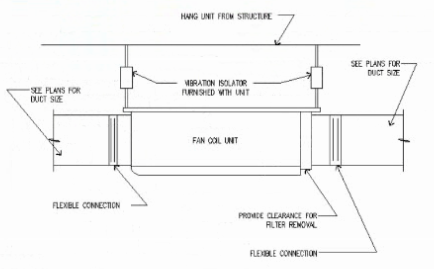
Refer to the exhibit.
What is the purpose of the flexible connection in the fan coil shown?
Understanding the Diagram
The detail shows a fan coil unit suspended from the structure, with:
Vibration isolators at the hanging rods to limit mechanical vibration transfer to the structure.
Flexible duct connections between the fan coil unit and the rigid ductwork.
Purpose of Flexible Duct Connections
Flexible connections in HVAC duct systems are designed to:
Prevent transmission of vibration and sound from the mechanical equipment (fan coil unit) into the rigid ductwork and building.
Compensate for small misalignments between the ductwork and equipment.
Accommodate minor thermal expansion/contraction movements.
Key Function in This Context: Fan coil units contain fans that create vibration and noise. Without a flexible connection, this vibration would travel directly through the rigid ductwork into occupied spaces, increasing noise levels.
Why Other Options Are Incorrect:
A . To provide a field point of connection --- While the flexible connector does connect ducts, its purpose is not just convenience; it is specifically for vibration/sound isolation.
B . To insulate against heat transfer --- This is done with thermal duct insulation, not flexible connectors.
D . To transition from flange to desired duct size --- Transitions are made using sheet metal fittings, not flexible connectors.
NCARB ARE 5.0 PDD Study Guide Reference:
Content Area: Integration of Building Materials & Systems --- Mechanical Systems and Acoustics
Sources:
Mechanical and Electrical Equipment for Buildings (MEEB) --- Vibration Control in Mechanical Systems
Architectural Graphic Standards --- Flexible Duct Connections for Noise and Vibration Isolation
ASHRAE Handbook --- HVAC Applications, Chapter on Sound and Vibration Control
Key Point: Flexible connectors in ductwork break the direct mechanical path for vibration and sound, reducing noise transfer from fans to occupied areas.
- Select Question Types you want
- Set your Desired Pass Percentage
- Allocate Time (Hours : Minutes)
- Create Multiple Practice tests with Limited Questions
- Customer Support
Laura Young
21 days agoGerald Gonzalez
26 days agoJessica Jones
2 months agoElizabeth Moore
2 months agoJoseph Carter
3 months agoHarold Mitchell
3 months agoRachel Cook
4 months agoNathan Roberts
4 months agoCynthia Perez
5 months agoKaren Flores
5 months agoKimberly Brown
5 months agoLinda Clark
5 months agoSteven Harris
5 months agoDavid Johnson
5 months agoStephen Miller
5 months agoNorah
6 months agoLaurena
6 months agoThomasena
6 months agoMicah
7 months agoDaniela
7 months agoIlona
7 months agoMireya
8 months agoJohnna
8 months agoValentin
8 months agoChantell
8 months agoReta
9 months agoAmmie
9 months agoLizbeth
9 months agoJose
9 months agoPamella
9 months agoKasandra
10 months agoNoemi
10 months agoTiffiny
10 months agoMaira
11 months agoKanisha
11 months agoBenton
11 months agoPearly
11 months agoTasia
12 months agoCheryll
12 months agoFrancine
12 months agoAsha
1 year agoAdolph
1 year agoGolda
1 year agoSheridan
1 year agoGussie
1 year agoMattie
1 year ago