Free Preparation Discussions
 MENU
MENU
Free Microsoft AZ-104 Exam Dumps - Page 21
MultipleChoice
Note: This question is part of a series of questions that present the same scenario. Each question in the series contains a unique solution that might meet the stated goals. Some question sets might have more than one correct solution, while others might not have a correct solution.
After you answer a question in this section, you will NOT be able to return to it. As a result, these questions will not appear in the review screen.
You have an Azure subscription that contains the following resources:
* A virtual network that has a subnet named Subnet1
* Two network security groups (NSGs) named NSG-VM1 and NSG-Subnet1
* A virtual machine named VM1 that has the required Windows Server configurations to allow Remote Desktop connections
NSG-Subnet1 has the default inbound security rules only.
NSG-VM1 has the default inbound security rules and the following custom inbound security rule:
* Priority: 100
* Source: Any
* Source port range: *
* Destination: *
* Destination port range: 3389
* Protocol: UDP
* Action: Allow
VM1 connects to Subnet1. NSG1-VM1 is associated to the network interface of VM1. NSG-Subnet1 is associated to Subnet1.
You need to be able to establish Remote Desktop connections from the internet to VM1.
Solution: You add an inbound security rule to NSG-Subnet1 that allows connections from the Internet source to the VirtualNetwork destination for port range 3389 and uses the UDP protocol.
Does this meet the goal?
OptionsHotspot
You have an Azure virtual machine that runs Windows Server 2019 and has the following configurations:
* Name: VM1
* Location: West US
* Connected to: VNET1
* Private IP address: 10.1.0.4
* Public IP address: 52.186.85.63
* DNS suffix in Windows Server: Adatum.com
You create the Azure DNS zones shown in the following table.
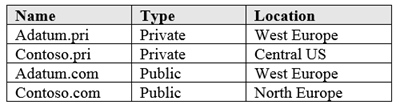
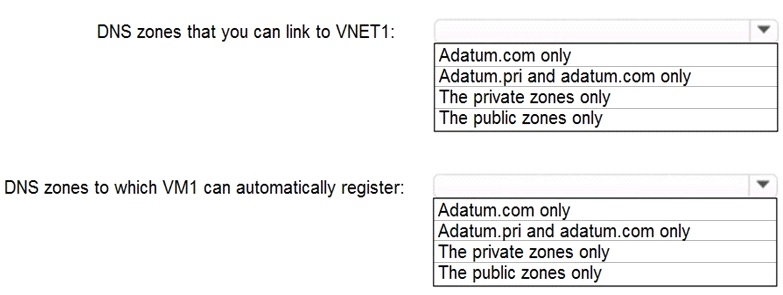
You need to identify which DNS zones you can link to VNET1 and the DNS zones to which VM1 can automatically register.
Which zones should you identify? To answer, select the appropriate options in the answer area.
Hotspot
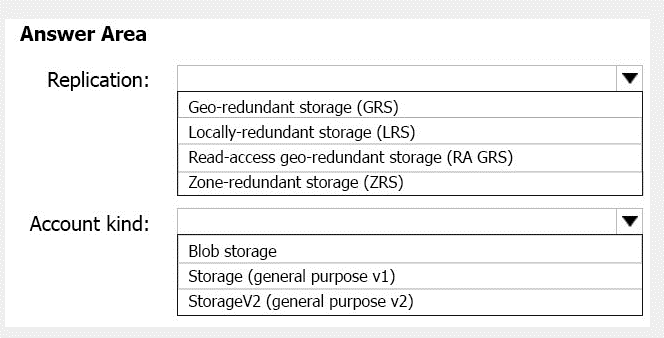
You plan to create an Azure Storage account in the Azure region of East US 2.
You need to create a storage account that meets the following requirements:
* Replicates synchronously
* Remains available if a single data center in the region fails
How should you configure the storage account? To answer, select the appropriate options in the answer area.
NOTE: Each correct selection is worth one point.
Hotspot
You have an Azure subscription that contains a virtual machine scale set. The scale set contains four instances that have the following configurations:
* Operating system: Windows Server 2016
* Size: Standard_D1_v2
You run the get-azvmss cmdlet as shown in the following exhibit:
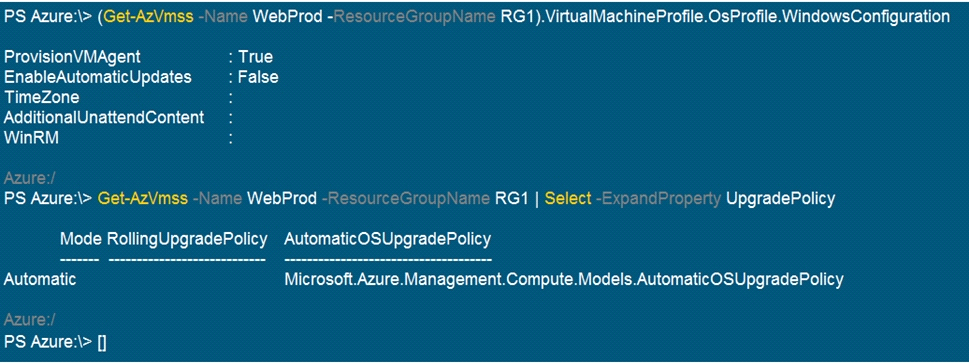
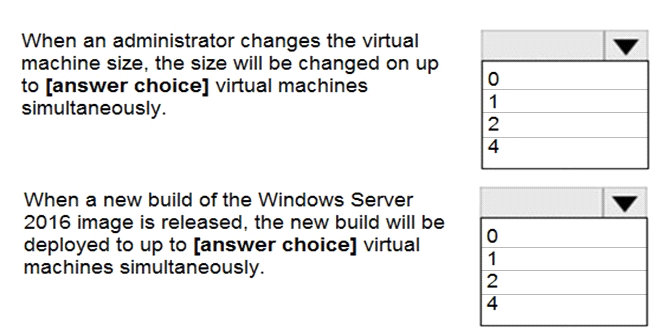
Use the drop-down menus to select the answer choice that completes each statement based on the information presented in the graphic.
NOTE: Each correct selection is worth one point.
Hotspot
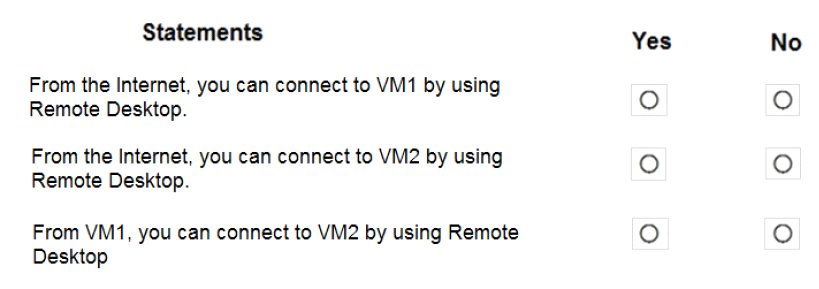
You have an Azure subscription that contains the virtual machines shown in the following table:

VM1 and VM2 use public IP addresses. From Windows Server 2019 on VM1 and VM2, you allow inbound Remote Desktop connections.
Subnet1 and Subnet2 are in a virtual network named VNET1.
The subscription contains two network security groups (NSGs) named NSG1 and NSG2. NSG1 uses onlythe default rules.
NSG2 uses the default rules and the following custom incoming rule:
* Priority: 100
* Name: Rule1
* Port: 3389
* Protocol: TCP
* Source: Any
* Destination: Any
* Action: Allow
NSG1 is associated to Subnet1. NSG2 is associated to the network interface of VM2.
For each of the following statements, select Yes if the statement is true. Otherwise, select No.
NOTE: Each correct selection is worth one point
.
Hotspot
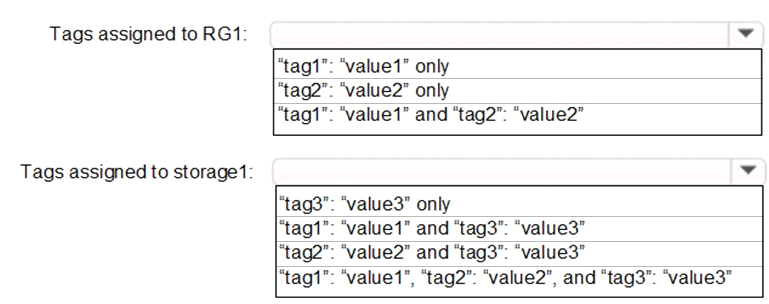
You have an Azure subscription named Subscription1 that contains the following resource group:
* Name: RG1
* Region: West US
* Tag: ''tag1'': ''value1''
You assign an Azure policy named Policy1 to Subscription1 by using the following configurations:
* Exclusions: None
* Policy definition: Append tag and its default value
* Assignment name: Policy1
* Parameters:
- Tag name: Tag2
- Tag value: Value2
After Policy1 is assigned, you create a storage account that has the following configurations:
* Name: storage1
* Location: West US
* Resource group: RG1
* Tags: ''tag3'': ''value3''
You need to identify which tags are assigned to each resource.
What should you identify? To answer, select the appropriate options in the answer area.
NOTE: Each correct selection is worth one point.
MultipleChoice
You have an Azure subscription named Subscription1 that has the following providers registered:
* Authorization
* Automation
* Resources
* Compute
* KeyVault
* Network
* Storage
* Billing
* Web
Subscription1 contains an Azure virtual machine named VM1 that has the following con figurations:
* Private IP address: 10.0.0.4 (dynamic)
* Network security group (NSG): NSG1
* Public IP address: None
* Availability set: AVSet
* Subnet: 10.0.0.0/24
* Managed disks: No
* Location: East US
You need to record all the successful and failed connection attempts to VM1.
Which three actions should you perform? Each correct answer presents part of the solution.
NOTE: Each correct selection is worth one point.
OptionsHotspot
You have an Azure subscription that contains the resources shown in the following table.
VMSS1 is set to VM (virtual machines) orchestration mode.
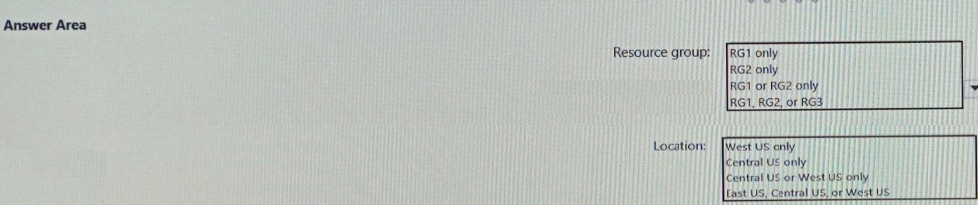
You need to deploy a new Azure virtual machine named VM1, and then add VM1 to VMSS1.
Which resource group and location should you use to deploy VM1? To answer, select the appropriate options in the
NOTE: Each correct selection is worth one point.
MultipleChoice
You have an Azure subscription that contains a virtual network named VNET1. VNET1 contains the subnets shown in the following table.
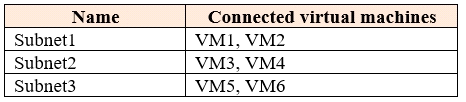
Each virtual machine uses a static IP address.
You need to create network security groups (NSGs) to meet following requirements:
* Allow web requests from the internet to VM3, VM4, VM5, and VM6.
* Allow all connections between VM1 and VM2.
* Allow Remote Desktop connections to VM1.
* Prevent all other network traffic to VNET1.
What is the minimum number of NSGs you should create?
OptionsHotspot
You have an Azure subscription named Subscription1 that contains the virtual networks in the following table.
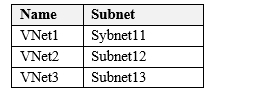
Subscripton1 contains the virtual machines in the following table.
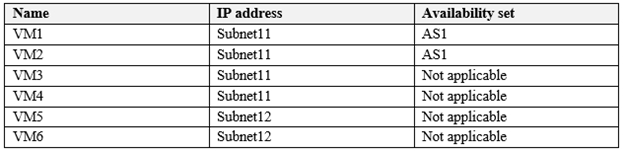
In Subscription1, you create a load balancer that has the following configurations:
* Name: LB1
* SKU: Basic
* Type: Internal
* Subnet: Subnet12
* Virtual network: VNET1
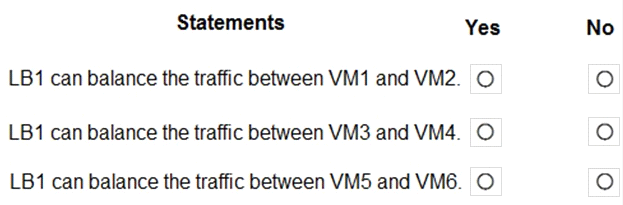
For each of the following statements, select Yes if the statement is true. Otherwise, select No.
NOTE: each correct selection is worth one point.