Deal of The Day! Hurry Up, Grab the Special Discount - Save 25% - Ends In 00:00:00 Coupon code: SAVE25

Free Preparation Discussions
 MENU
MENU
Free Juniper JN0-363 Exam Dumps June 2026
Here you can find all the free questions related with Juniper Service Provider Routing and Switching, Specialist (JN0-363) exam. You can also find on this page links to recently updated premium files with which you can practice for actual Juniper Service Provider Routing and Switching, Specialist Exam. These premium versions are provided as JN0-363 exam practice tests, both as desktop software and browser based application, you can use whatever suits your style. Feel free to try the Service Provider Routing and Switching, Specialist Exam premium files for free, Good luck with your Juniper Service Provider Routing and Switching, Specialist Exam.Question No: 1
MultipleChoice
Interface ge-0/0/0.0 connecls yout network to your ISP. You want to advertise this interface address as an Internal route In OSPF without creating a neighbor with your ISP.
In this scenario, how is this task accomplished?
OptionsQuestion No: 2
MultipleChoice
You are troubleshooting two OSPF routers that have an adjacency that remains in the ExStart state.
What would cause this problem?
OptionsQuestion No: 3
MultipleChoice
Exhibit
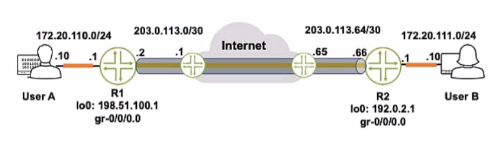
Referring to the exhibit, how do you verify the status of the tunnel from R1?
OptionsQuestion No: 4
MultipleChoice
Exhibit

Referring to the exhibit, what must be included in the Route1 configuration when establishing an EBGP session with the ISP?
OptionsQuestion No: 5
MultipleChoice
Exhibit

Which two statements ate correct about the information shown in the exhibit? (Choose two.)
Options