Deal of The Day! Hurry Up, Grab the Special Discount - Save 25% - Ends In 00:00:00 Coupon code: SAVE25
Welcome to Pass4Success

- Free Preparation Discussions

Juniper JN0-637 Exam - Topic 1 Question 29 Discussion

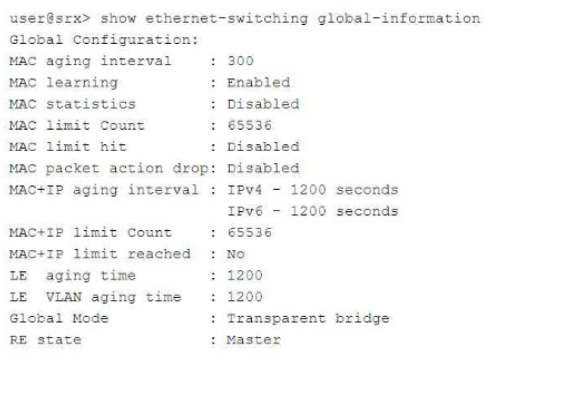
Exhibit:Referring to the exhibit, which two statements are correct? (Choose two.)
B) You can secure inter-VLAN traffic with a security policy on this device. and C) The device can pass Layer 2 and Layer 3 traffic at the same time.
A) You cannot secure intra-VLAN traffic with a security policy on this device.
D) The device cannot pass Layer 2 and Layer 3 traffic at the same time.

Juniper JN0-637 Exam - Topic 1 Question 29 Discussion

Actual exam question for Juniper's JN0-637 exam
Question #: 29
Topic #: 1
[All JN0-637 Questions]

Exhibit:

Referring to the exhibit, which two statements are correct? (Choose two.)

Show Suggested Answer Hide Answer
Suggested Answer: B, C

The exhibit provides information about an SRX Series device operating in transparent mode (Layer 2) and Layer 3 routing at the same time. Let's break down the correct answers:

Explanation of Answer B (Secure Inter-VLAN Traffic with a Security Policy):

The SRX device can secure inter-VLAN traffic because it supports security policies for Layer 3 traffic between different VLANs. In this case, traffic moving between different VLANs (i.e., Layer 3 traffic) can be processed and controlled using security policies.

Explanation of Answer C (Pass Layer 2 and Layer 3 Traffic Simultaneously):

The SRX device can handle both Layer 2 and Layer 3 traffic simultaneously. In mixed mode, the device is capable of switching traffic at Layer 2 (intra-VLAN) while also routing traffic at Layer 3 (inter-VLAN). This is evident from the global configuration showing transparent bridge mode and Layer 3 interfaces.

Juniper Security Reference:

Mixed Mode Overview: Juniper SRX devices in mixed mode can operate as both a Layer 2 switch and a Layer 3 router, allowing it to pass traffic at both layers simultaneously. Reference: Juniper Mixed Mode Documentation.


Contribute your Thoughts:

0/2000 characters
Marge
3 days ago
I lean towards C and D. Confusing, though.
upvoted 0 times
...
Cristy
8 days ago
But B makes sense too. Inter-VLAN security is possible.
upvoted 0 times
...
William
13 days ago
A is definitely right. You can't secure intra-VLAN.
upvoted 0 times
...
Lang
18 days ago
I feel like C and D are tricky.
upvoted 0 times
...
Lenny
23 days ago
I think A and B are correct.
upvoted 0 times
...
Angella
28 days ago
D) seems off, I think it can pass both types of traffic.
upvoted 0 times
...
Stefania
1 month ago
C) is correct, it can do both!
upvoted 0 times
...
Alysa
1 month ago
Wait, can it really handle both Layer 2 and Layer 3?
upvoted 0 times
...
Thaddeus
1 month ago
I disagree, B) is the right choice!
upvoted 0 times
...
Jennifer
2 months ago
A) is definitely true.
upvoted 0 times
...
Yoko
2 months ago
I’m a bit confused about the Layer 2 and Layer 3 capabilities; I thought they could operate simultaneously, but I need to double-check that.
upvoted 0 times
...
Luisa
2 months ago
I feel like the device should be able to handle both Layer 2 and Layer 3 traffic, but I can't recall the specifics.
upvoted 0 times
...
Nan
2 months ago
I think we practiced a similar question where inter-VLAN traffic was discussed, and I believe it can be secured with a policy.
upvoted 0 times
...
Daniel
2 months ago
I remember studying about securing intra-VLAN traffic, but I'm not sure if it applies here.
upvoted 0 times
...

Save Cancel