New Year Sale 2026! Hurry Up, Grab the Special Discount - Save 25% - Ends In 00:00:00 Coupon code: SAVE25

Welcome to Pass4Success

- Free Preparation Discussions

Google Professional Machine Learning Engineer Exam - Topic 7 Question 62 Discussion

Actual exam question for Google's Professional Machine Learning Engineer exam
Question #: 62
Topic #: 7
[All Professional Machine Learning Engineer Questions]

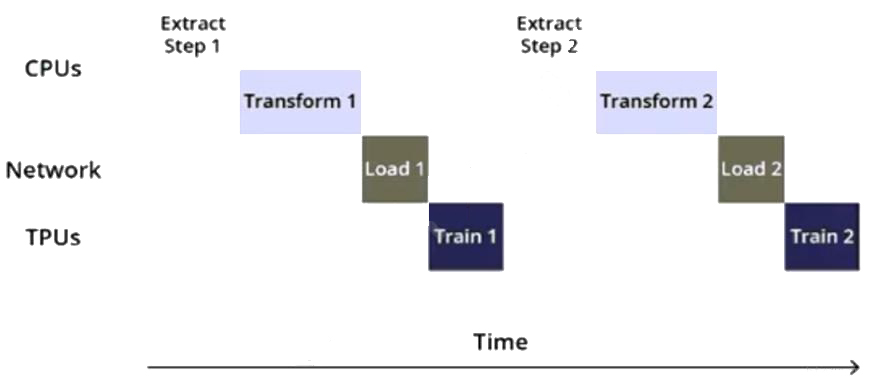
You are training an object detection model using a Cloud TPU v2. Training time is taking longer than expected. Based on this simplified trace obtained with a Cloud TPU profile, what action should you take to decrease training time in a cost-efficient way?
Show Suggested Answer Hide Answer
Suggested Answer: A

Contribute your Thoughts:

0/2000 characters
Janey
4 months ago
Wait, can you really get better performance just by changing the input function?
upvoted 0 times
...
Dean
4 months ago
Definitely agree with the input function rewrite!
upvoted 0 times
...
Lashanda
4 months ago
Not sure about that, isn't batch size already maxed out?
upvoted 0 times
...
Karan
4 months ago
I think parallel processing is the way to go.
upvoted 0 times
...
Ena
4 months ago
Moving to TPU v3 could really speed things up!
upvoted 0 times
...
Daniel
5 months ago
Increasing the batch size sounds familiar, but I can't recall if that alone would solve the training time issue.
upvoted 0 times
...
Argelia
5 months ago
I practiced a similar question where parallel processing improved performance, so maybe option D is the right choice here.
upvoted 0 times
...
Arlette
5 months ago
I think moving to a Cloud TPU v3 could be beneficial, but I wonder if the cost would outweigh the benefits.
upvoted 0 times
...
Berry
5 months ago
I remember something about optimizing input functions, but I'm not sure if rewriting it would really help with the training time.
upvoted 0 times
...
Cherelle
5 months ago
Okay, let's see. The question is asking about identifying the geolocation information for a Sentinel incident. Based on the options, it seems like I need to look in the Incidents view and review the details of the associated entities. I think option B is the way to go.
upvoted 0 times
...
Mel
5 months ago
I've got a good feeling about B. Forwarding (IP) virtual servers bypass the normal load balancing process, so they don't use a default pool.
upvoted 0 times
...
Gerald
5 months ago
Okay, let me think this through. ALE is the expected annual loss from a threat, so it makes sense that it would involve the SLE and the frequency of the threat occurring. I'm leaning towards D, but I want to double-check my understanding.
upvoted 0 times
...
Oneida
5 months ago
I remember studying something about how MQTT is lightweight for IoT applications—definitely sounds like it fits the publish-subscribe model.
upvoted 0 times
...

Save Cancel