
Free Preparation Discussions
 MENU
MENU
Fortinet NSEI_OTS_AR-7.6 Exam - Topic 3 Question 5 Discussion
Topic #: 3
Refer to the exhibit.
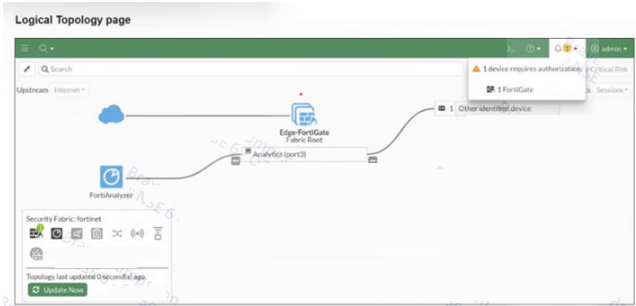
A Logical Topology page of a FortiGate device is shown. Your OT company wants to gain visibility into the network. You decide to implement device detection with the Security Fabric. Based on the exhibit, which statement is correct? (Choose one answer)
The correct answer is A. Device Detection is enabled on the other identified device.
The study guide explains that device identification is a ''useful feature for the Security Fabric topology view'' and that ''FortiGate detects most third-party devices in your network and adds them to the topology view of the Security Fabric.'' It also states that in the interfaces section, you can enable device detection, and this detection is what allows FortiGate to identify devices based on observed traffic.
In the exhibit, the tooltip distinguishes between ''1 device requires authorization'' and ''1 other identified device.'' That means the unauthorized device is a separate FortiGate/Fabric member issue, while the other identified device is simply a detected third-party device shown in the topology because device detection is working. Therefore, the correct interpretation is that device detection is enabled for that identified device. Option B is incorrect because the exhibit does not say the other identified device requires authorization. Option C is not supported by the study guide, and option D is too specific because no evidence in the exhibit confirms that the detection was enabled specifically on port3.
Deeanna
3 days agoKami
8 days agoLina
13 days agoJuliana
19 days agoMarget
24 days agoJamika
29 days agoDana
1 month agoErinn
1 month agoBeata
1 month ago