
Free Preparation Discussions
 MENU
MENU
Fortinet NSEI_OTS_AR-7.6 Exam Questions
- Topic 1: Asset management: Covers identifying and managing OT assets by aligning with OT standards and Fortinet compliance, applying the Security Fabric to OT networks, and using FortiGate and FortiNAC for device detection.
- Topic 2: Network access control: Covers OT Ethernet concepts, designing network segmentation schemas, and configuring authentication for controlling network access in OT environments.
- Topic 3: Network security: Covers configuring security inspection for industrial protocols, applying virtual patching for unpatched OT systems, and setting up automation for security response.
- Topic 4: Monitoring and risk assessment: Covers creating event handlers in FortiAnalyzer, performing risk assessment and management, and analyzing FortiAnalyzer security reports to evaluate OT network risk.
Free Fortinet NSEI_OTS_AR-7.6 Exam Actual Questions
Note: Premium Questions for NSEI_OTS_AR-7.6 were last updated On Aug. 10, 2026 (see below)
Refer to the exhibit.
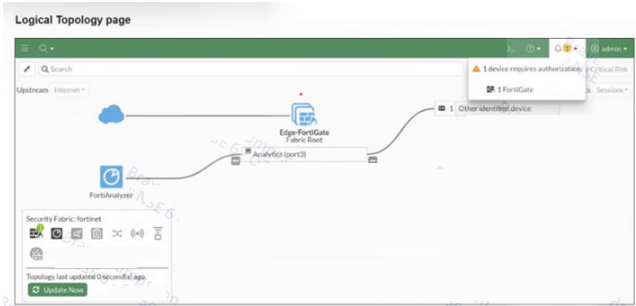
A Logical Topology page of a FortiGate device is shown. Your OT company wants to gain visibility into the network. You decide to implement device detection with the Security Fabric. Based on the exhibit, which statement is correct? (Choose one answer)
The correct answer is A. Device Detection is enabled on the other identified device.
The study guide explains that device identification is a ''useful feature for the Security Fabric topology view'' and that ''FortiGate detects most third-party devices in your network and adds them to the topology view of the Security Fabric.'' It also states that in the interfaces section, you can enable device detection, and this detection is what allows FortiGate to identify devices based on observed traffic.
In the exhibit, the tooltip distinguishes between ''1 device requires authorization'' and ''1 other identified device.'' That means the unauthorized device is a separate FortiGate/Fabric member issue, while the other identified device is simply a detected third-party device shown in the topology because device detection is working. Therefore, the correct interpretation is that device detection is enabled for that identified device. Option B is incorrect because the exhibit does not say the other identified device requires authorization. Option C is not supported by the study guide, and option D is too specific because no evidence in the exhibit confirms that the detection was enabled specifically on port3.
What is the main OT component for monitoring and controlling industrial processes? (Choose one answer)
The correct answer is C. Industrial Control System (ICS). The study guide states that ''ICS is a main component of OT'' and ''consists of systems used for monitoring and controlling industrial processes.'' It also explains that ICS includes various devices, systems, controls, and networks that manage industrial processes, and that the most common types are SCADA and distributed control systems (DCS). This makes ICS the primary OT component for monitoring and controlling industrial processes.
The other options are related OT components, but they are not the best answer to this wording. SCADA collects real-time data and helps visualize and control the OT environment, but it is described as a system within the broader ICS structure. PLC devices collect and transmit real-time data and connect sensors and RTUs to SCADA, while IIoT refers to sensors, actuators, and other connected field devices. Therefore, the overarching main OT component for monitoring and controlling industrial processes is ICS.
Refer to the exhibit.
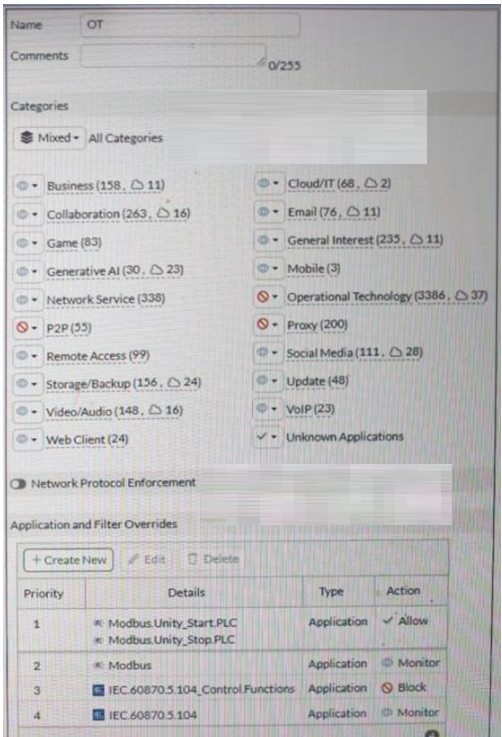
A partial Application Sensor profile is shown. When you apply this profile in a firewall policy, which two statements are correct? (Choose two answers)
The correct answers are A and C.
Option C is correct because the profile clearly contains the Operational Technology category and specific OT application signatures such as Modbus and IEC.60870.5.104. The study guide says ''You can use application control signatures to detect OT protocols'' and ''You can filter to a specific OT protocol.'' That means OT application signatures are active in this sensor profile.
Option A is correct because the guide explains that application control works at different levels: ''Detection of protocol (one detection per session)'' and ''Message level (one detection per protocol message).'' It also says you can use application signatures for ''granular message type identification.'' In the exhibit, IEC.60870.5.104.Control.Functions is explicitly configured, which is a granular IEC message/control-level signature rather than only a protocol-level match. That means logging and control can occur at the IEC command level.
Option B is not correct because the profile shows Modbus configured at the parent protocol level as Monitor, while the guide states that the ''parent signature takes precedence over the child signature.'' Since protocol-level detection is one detection per session, that does not mean FortiGate will necessarily log each Modbus command individually.
Option D is incorrect because even though the broader Operational Technology category is set to block, the profile includes specific application and filter overrides for Modbus and IEC 104 behavior. So the resulting effect is not simply that all OT protocols are blocked.
Refer to the exhibit.
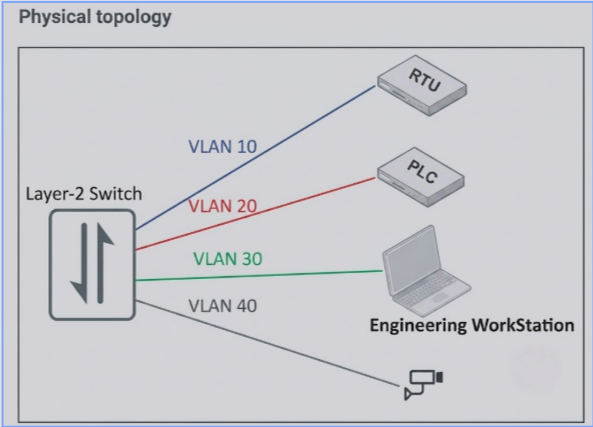
A partial OT network is shown. You have configured the FortiGate device with VLANs to segment the OT network. The supervisor now wants to connect to the PLC from the Engineering Workstation. How can you allow access from the Engineering Workstation to the PLC? (Choose one answer)
The correct answer is D. You must configure a layer 3 switch.
The study guide explains that ''Layer 2 devices can add or remove tags'' but ''cannot modify them.'' It then states that ''A layer 3 device, such as a router or FortiGate, can modify the VLAN tag before routing the packet. This allows them to route traffic between VLANs.'' It also explicitly describes ''Router on a Stick'' as ''a way to allow routing between VLANs.'' Since the exhibit shows a layer-2 switch and the Engineering Workstation and PLC are placed in different VLANs, inter-VLAN communication requires layer-3 routing.
The other options do not solve this requirement. intra-switch-policy explicit/implicit applies to a software switch, where member interfaces are in the same broadcast domain and same subnet, not to routing between separate VLANs. forward domain IDs are used in transparent mode to confine broadcasts to specific broadcast domains; they do not provide inter-VLAN access. Therefore, to let the Engineering Workstation in one VLAN reach the PLC in another VLAN, you need a layer 3 routing function, which matches option D.
You want to protect OT devices that are not updated against known vulnerabilities so you apply virtual patching to the firewall policies. What must you check to confirm that the OT devices are virtually patched? (Choose one answer)
The correct answer is C. The output of the CLI command get rule otvp status. In the Virtual Patching section, the study guide shows the workflow where FortiGate queries FortiGuard for device-specific vulnerabilities, receives OT virtual patching signatures, maps them to the device MAC address, and then explicitly displays the CLI verification command get rule otvp status together with fields such as Rule-name, Vuln_type, and Cve. This is the direct confirmation mechanism shown in the guide for checking whether OT devices have virtual patching rules associated with them.
The other options are less accurate for confirmation. The OT View page is for Purdue-level visualization, and the Asset Identity List page shows device and asset information, but neither is presented in the guide as the command or control used to verify virtual patching status. The study guide specifically uses get rule otvp status as the status check tied to virtual patching behavior.
- Select Question Types you want
- Set your Desired Pass Percentage
- Allocate Time (Hours : Minutes)
- Create Multiple Practice tests with Limited Questions
- Customer Support
Currently there are no comments in this discussion, be the first to comment!