
 MENU
MENU
You receive an e-mail like the one shown below. When you click on the link contained in the mail, you are redirected to a website seeking you to download free Anti-Virus software.
Dear valued customers,
We are pleased to announce the newest version of Antivirus 2010 for Windows which will probe you with total security against the latest spyware, malware, viruses, Trojans and other online threats. Simply visit the link below and enter your antivirus code:
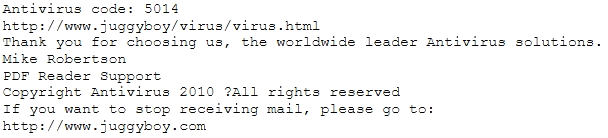
or you may contact us at the following address:
Media Internet Consultants, Edif. Neptuno, Planta
Baja, Ave. Ricardo J. Alfaro, Tumba Muerto, n/a Panama
How will you determine if this is Real Anti-Virus or Fake Anti-Virus website?
Suggested Answer: C
Get Premium 312-50 Questions
as Interactive Web-Based Practice Test or PDF
Real Exam Format
Detailed Explanations
Instant Access
Get Your Practice Test
15 comments · newest first
RA
Raymon
12 months ago
Professional design doesn't mean it's real, be careful!
HO
Horace
12 months ago
Totally agree, SSL is a must!
MA
Maxima
12 months ago
Wait, how can a suspicious site really protect you?
NI
Nickie
1 year ago
I don't trust any site that asks for my antivirus code.
JE
Jeff
1 year ago
Definitely check the URL on Google first!
AH
Ahmed
1 year ago
I definitely wouldn’t download anything from a suspicious site. That seems like a risky move, and I recall that being a big no-no in our training.
DA
Danica
1 year ago
I feel like connecting via SSL could be misleading. Just because a site is secure doesn’t mean it’s legitimate, right?
CL
Clorinda
1 year ago
I think searching the URL and product name on Google is a solid strategy. We practiced that in a similar question last week.
TH
Theron
1 year ago
I remember we discussed how to identify phishing attempts in class, but I'm not sure if just checking the website design is enough.
TE
Tequila
1 year ago
Wait, do we need to use any kind of conditional logic here? I'm a little confused on how to handle the different cases based on the group membership. Maybe I should sketch out the playbook structure first before jumping in.
BO
Bok
1 year ago
From the practice questions, I recall that addressing capacity needs early is important to ensure scalability. So, I guess option B makes the most sense.
KA
Kattie
1 year ago
The key here is to match the layers between the two models. The Internet layer in TCP/IP seems to be the closest equivalent to the Network layer in ISO/OSI, so I'll select option B.
VA
Vallie
1 year ago
I think this is a pretty straightforward question. The key is to focus on the specific requirements for the on-premise client installation, which likely involve the license and tenant information.
ME
Merlyn
1 year ago
I practiced a similar question last week, and I'm pretty sure high definition wouldn't directly help with retention.
CH
Charlette
1 year ago
Hmm, I'm not sure if that's the only option. Modifying an Azure firewall or Traffic Manager profile could also work, but I'd need to review the details to be sure.