Deal of The Day! Hurry Up, Grab the Special Discount - Save 25% - Ends In 00:00:00 Coupon code: SAVE25
Welcome to Pass4Success

- Free Preparation Discussions

Cisco 300-440 Exam - Topic 4 Question 14 Discussion

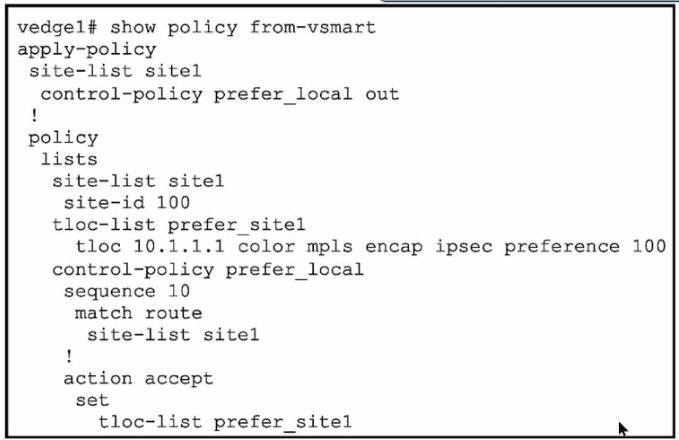
Refer to the exhibit.A network engineer discovers that the policy that is configured on an on-premises Cisco WAN edge router affects only the route tables of the specific devices that are listed in the site list. What is the problem?
D) A centralized data policy must be configured
A) An inbound policy must be applied.
B) The action must be set to deny
C) A localized data policy must be configured.

Cisco 300-440 Exam - Topic 4 Question 14 Discussion

Actual exam question for Cisco's 300-440 exam
Question #: 14
Topic #: 4
[All 300-440 Questions]

Refer to the exhibit.

A network engineer discovers that the policy that is configured on an on-premises Cisco WAN edge router affects only the route tables of the specific devices that are listed in the site list. What is the problem?

Show Suggested Answer Hide Answer
Suggested Answer: D

A fully meshed topology with SD-WAN technology using dynamic routing and prioritized traffic for QoS meets the network architecture requirements of the company. A fully meshed topology provides high availability by eliminating single points of failure and allowing multiple paths between branch offices. SD-WAN technology enables multihoming by supporting multiple transport options, such as MPLS, internet, LTE, etc. SD-WAN also provides QoS by applying policies to prioritize traffic based on application, user, or network conditions. Dynamic routing allows the SD-WAN solution to adapt to changing network conditions and optimize the path selection for each traffic type. A fully meshed topology with SD-WAN technology can also support specific routing needs, such as segment routing, policy-based routing, or application-aware routing.Reference:

Designing and Implementing Cloud Connectivity (ENCC) v1.0

[Cisco SD-WAN Design Guide]

[Cisco SD-WAN Configuration Guide]


Contribute your Thoughts:

0/2000 characters
Sheron
9 months ago
Not sure about that, could be something else at play here.
upvoted 0 times
...
Maile
9 months ago
Totally agree with D, that’s what I’d go for.
upvoted 0 times
...
Shenika
10 months ago
Wait, why would a localized policy even be a problem?
upvoted 0 times
...
Vilma
10 months ago
I think it’s definitely option D!
upvoted 0 times
...
Leandro
10 months ago
Sounds like a centralized data policy issue.
upvoted 0 times
...
Bette
10 months ago
I keep mixing up localized and centralized policies; I hope I remember the right one for this question!
upvoted 0 times
...
Carline
11 months ago
This question feels familiar; I think we practiced something similar where the scope of the policy was a key issue.
upvoted 0 times
...
Halina
11 months ago
I'm not entirely sure, but I think an inbound policy might be necessary to impact the route tables more broadly.
upvoted 0 times
...
Mabel
11 months ago
I remember discussing how localized policies only affect specific devices, so maybe a centralized policy is needed here?
upvoted 0 times
...
Thad
11 months ago
Hmm, this is an interesting one. I think the key is to focus on the specific problem statement - the policy is only affecting certain devices. I'll need to carefully consider the options and see which one best addresses that issue.
upvoted 0 times
...
Wenona
11 months ago
I'm a bit confused by this question. The exhibit doesn't seem to provide a lot of context, and the answer options are a bit vague. I'll need to think this through step-by-step to figure out the right solution.
upvoted 0 times
...
Lemuel
11 months ago
Alright, this looks like a classic network policy issue. I'm pretty confident I can solve this one - I just need to make sure I understand the details of the question and the exhibit.
upvoted 0 times
...
Emilio
11 months ago
Okay, let's see here. The policy is only affecting the route tables of specific devices, so I'm thinking the problem might be with the policy configuration itself. I'll need to analyze the options carefully.
upvoted 0 times
...
Bok
11 months ago
Hmm, this seems like a tricky one. I'll need to carefully read through the question and examine the exhibit to figure out the best approach.
upvoted 0 times
...
Kyoko
11 months ago
Disabling HDP-related services could be worth a try, but I'm not sure if that's the root cause of the problem.
upvoted 0 times
...
Onita
11 months ago
Hmm, the options seem a bit complex. I'll need to carefully read through each one and think about the implications of each approach. I want to make sure I select the best option for the customer's needs.
upvoted 0 times
...
Xenia
1 year ago
Centralized policy, huh? So, I guess the edge router is the communication hub for the whole network, like a big virtual switchboard. Gotta keep that thing organized!
upvoted 0 times
...
Svetlana
1 year ago
Bingo! A centralized data policy is definitely the way to go. This will ensure the policy is applied consistently across all devices, not just the ones in the site list.
upvoted 0 times
Junita
1 year ago
That makes sense. A centralized data policy would provide consistent application of the policy across all devices.
upvoted 0 times
...
Adelle
1 year ago
C) A centralized data policy must be configured.
upvoted 0 times
...
Dorthy
1 year ago
B) The action must be set to deny
upvoted 0 times
...
Dorethea
1 year ago
A) An inbound policy must be applied.
upvoted 0 times
...
...
Romana
1 year ago
A localized data policy? That doesn't sound right. Wouldn't a centralized approach be more effective in managing the WAN edge router?
upvoted 0 times
Kanisha
1 year ago
User1: It seems like the localized data policy is causing issues with specific devices.
upvoted 0 times
...
Roslyn
1 year ago
User2: I agree, having a centralized approach can help manage everything more effectively.
upvoted 0 times
...
Velda
1 year ago
User1: Maybe a centralized data policy would be more efficient.
upvoted 0 times
...
...
Kimberely
1 year ago
Wait, why would we want to deny the action? Isn't the goal to configure the policy properly, not just block everything?
upvoted 0 times
Isadora
1 year ago
Keena: It depends on the specific requirements of the network and the level of control needed.
upvoted 0 times
...
Lucina
1 year ago
User 3: But wouldn't configuring the policy properly be a better solution than just denying everything?
upvoted 0 times
...
Keena
1 year ago
User 2: That makes sense, it could be a security measure to control access.
upvoted 0 times
...
Gayla
1 year ago
User 1: Maybe denying the action is necessary to ensure only specific devices are affected.
upvoted 0 times
...
...
Kip
1 year ago
Hmm, I'm not sure if an inbound policy is the right solution here. Shouldn't the policy affect all devices, not just the ones in the site list?
upvoted 0 times
Jesusa
1 year ago
User 2: That could be the solution to make sure all devices are affected by the policy.
upvoted 0 times
...
Alline
1 year ago
User 1: Maybe a centralized data policy should be configured instead.
upvoted 0 times
...
...
Willodean
1 year ago
But wouldn't a localized data policy be more efficient for specific devices?
upvoted 0 times
...
Berry
1 year ago
I agree with Rodolfo. A centralized data policy would ensure consistency across all devices.
upvoted 0 times
...
Rodolfo
1 year ago
I think the problem is that a centralized data policy must be configured.
upvoted 0 times
...

Save Cancel