
Free Preparation Discussions
 MENU
MENU
Cisco 300-440 Exam Questions
- Cisco Certified Network Professional CCNP Certifications
- Cisco Certified Network Professional Enterprise CCNP Enterprise Certifications
- Topic 1: Architecture Models: In this topic different aspects of connectivity to cloud providers are discussed. It focuses on AWS, Azure, and Google Cloud. Moreover, the topic explains private connectivity to leading cloud providers and connectivity options for Software as a Service (SaaS) cloud providers.
- Topic 2: Design: Questions about cloud-native security policies for AWS, Azure, and Google Cloud appear in this topic. It also recommends connectivity models that ensure high availability, resiliency, SLAs, and reliability. Furthermore, the topic delves into connectivity models based on network architecture requirements. The topic further discusses factors including bandwidth, QoS, dedicated vs shared connections and multi-homing.
- Topic 3: IPsec Cloud Connectivity: The configuration of IPsec-based secure cloud connectivity is one of the focal points of this topic. Additionally, it delves into configuration of IPsec-based secure cloud connectivity between an on-premises Cisco IOS XE router and native Azure, AWS, and Google Cloud endpoints. Lastly, the topic discusses configuration of routing on Cisco IOS XE routers.
- Topic 4: SD-WAN Cloud Connectivity: Questions about configuration of SD-WAN-based cloud connectivity using Cisco infrastructure appear in this topic. Furthermore, it discusses configuration of Cisco SD-WAN OnRamp, configuration for connecting to a SaaS cloud provider, and configuration of Cisco SD-WAN policies to address traffic.
- Topic 5: Operation: The topic delves into diagnosis of IPsec-based secure cloud connectivity between an on-premises native Cloud endpoints and Cisco IOS XE router. It also explains the diagnosis of routing issues on Cisco IOS XE routers, and diagnosis of Cisco SD-WAN policy issues, focusing on all the traffic.
Free Cisco 300-440 Exam Actual Questions
Note: Premium Questions for 300-440 were last updated On Sep. 19, 2026 (see below)
A cloud engineer is setting up a new set of nodes in the AWS EKS cluster to manage database integration with Mongo Atlas. The engineer set up security to Mongo but now wants to ensure that the nodes are also secure on the network side. Which feature in AWS should the engineer use?
Security groups are a feature in AWS that allow you to control the inbound and outbound traffic to your instances. They act as a virtual firewall that can filter the traffic based on the source, destination, protocol, and port. You can assign one or more security groups to your instances, and each security group can have multiple rules. Security groups are stateful, meaning that they automatically allow the response traffic for any allowed inbound traffic, and vice versa. Security groups are essential for securing your nodes in the AWS EKS cluster, as they can prevent unauthorized access to your Mongo Atlas database or other resources. You can also use security groups to isolate your nodes from other instances in the same VPC or subnet, or to allow communication between nodes in different clusters or regions.Reference:=
AWS Security Groups
Security Groups for Your VPC
Security Groups for Your Amazon EC2 Instances
Security Groups for Your Amazon EKS Cluster
Which feature is unique to Cisco SD-WAN IPsec tunnels compared to native IPsec VPN tunnels?
Cisco SD-WAN IPsec tunnels are different from native IPsec VPN tunnels in several ways. One of the unique features of Cisco SD-WAN IPsec tunnels is that they support real-time dynamic path selection, which means that they can automatically choose the best path for each application based on the network conditions and policies. This feature improves the performance, reliability, and efficiency of the network traffic. Native IPsec VPN tunnels, on the other hand, do not have this capability and rely on static routing or manual configuration to select the path for each tunnel. This can result in suboptimal performance, increased latency, and higher costs.Reference:=Traditional IPsec Versus Cisco SD-WAN IPsec,SD-WAN vs IPsec VPN's - What's the difference?,SD-WAN vs. VPN: How Do They Compare?,Traditional IPSEC Versus SD-WAN IPSEC
Refer to the exhibit.

Which Cisco lKEv2 configuration brings up the IPsec tunnel between the remote office router and the AWS virtual private gateway?
A)

B)

C)

Option C is the correct answer because it configures the IKEv2 profile with the correct match identity, authentication, and keyring parameters. It also configures the IPsec profile with the correct transform set and lifetime parameters. Option A is incorrect because it does not specify the match identity remote address in the IKEv2 profile, which is required to match the AWS virtual private gateway IP address. Option B is incorrect because it does not specify the authentication pre-share in the IKEv2 profile, which is required to authenticate the IKEv2 peers using a pre-shared key.Option C also matches the configuration example provided by AWS1and Cisco2for setting up an IKEv2 IPsec site-to-site VPN between a Cisco IOS-XE router and an AWS virtual private gateway.Reference:=
1: AWS VPN Configuration Guide for Cisco IOS-XE
2: Configure IOS-XE Site-to-Site VPN Connection to Amazon Web Services
Refer to the exhibit.
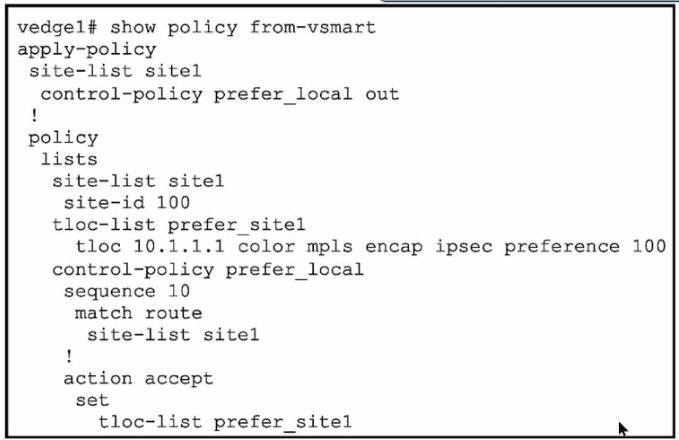
A network engineer discovers that the policy that is configured on an on-premises Cisco WAN edge router affects only the route tables of the specific devices that are listed in the site list. What is the problem?
A centralized data policy is a policy that is applied to all devices in the overlay network, regardless of the site list. A localized data policy is a policy that is applied only to the devices that are listed in the site list. In this case, the network engineer wants to apply the policy to all devices in the overlay network, not just the specific devices in the site list. Therefore, a centralized data policy must be configured on the on-premises Cisco WAN edge router.Reference:=
Designing and Implementing Cloud Connectivity (ENCC) v1.0, Module 3: Implementing Cloud Connectivity, Lesson 3: Implementing Cisco SD-WAN Cloud OnRamp for Colocation, Topic: Centralized Data Policy
[Cisco SD-WAN Cloud OnRamp for Colocation Deployment Guide], Chapter: Configuring Centralized Data Policy
An engineer must enable the OMP advertisement of BGP routes for a specific VRF instance on a Cisco IOS XE SD-WAN device. What should be configured after the global address-family ipv4 is configured?
To enable the OMP advertisement of BGP routes for a specific VRF instance on a Cisco IOS XE SD-WAN device, the engineer must first configure the global address-family ipv4 and then enable bgp advertisement under the vrf definition.This will allow the device to advertise the BGP routes learned from the cloud provider to the OMP control plane, which will then distribute them to the other SD-WAN devices in the overlay network1
- Select Question Types you want
- Set your Desired Pass Percentage
- Allocate Time (Hours : Minutes)
- Create Multiple Practice tests with Limited Questions
- Customer Support
Justin Edwards
7 days agoChristopher Adams
19 days agoMaria Davis
1 month agoMargaret Bailey
2 months agoKaren Bailey
2 months agoGerald Scott
3 months agoSusan Parker
3 months agoChristopher Green
4 months agoJoseph Baker
4 months agoKenneth Murphy
5 months agoLinda Perez
5 months agoJustin Nguyen
5 months agoRobert Adams
5 months agoLinda Jones
5 months agoBrian Allen
5 months agoMark Garcia
5 months agoStephane
6 months agoCorinne
6 months agoBev
6 months agoAlbina
7 months agoCarma
7 months agoWynell
7 months agoYolando
7 months agoYoko
8 months agoTiera
8 months agoTracie
8 months agoRoxane
8 months agoDarnell
9 months agoBettye
9 months agoJarvis
9 months agoEdelmira
9 months agoDylan
10 months agoLindsey
10 months agoReed
10 months agoRenato
10 months agoWai
11 months agoMurray
11 months agoEugene
11 months agoDomingo
11 months agoEveline
12 months agoSamuel
12 months agoGlenn
1 year agoHoa
1 year agoMollie
1 year agoAnnalee
1 year agoDenny
1 year agoJacinta
1 year agoBillye
1 year agoMaile
1 year agoBelen
1 year agoAvery
1 year agoWendell
1 year agoEun
1 year agoKaty
1 year agoCeleste
1 year agoMiriam
2 years agoCherelle
2 years agoClay
2 years agoEdwin
2 years agoLouvenia
2 years agoCatherin
2 years agoElza
2 years agoAnnalee
2 years agoMing
2 years agoMing
2 years agoStanton
2 years agoMurray
2 years agoCordell
2 years agoElvera
2 years agoZita
2 years agoLaticia
2 years agoLarae
2 years agoLayla
2 years agoLashandra
2 years agoThora
2 years agoReid
2 years agoLeigha
2 years agoKanisha
2 years agoPolly
2 years agoDominga
2 years agoOdette
2 years agoReena
2 years agoEliseo
2 years agoWava
2 years agoMelda
2 years agoBernadine
2 years agoGerman
2 years agoJustine
2 years agoJanella
2 years agoLeanna
2 years agoSabine
2 years agoTiera
2 years agoMignon
2 years agoKeith
2 years agoCyril
2 years agoTracie
2 years agoStephen
2 years agoSkye
3 years ago