
Free Preparation Discussions
 MENU
MENU
Cisco 300-220 Exam - Topic 6 Question 7 Discussion
Topic #: 6
Refer to the exhibit.
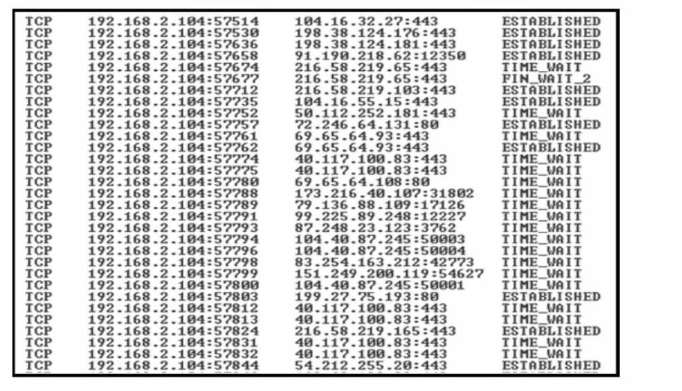
A security team detects a spike in traffic from the company web server. After further investigation, the team discovered that multiple connections have been established from the server to different IP addresses, but the web server logs contain both expected traffic and DDoS traffic. Which attribute must the team use to further filter the logs?
The correct answer is Connection status. In this scenario, the key challenge for the security team is differentiating legitimate outbound traffic from malicious or DDoS-related traffic originating from the same web server. Since both types of traffic coexist in the logs, analysts must rely on an attribute that meaningfully distinguishes normal behavior from abnormal patterns.
The exhibit shows numerous TCP connections from the web server to many different external IP addresses, with varying TCP states such as ESTABLISHED, TIME_WAIT, and FIN_WAIT. These connection states are highly valuable for threat hunting and network analysis. During DDoS activity---especially reflected or amplification-style attacks, or when a server is abused as part of an attack---connections often remain half-open, rapidly transition to TIME_WAIT, or fail to fully establish. In contrast, legitimate web traffic typically results in stable, short-lived ESTABLISHED sessions that follow predictable patterns.
Option B (destination port) is not useful here because most web traffic---both legitimate and malicious---commonly uses ports 80 or 443. Option C (IP address of the web server) provides no filtering value because all traffic already originates from that server. Option D (protocol) is also ineffective, as both normal and DDoS traffic in this case use TCP.
From a professional SOC and threat hunting standpoint, connection state analysis is a foundational technique for detecting volumetric attacks, beaconing behavior, and abnormal session churn. By filtering logs based on connection status, analysts can quickly isolate suspicious patterns such as excessive short-lived connections, abnormal teardown behavior, or asymmetric session states that are characteristic of DDoS-related activity.
This approach aligns with mature threat hunting practices: when indicators overlap, pivot to behavioral attributes. Connection status provides the necessary behavioral signal to separate expected traffic from attack traffic and supports faster, more accurate incident response.
Bettina
3 days agoBarbra
8 days agoGlory
13 days agoSon
19 days agoStephaine
24 days agoJanae
29 days agoRessie
1 month agoLeonard
1 month agoCherry
1 month agoCharlene
2 months agoAndra
2 months agoRichelle
2 months agoSheron
2 months agoBlair
2 months agoTina
4 months agoNida
4 months agoLucy
5 months agoJade
5 months agoLuis
5 months agoFloyd
5 months ago