Deal of The Day! Hurry Up, Grab the Special Discount - Save 25% - Ends In 00:00:00 Coupon code: SAVE25
Welcome to Pass4Success

- Free Preparation Discussions

Cisco 300-215 Exam - Topic 3 Question 114 Discussion

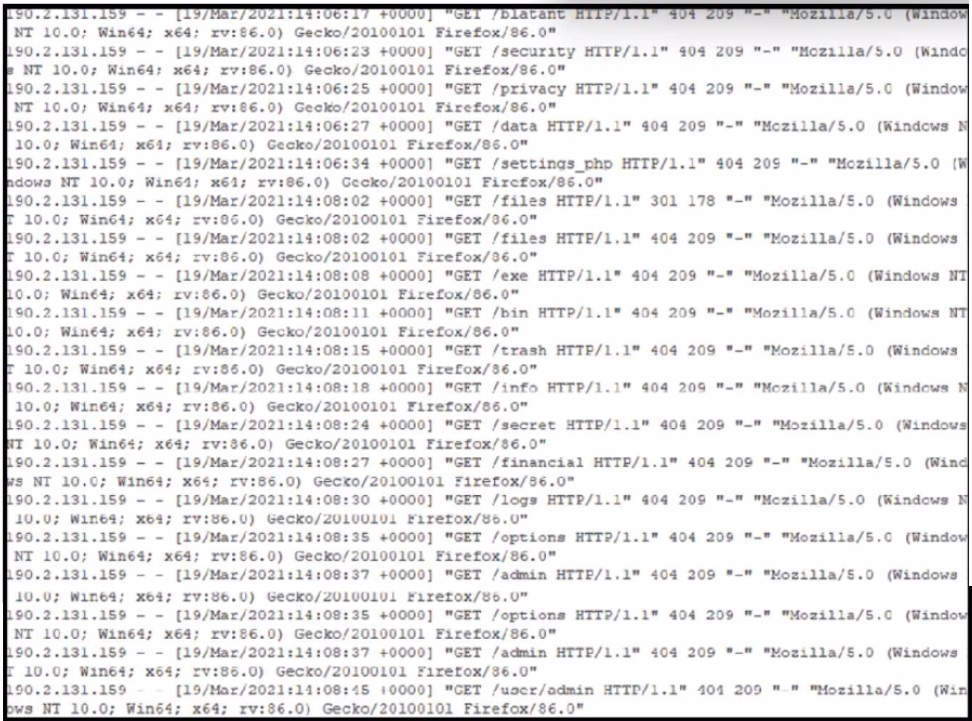
Refer to the exhibit.Refer to the exhibit. A security analyst notices that a web application running on NGINX is generating an unusual number of log messages. The application is operational and reachable. What is the cause of this activity?
B) directory fuzzing
A) botnet infection
C) DDoS attack
D) SQL injection

Cisco 300-215 Exam - Topic 3 Question 114 Discussion

Actual exam question for Cisco's 300-215 exam
Question #: 114
Topic #: 3
[All 300-215 Questions]

Refer to the exhibit.

Refer to the exhibit. A security analyst notices that a web application running on NGINX is generating an unusual number of log messages. The application is operational and reachable. What is the cause of this activity?

Show Suggested Answer Hide Answer
Suggested Answer: B

The provided log file contains multiple HTTP GET requests attempting to access various directories and files on the web server such as:

/balance

/security

/finance

/secret

/opt

/fuzzer/admin

These requests appear to be sequential, systematically targeting commonly used file and directory paths. The response codes are mostly 404 (Not Found) and a few 301s, indicating that the requester is trying different permutations of paths to discover hidden or vulnerable endpoints. This behavior is consistent with directory fuzzing, a reconnaissance technique used by attackers (or automated tools) to map out web directory structures by sending a high volume of crafted requests to guess hidden or unlinked directories and files.

This is distinct from DDoS (which would manifest as volume-based access issues), SQL injection (which targets specific parameters within requests), or botnet infection (which generally involves command-and-control communication or massive traffic floods).


Contribute your Thoughts:

0/2000 characters
Vanna
3 days ago
DDoS makes sense with high log volume.
upvoted 0 times
...
Eve
8 days ago
Botnet infection seems plausible.
upvoted 0 times
...
Lavonda
13 days ago
I feel like SQL injection is less likely.
upvoted 0 times
...
Laura
19 days ago
Could be directory fuzzing too.
upvoted 0 times
...
Carey
24 days ago
I think it's a DDoS attack.
upvoted 0 times
...
Dylan
29 days ago
Nah, I doubt it’s a botnet infection, that’s too obvious.
upvoted 0 times
...
Jaleesa
1 month ago
I’m surprised it’s operational with all those logs!
upvoted 0 times
...
Troy
1 month ago
Definitely not SQL injection, the app is still up.
upvoted 0 times
...
Darrin
1 month ago
I think it could be a DDoS attack, too many requests!
upvoted 0 times
...
Dustin
2 months ago
Looks like a classic case of directory fuzzing.
upvoted 0 times
...
Shelba
2 months ago
I'm leaning towards botnet infection since it can cause a spike in log activity, but I need to double-check my notes on that.
upvoted 0 times
...
Lucina
2 months ago
I think SQL injection might generate a lot of log messages, but I can't recall the specifics on how it would look in the logs.
upvoted 0 times
...
Rikki
2 months ago
This reminds me of a practice question where we discussed directory fuzzing. It could be a possibility here too, right?
upvoted 0 times
...
Pilar
2 months ago
I remember studying about web application logs, and unusual log messages could indicate a DDoS attack, but I'm not entirely sure.
upvoted 0 times
...

Save Cancel