
Free Preparation Discussions
 MENU
MENU
Cisco 300-215 Exam Questions
- Cisco Certified Network Professional CCNP Certifications
- Cisco Certified Network Professional Cybersecurity Certifications
- Topic 1: Describe capabilities of Cisco security solutions related to threat intelligence/ Recognize encoding and obfuscation techniques
- Topic 2: Recommend a response based on intelligence artifacts/ Analyze the components needed for a root cause analysis report
- Topic 3: Evaluate elements required in an incident response playbook/ Determine the type of code based on a provided snippet
- Topic 4: Recommend actions based on post-incident analysis/ Describe the issues related to gathering evidence from virtualized environments
- Topic 5: Evaluate the relevant components from the ThreatGrid report/ Recognize the methods identified in the MITRE attack framework to perform fileless malware analysis
- Topic 6: Describe the process of performing forensics analysis of infrastructure network devices/ Interpret binaries using objdump and other CLI tools
- Topic 7: Analyze threat intelligence provided in different formats/ Determine the files needed and their location on the host
- Topic 8: Determine attack vectors or attack surface and recommend mitigation in a given scenario/ Describe the goals of incident response
- Topic 9: Analyze logs from modern web applications and servers/ Determine data to correlate based on incident type
- Topic 10: Recommend a response to 0 day exploitations/ Evaluate artifacts from threat intelligence to determine the threat actor profile
Free Cisco 300-215 Exam Actual Questions
Note: Premium Questions for 300-215 were last updated On Oct. 10, 2026 (see below)
Data has been exfiltrated and advertised for sale on the dark web. A web server shows:
Database unresponsiveness
PageFile.sys changes
Disk usage spikes with CPU spikes
High page faults
Which action should the IR team perform on the server?
The combination of CPU spikes, disk usage peaks, and fluctuating PageFile.sys indicates excessive virtual memory paging, which may be a sign of malicious memory or file access behavior. PageFile.sys is part of the virtual memory system, and analyzing it can reveal which processes or payloads are consuming unusual amounts of memory, especially during exfiltration events.
Refer to the exhibit.
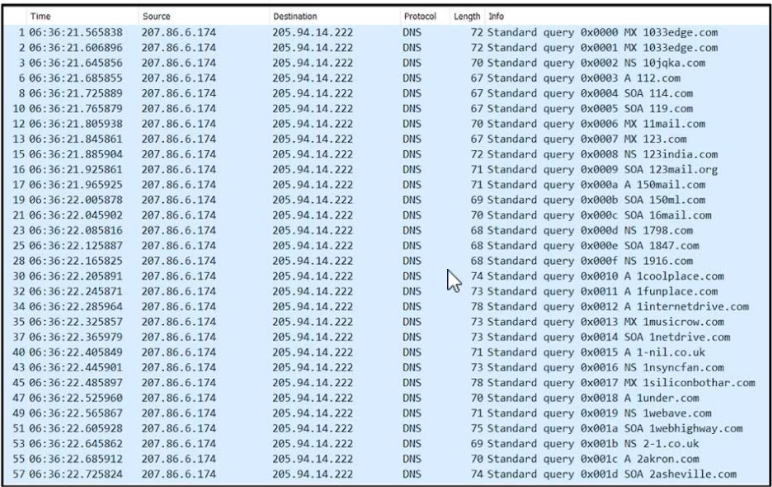
According to the Wireshark output, what is the Indicator of Attack?
The capture shows one source, 207.86.6.174, sending a rapid sequence of DNS queries to 205.94.14.222. The timestamps progress by roughly 0.04 seconds, producing dozens of requests in little more than one second. That unusually high request rate is the observable Indicator of Attack; the exhibit does not establish that the queried domains are malicious. Requesting several DNS record types can occur legitimately, so option B is descriptive but not the strongest attack indicator. Option A ignores the abnormal frequency. CBRFIR Forensics Processes objective 4.3 requires analysts to examine traffic associated with malicious activity using network-monitoring tools and Wireshark display analysis. The defensible conclusion must therefore remain tied to what the packet evidence directly proves: a DNS-query burst from a single host, which warrants correlation with baseline, endpoint, and threat-intelligence data. Cisco CBRFIR v1.2 exam topics
================
A threat hunter must analyze the threat intelligence report on APT29 and identify whether the threat actor is on the Windows machines of the customer network. According to the report the user executes a malicious file on the victim machine that establishes a C? connection over port 53 Afterward, the attacker uses a CI.I to stage and exfiltrate business data. Which two types of logs enable the threat hunter to accomplish the task? (Choose two.)
An incident responder reviews a log entry that shows a Microsoft Word process initiating an outbound network connection followed by PowerShell execution with obfuscated commands. Considering the machine's role in a sensitive data department, what is the most critical action for the responder to take next to analyze this output for potential indicators of compromise?
When dealing with suspected malicious activity involving obfuscated PowerShell scripts---especially when launched from Microsoft Word documents---behavioral analysis is the most critical next step. This approach helps in determining if the process chain is part of a known attack pattern, such as a phishing attempt using malicious macros that launch PowerShell for data exfiltration or payload download.
As highlighted in the CyberOps Technologies (CBRFIR) 300-215 study guide, understanding behavior and deobfuscating PowerShell scripts is an essential part of the forensic and incident response process. Specifically:
During the detection and analysis phase, if PowerShell is used with obfuscated or encoded commands, responders should investigate the intent and behavior of the command.
Deobfuscation allows analysts to see what the script is doing (e.g., downloading files, creating persistence mechanisms, or opening a reverse shell).
The guide states:
''For example, if the threat is malware, the compromised system should be immediately isolated and the malware should be placed in a sandbox or a detonation chamber to understand what it is trying to do''.
This confirms that understanding execution behavior (such as what the PowerShell script intends to perform) is key to uncovering indicators of compromise (IoCs).
Thus, option C---conducting a behavioral analysis and deobfuscating PowerShell---is the most critical and effective response at this stage.
Which scripts will search a log file for the IP address of 192.168.100.100 and create an output file named parsed_host.log while printing results to the console?
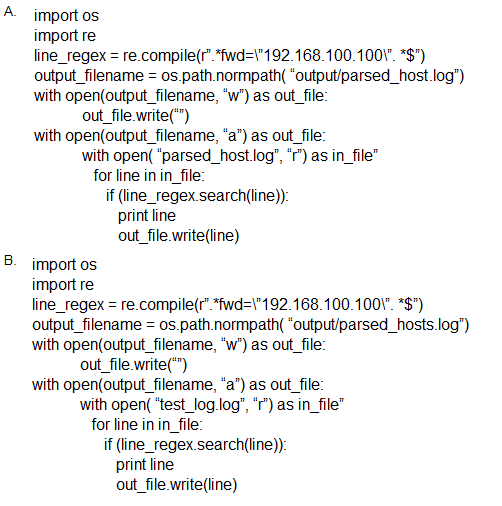
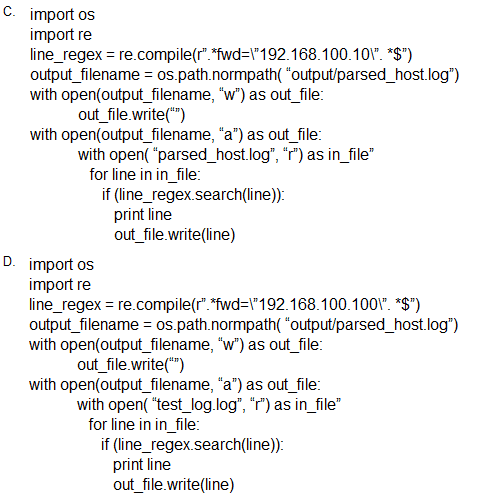
To determine the correct script, we evaluate the following requirements:
The script must search for the IP address 192.168.100.100.
The output should be written to a file named parsed_host.log.
The matching lines should be printed to the console.
Analysis of the options:
Option A: Correct IP regex used and correct output filename, but reads from parsed_host.log instead of a source log file like test_log.log (not ideal for initial parsing).
Option C: The IP address used is 192.168.100.101 instead of 192.168.100.100 --- incorrect.
Option D: Same IP address and logic as Option B, but uses print statement without parentheses, which is not valid in Python 3 unless using Python 2 --- not ideal.
Option B:
Uses correct IP: '192.168.100.100'
Reads from test_log.log (presumably the source log file).
Writes to output/parsed_host.log.
Prints each matching line and writes to output file --- satisfying all conditions.
ChatGPT said:
- Select Question Types you want
- Set your Desired Pass Percentage
- Allocate Time (Hours : Minutes)
- Create Multiple Practice tests with Limited Questions
- Customer Support
Dennis Rogers
28 days agoKevin Baker
1 month agoLaura Perez
2 months agoOlivia Green
2 months agoSarah Carter
3 months agoGeorge Lopez
3 months agoHarold Moore
4 months agoKenneth Clark
4 months agoBrian Nelson
5 months agoMonica Anderson
5 months agoAshley Williams
6 months agoMonica Parker
6 months agoRachel Rivera
5 months agoJames Young
5 months agoGeorge Jackson
6 months agoAndrew Morris
5 months agoAlton
6 months agoArlette
7 months agoBeth
7 months agoRoyal
7 months agoFelix
7 months agoKayleigh
8 months agoAngelica
8 months agoCaitlin
8 months agoTegan
8 months agoAlfred
9 months agoArlean
9 months agoMiles
9 months agoAja
9 months agoAnabel
10 months agoSuzan
10 months agoCaren
10 months agoRodrigo
10 months agoCecil
11 months agoMinna
11 months agoCatalina
11 months agoMaurine
11 months agoJeanice
12 months agoCeleste
12 months agoJennifer
1 year agoSharan
1 year agoMerissa
1 year agoHerman
1 year agoSerina
1 year agoIzetta
1 year agoCarlee
1 year agoRosann
1 year agoKaran
1 year agoAnnelle
1 year agoSherell
1 year agoTommy
1 year agoLauryn
2 years agoCarey
2 years agoJesus
2 years agoQuentin
2 years agoColeen
2 years agoXuan
2 years agoMoon
2 years agoLenna
2 years agoMaybelle
2 years agoKimberely
2 years agoDomingo
2 years agoBritt
2 years agoJeniffer
2 years agoVernell
2 years agoCheryl
2 years agoDaryl
2 years agoCassie
2 years agoHerminia
2 years agoLou
2 years agoOmega
2 years agoMarva
2 years agoOna
2 years agoDomitila
2 years agoJaleesa
2 years agoIvette
2 years agoCeleste
2 years agoSantos
2 years agoWillow
2 years agoMelina
2 years agoSalina
2 years agoTrina
2 years agoDorthy
2 years agoJames
2 years agoHannah
2 years ago