
Free Preparation Discussions
 MENU
MENU
ARDMS AE-Adult-Echocardiography Exam Questions
- Topic 1: Anatomy and Physiology: This section of the exam measures skills of adult echocardiography technicians and covers knowledge and abilities related to normal cardiac anatomy and physiology. It includes assessing great vessels like the aorta and pulmonary arteries, recognizing anatomic variants of the heart, and evaluating cardiac chambers, pericardium, valve structures, and vessels of arterial and venous return. Candidates must document normal systolic and diastolic function, normal valve function and measurements, the phases of the cardiac cycle, normal Doppler changes with respiration, and appearance of arterial and venous waveforms. This also involves assessing the normal hemodynamic response to stress testing and maneuvers such as Valsalva, respiratory, handgrip, and postural changes.
- Topic 2: Pathology: This section of the exam measures skills of adult echocardiography technicians and focuses on identifying and evaluating abnormal physiology and perfusion and postoperative conditions. It includes assessment of ventricular aneurysms, aortic and valve abnormalities, arrhythmias, cardiac masses, diastolic dysfunction, endocarditis, ischemic diseases, cardiomyopathies, congenital anomalies, and postoperative valve repair or replacement and intracardiac devices. Candidates must demonstrate ability to recognize abnormal Doppler signals, EKG changes, wall motion abnormalities, and a wide range of cardiac pathologies including pulmonary hypertension and septal defects.
- Topic 3: Clinical Care and Safety: This section of the exam measures skills of adult echocardiography technicians in applying clinical care principles and safety protocols. It includes evaluating patient history and external data, preparing patients including fasting state and intravenous line management, proper patient positioning, EKG lead placement, blood pressure measurement, and ergonomic techniques. Candidates are expected to identify critical echocardiographic findings, know contraindications for procedures, and be able to respond and manage medical emergencies that may arise during echocardiographic exams.
- Topic 4: Measurement Techniques, Maneuvers, and Sonographic Views: This section of the exam measures skills of adult echocardiography technicians in performing accurate cardiac measurements, conducting provocative maneuvers, and obtaining optimized sonographic imaging views. It involves applying 2D, 3D, M-mode, and Doppler techniques to measure heart valves, chambers, and vessels, including the aortic valve, mitral valve, left and right ventricles, atria, pulmonary artery, and shunt ratios. Candidates must instruct patients in maneuvers such as Valsalva, cough, sniff, and squat. They should also be proficient in acquiring standard echocardiographic views including apical, parasternal, subcostal, and suprasternal notch views.
- Topic 5: Instrumentation, Optimization, and Contrast: This section of the exam measures skills of adult echocardiography technicians related to use and optimization of ultrasound instrumentation and the application of contrast agents. Candidates should recognize imaging artifacts, utilize non-imaging transducers, and adjust ultrasound console settings for optimal imaging and Doppler recordings. Knowledge of harmonic imaging, principles of contrast agents, and the safe and effective use of saline and echo-enhancing contrast agents is essential. Candidates must also be able to optimize images when using contrast agents to ensure diagnostic quality.
Free ARDMS AE-Adult-Echocardiography Exam Actual Questions
Note: Premium Questions for AE-Adult-Echocardiography were last updated On Sep. 23, 2026 (see below)
Which Doppler signal is used to calculate the pulmonary artery end-diastolic pressure gradient?
Pulmonary artery end-diastolic pressure (PAEDP) can be estimated noninvasively by measuring the end-diastolic velocity of pulmonary regurgitation (pulmonary insufficiency) using continuous-wave Doppler. The pressure gradient between the pulmonary artery and right ventricle at end-diastole is calculated using the modified Bernoulli equation from this velocity.
Tricuspid insufficiency is used to estimate right ventricular systolic pressure. Tricuspid inflow and pulmonary inflow velocities provide information on diastolic function but not direct pressure gradients.
This method is well validated and included in ASE guidelines for pulmonary hypertension assessment and Doppler hemodynamics16:Textbook of Clinical Echocardiography, 6ep.300-30512:ASE Doppler Guidelinesp.110-115.
A continuous flow murmur is most likely due to which abnormality?
A continuous murmur, heard throughout systole and diastole, is most characteristically caused by a patent ductus arteriosus (PDA). PDA represents persistent communication between the aorta and pulmonary artery, allowing continuous blood flow during both phases of the cardiac cycle.
Ventricular septal defect usually produces a holosystolic murmur. Concomitant aortic stenosis and mitral regurgitation cause separate murmurs but not continuous. Ebstein anomaly with atrial septal defect typically produces murmurs related to tricuspid regurgitation or ASD but not a continuous murmur.
This clinical correlation is detailed in the 'Textbook of Clinical Echocardiography, 6e', Chapter on Congenital Heart Disease and Murmur Etiologies20:420-425Textbook of Clinical Echocardiography.
Which unit of measurement is used to quantify tricuspid annular plane systolic excursion?
Tricuspid annular plane systolic excursion (TAPSE) is measured as the linear displacement of the tricuspid annulus during systole and is expressed in centimeters (cm). It quantifies right ventricular longitudinal systolic function.
Centimeters per second is a velocity measurement used in tissue Doppler imaging. Milliliters per minute refers to volume flow, and millimeters of mercury measures pressure.
This is standardized in the 'Textbook of Clinical Echocardiography, 6e', Chapter on Right Ventricular Functional Assessment20:320-325Textbook of Clinical Echocardiography.
Based on this video, what is the estimated right atrial pressure in millimeters of mercury (mmHg)?
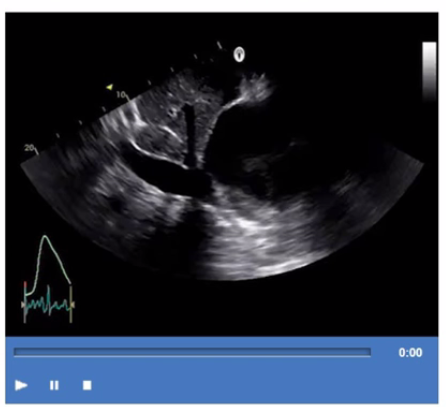
Comprehensive and Detailed Explanation From Exact Extract:
The video shows a subcostal IVC view with measurement of IVC diameter and respiratory collapsibility. The IVC appears dilated (>2.1 cm) with less than 50% collapse on inspiration, suggesting elevated right atrial pressure (RAP).
According to ASE guidelines for noninvasive RAP estimation, an IVC diameter >2.1 cm with <50% collapsibility corresponds to an RAP of approximately 10 mmHg.
Lower RAP values correspond to smaller IVC and greater collapsibility. This is a standard measurement in adult echocardiography practice and ASE chamber quantification guidelines12:ASE Chamber Quantification Guidelinesp.80-8516:Textbook of Clinical Echocardiography, 6ep.115-120.
Which diagnosis is most consistent with the findings in these images?
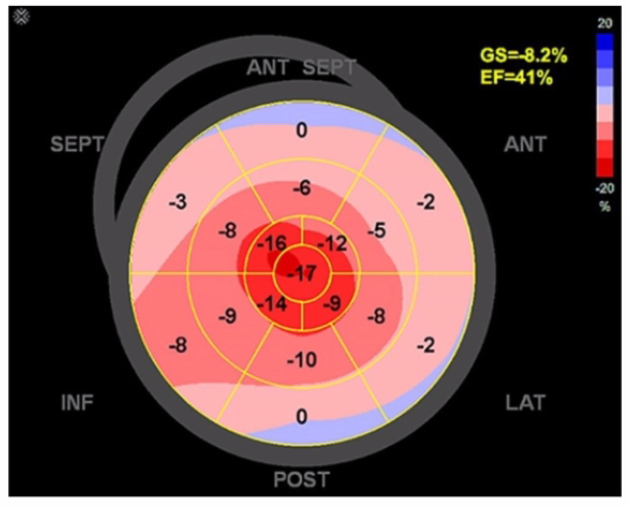
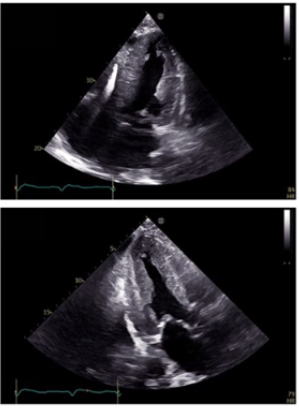
The first image shows a bullseye plot of global longitudinal strain (GLS) with marked reduction in strain values (less negative numbers) most prominently in the apical segments (central red zone), with an overall GLS of -8.2% (normal is about -20%) and a reduced ejection fraction of 41%. This pattern is characteristic of Takotsubo cardiomyopathy, which typically demonstrates regional wall motion abnormalities that predominantly involve the apex and mid segments of the left ventricle with basal sparing.
The 2D echocardiographic images show apical ballooning, a hallmark of Takotsubo cardiomyopathy, where the apex is akinetic or dyskinetic and the basal segments contract normally or hypercontract. Doppler images show findings consistent with impaired ventricular function.
In contrast:
Apical hypertrophic cardiomyopathy (HCM) would show increased wall thickness localized to the apex but not apical ballooning or reduced strain in that typical pattern.
Hypertrophic obstructive cardiomyopathy (HOCM) involves basal septal hypertrophy with outflow obstruction, not apical akinesis or ballooning.
Restrictive cardiomyopathy from amyloidosis involves diffuse infiltration and generally a different strain pattern with more uniform reduction and ''apical sparing'' rather than apical involvement.
This interpretation aligns with the diagnostic criteria and echocardiographic features described in the adult echocardiography literature, including the 'Textbook of Clinical Echocardiography' (Chapter on Cardiomyopathies) and ASE guidelines, which highlight apical ballooning and regional strain abnormalities as diagnostic features of Takotsubo cardiomyopathy16:Cardiomyopathy ChapterTextbook of Clinical Echocardiography, 6e12:ASE Guidelines on Strain Imagingp.130-135.
- Select Question Types you want
- Set your Desired Pass Percentage
- Allocate Time (Hours : Minutes)
- Create Multiple Practice tests with Limited Questions
- Customer Support
Joseph Brown
13 days agoEmma Campbell
1 month agoJeffrey Ramirez
1 month agoEdward Green
2 months agoCynthia Garcia
2 months agoEdward Green
3 months agoStephen Lopez
4 months agoWilliam Hill
4 months agoStephanie Wilson
4 months agoDennis Flores
5 months agoMichael Allen
5 months agoJeffrey Thompson
4 months agoTiffany Parker
4 months agoAmanda White
4 months agoEladia
6 months agoAlesia
6 months agoAnnelle
6 months agoFlo
6 months agoJacki
7 months agoLyla
7 months agoElouise
7 months agoKristel
8 months agoCaren
8 months agoLeonora
8 months agoDorinda
8 months agoCortney
8 months agoArlean
9 months agoNana
9 months agoTanja
9 months agoDierdre
9 months agoShawnda
10 months agoHelga
10 months agoSabina
10 months agoMalissa
10 months agoAlberta
11 months ago