Arcitura Education S90.20 Exam - Topic 1 Question 28 Discussion
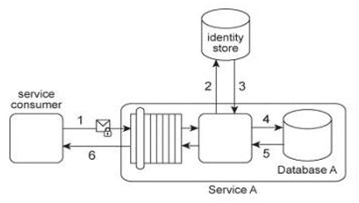
Service A provides a data access capability that can be used by a variety of service consumers. The database records accessed by Service A are classified as either private or public. There are two types of service consumers that use Service A:Service consumers with public access permissions (allowed to access only public data records) and service consumers with private access permissions (allowed to access all data records). For performance reasons the Service A architecture uses a single database, named Database A .Each record in Database A is classified as either private or public. After Service A is invoked by a service consumer (1), it authenticates the request message using an identity store and retrieves the corresponding authorization (2, 3). Once authorized, the service consumer's request is submitted to Database A (4), which then returns the requested data (5) If the service consumer has private access permissions, all of the returned data is included in Service A's response message (6). If the service consumer has public access permissions, then Service A first filters the data in order to remove all unauthorized private data records, before sending to the response message to the service consumer (6). An investigation recently detected that private data has been leaked to unauthorized service consumers. An audit of the Service A architecture revealed that Service A's filtering logic is flawed, resulting in situations where private data was accidentally shared with service consumers that only have public access permissions. Further, it was discovered that attackers have been monitoring response messages sent by Service A in order to capture private data. It is subsequently decided to split Database A into two databases:one containing only private data (the Private Database) and the other containing only public data (the Public Database). What additional changes are necessary to address these security problems?
A) The Service A logic needs to be modified to work with the two new databases. Service A needs to be able to access the Public Database and the Private Database when it receives a request message from a service consumer with private access permissions, and it must only access the Public Database when it receives a request message from a service consumer with public access permissions. Furthermore, any response messages issued by Service A containing private data need to be encrypted.
B) A utility service needs to be created and positioned between Service A and the service consumer. The utility service can-contain screening logic that can verify the service consumer's credentials and then forward the request message to the Private Database or to the Public Database, depending on the service consumer's access permissions. Because each request message is evaluated by the database, no filtering of the returned data is necessary. The data is sent back to the consumer in a response message encrypted using symmetric key encryption.
C) After the service consumer's request message is authenticated. Service A can generate a onetime symmetric encryption key that it sends to the service consumer. This key is encrypted by the public key of the service consumer. After the service consumer acknowledges the receipt of the one-time encryption key, Service A forwards the service consumer's data access request (and the corresponding credentials) to both databases. After receiving the responses from the databases, Service A compiles the results into a single response message. This message is encrypted with the one-time key and sent by Service A to the service consumer.
D) The Service A architecture can be enhanced with certificate-based authentication of service consumers in order to avoid dependency on the identity store. By using digital certificates, Service A can authenticate a service consumer's request message and then forward the data access request to the appropriate database. After receiving the responses from the databases, Service A can use the service consumer's public key to encrypt the response message that is sent to the service consumer.

 MENU
MENU
Glory
10 months agoGenevieve
10 months agoArlene
10 months agoGilma
11 months agoSuzan
11 months agoUla
11 months agoCharlie
11 months agoLyda
11 months agoSylvia
11 months agoKiley
11 months agoHoward
11 months agoStaci
11 months ago