
Deal of The Day! Hurry Up, Grab the Special Discount - Save 25% - Ends In 00:00:00 Coupon code: SAVE25
Welcome to Pass4Success

- Free Preparation Discussions

Arcitura Education S90.20 Exam - Topic 1 Question 25 Discussion

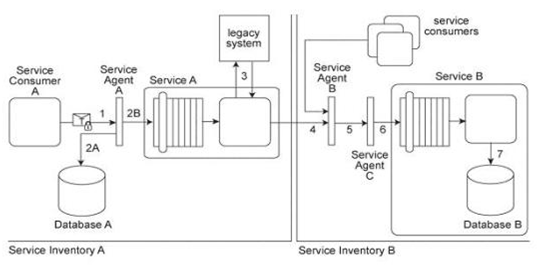
Service Consumer A sends a request message with an authentication token to Service A, but before the message reaches Service A, it is intercepted by Service Agent A (1). Service Agent A validates the security credentials and also validates whether the message is compliant with Security Policy A .If either validation fails, Service Agent A rejects the request message and writes an error log to Database A (2A). If both validations succeed, the request message is sent to Service A (2B). Service A retrieves additional data from a legacy system (3) and then submits a request message to Service B Before arriving at Service B, the request message is intercepted by Service Agent B (4) which validates its compliance with Security Policy SIB then Service Agent C (5) which validates its compliance with Security Policy B .If either of these validations fails, an error message is sent back to Service A .that then forwards it to Service Agent A so that it the error can be logged in Database A (2A). If both validations succeed, the request message is sent to Service B (6). Service B subsequently stores the data from the message in Database B (7). Service A and Service Agent A reside in Service Inventory A .Service B and Service Agents B and C reside in Service Inventory B .Security Policy SIB is used by all services that reside in Service Inventory B .Service B can also be invoked by other service consumers from Service Inventory B .Request messages sent by these service consumers must also be compliant with Security Policies SIB and B .Access to the legacy system in Service Inventory A is currently only possible via Service A, which means messages must be validated for compliance with Security Policy A .A new requirement has emerged to allow services from Service Inventory B to access the legacy system via a new perimeter service that will be dedicated to processing request messages from services residing in Service Inventory B .Because the legacy system has no security features, all security processing will need to be carried out by the perimeter service. However, there are parts of Security Policy A that are specific to Service A and do not apply to the legacy system or the perimeter service. Furthermore, response messages sent by the perimeter service to services from Service Inventory B will still need to be validated for compliance to Security Policy B and Security Policy SIB .How can the Policy Centralization pattern be correctly applied without compromising the policy compliance requirements of services in both service inventories?
C) The parts of Security Policy A that are required for access to the new perimeter service need to be removed and placed into a new security policy that is shared by Service A and the perimeter service. Messages sent by services accessing the perimeter service from Service Inventory B will need to be compliant with the new security policy. Because the perimeter service is dedicated to message exchange with services from Service Inventory B, response messages sent by the perimeter service can be designed for compliance to Security Policy B and Security Policy SIB .
A) In order for Security Policy A to be centralized so that it can be shared by Service A and the new perimeter service, messages sent to the perimeter service from services in Service Inventory B will need to continue complying with Security Policy A, even if it requires that the messages contain content that does not relate to accessing the legacy system. In order to centralize Security-Policy B it will need to be combined with Security Policy SIB, which means that the functionality within Service Agents B and C can be combined into a single service agent.
B) A single centralized security policy can be created by combining Security Policy A, Security Policy B .and Security Policy SIB into a single security policy that is shared by services in both Service Inventory A and Service Inventory B .This means that the new perimeter service can share the same new security policy with Service A .This further simplifies message exchange processing because request messages sent by services in Service Inventory B to the new perimeter service need to comply to the same security policy as the response messages sent back by the perimeter service to the services in Service Inventory B .
D) Due to the amount of overlap among Security Policy A, Security Policy B, and Security Policy SIB, the Policy Centralization pattern cannot be correctly applied to enable the described message exchange between the perimeter service in Service Inventory A and services in Service Inventory B .

Arcitura Education S90.20 Exam - Topic 1 Question 25 Discussion

Actual exam question for Arcitura Education's S90.20 exam
Question #: 25
Topic #: 1
[All S90.20 Questions]

Service Consumer A sends a request message with an authentication token to Service A, but before the message reaches Service A, it is intercepted by Service Agent A (1). Service Agent A validates the security credentials and also validates whether the message is compliant with Security Policy A .If either validation fails, Service Agent A rejects the request message and writes an error log to Database A (2A). If both validations succeed, the request message is sent to Service A (2B). Service A retrieves additional data from a legacy system (3) and then submits a request message to Service B Before arriving at Service B, the request message is intercepted by Service Agent B (4) which validates its compliance with Security Policy SIB then Service Agent C (5) which validates its compliance with Security Policy B .If either of these validations fails, an error message is sent back to Service A .that then forwards it to Service Agent A so that it the error can be logged in Database A (2A). If both validations succeed, the request message is sent to Service B (6). Service B subsequently stores the data from the message in Database B (7). Service A and Service Agent A reside in Service Inventory A .Service B and Service Agents B and C reside in Service Inventory B .Security Policy SIB is used by all services that reside in Service Inventory B .Service B can also be invoked by other service consumers from Service Inventory B .Request messages sent by these service consumers must also be compliant with Security Policies SIB and B .Access to the legacy system in Service Inventory A is currently only possible via Service A, which means messages must be validated for compliance with Security Policy A .A new requirement has emerged to allow services from Service Inventory B to access the legacy system via a new perimeter service that will be dedicated to processing request messages from services residing in Service Inventory B .Because the legacy system has no security features, all security processing will need to be carried out by the perimeter service. However, there are parts of Security Policy A that are specific to Service A and do not apply to the legacy system or the perimeter service. Furthermore, response messages sent by the perimeter service to services from Service Inventory B will still need to be validated for compliance to Security Policy B and Security Policy SIB .How can the Policy Centralization pattern be correctly applied without compromising the policy compliance requirements of services in both service inventories?

Show Suggested Answer Hide Answer
Suggested Answer: C

Contribute your Thoughts:

0/2000 characters
Anglea
7 months ago
Option D seems too pessimistic; there's always a way to centralize!
upvoted 0 times
...
Avery
7 months ago
I agree with B, it simplifies compliance across inventories.
upvoted 0 times
...
Effie
8 months ago
Wait, can we really combine all those policies without issues?
upvoted 0 times
...
Donette
8 months ago
I think option B makes the most sense for centralization.
upvoted 0 times
...
Darrel
8 months ago
Sounds like a complex setup with all those security policies!
upvoted 0 times
...
Mari
8 months ago
Visualforce pages are a classic solution, but I'm not sure they offer the same level of flexibility and interactivity as the other options. I'll need to weigh the pros and cons carefully.
upvoted 0 times
...
Elizabeth
8 months ago
Hmm, I'm a bit unsure about this one. Validating data across multiple entities using a BAdI - that's a new concept for me. I'll need to think through the steps carefully and try to recall the key things I need to do.
upvoted 0 times
...
Bobbye
8 months ago
I'm leaning towards requirement 3 being met, directing connections to New York first sounds correct, but what if there's a misconfiguration on the failover?
upvoted 0 times
...
Chandra
8 months ago
I'm a bit confused on the difference between Cloud VPN and Cloud NAT. I'll need to review those features to figure out which one would be better for minimizing data traffic costs.
upvoted 0 times
...

Save Cancel