Arcitura Education S90.20 Exam - Topic 1 Question 20 Discussion
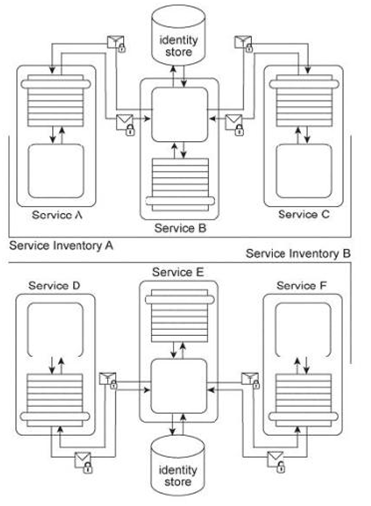
Services A, B, and C reside in Service Inventory A and Services D, E, and F reside in Service Inventory B .Service B is an authentication broker that issues WS-Trust based SAML tokens to Services A and C upon receiving security credentials from Services A and C .Service E is an authentication broker that issues WS-Trust based SAML tokens to Services D and F upon receiving security credentials from Services D and E .Service B uses the Service Inventory A identify store to validate the security credentials of Services A and C .Service E uses the Service Inventory B identity store to validate the security credentials of Services D and F .To date, the two service inventories have existed independently from each other. However, a requirement has emerged that the services in Service Inventory A need to be able to use the services in Service Inventory B, and vice versa. How can cross-service inventory message exchanges be enabled with minimal changes to the existing service inventory architectures and without introducing new security mechanisms?
B) The current security mechanism already fulfills the requirement because SAML tokens can be used across multiple security-domains. The only change required is for each authentication broker to be configured so that it issues service inventory-specific assertions for SAML tokens originating from other service inventories.
A) Because SAML tokens cannot be used across multiple security domains, authentication brokers C and E need to be replaced with one single authentication broker so that one token issuer is used for all services across both of the service inventories.
C) The individual domain service inventories need to be combined into one enterprise service inventory. The Service Perimeter Guard pattern can be applied to establish a contact point for request messages originating from outside the service inventory. Within the service inventory, services no longer need to be authenticated because they are all part of the same trust boundary.
D) The Trusted Subsystem pattern is applied to encapsulate Services B and E using a central utility service that balances request and response messages exchanged between Services B and E, depending on which service inventory the messages originate from. The utility service also contains transformation logic to ensure that the SAML tokens issued by Services B and E are compatible. This guarantees that an issued SAML token can be used across Service Inventories A and B without further need for runtime conversion.

 MENU
MENU
Erick
10 months agoLoreen
10 months agoGolda
11 months agoSheron
11 months agoBlair
11 months agoSina
11 months agoHelaine
11 months agoJesusita
11 months agoDustin
11 months ago