Arcitura Education S90.20 Exam - Topic 1 Question 19 Discussion
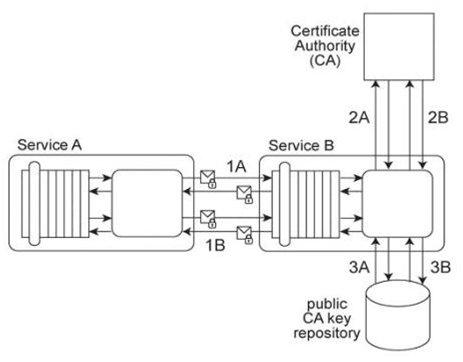
Service A exchanges messages with Service B multiple times during the same runtime service activity. Communication between Services A and B has been secured using transport-layer security. With each service request message sent to Service B (1A .IB), Service A includes an X.509 certificate, signed by an external Certificate Authority (CA). Service B validates the certificate by retrieving the public key of the CA (2A .2B) and verifying the digital signature of the X.509 certificate. Service B then performs a certificate revocation check against a separate external CA repository (3A, 3B). No intermediary service agents reside between Service A and Service B .Service B has recently suffered from poor runtime performance plus it has been the victim of an access-oriented attack. As a result, its security architecture must be changed to fulfill the following new requirements:1. The performance of security-related processing carried out by Service B when communicating with Service A must be improved.2. All request messages sent from Service A to Service B must be screened to ensure that they do not contain malicious content. Which of the following statements describes a solution that fulfills these requirements?
B) Add a service agent to screen messages sent from Service A to Service B .The service agent can reject any message containing malicious content so that only verified messages are passed through to Service B .Instead of using X.509 certificates, use WS-Secure Conversation sessions. Service A can request a Security Context Token (SCT) from a Security Token Service and use the derived keys from the session key to secure communication with Service B .Service B retrieves the session key from the Security Token Service.
A) Eliminate the need to retrieve the public key from the Certificate Authority and to verify the certificate revocation information by extending the service contract of Service B to accept certificates only from pre-registered Certificate Authorities. This form of pre-registration ensures that Service B has the public key of the corresponding Certificate Authority.
C) Apply the Trusted Subsystem pattern by introducing a new utility service between Service A and Service B .When Service A sends request messages, the utility service verifies the provided credentials and creates a customized security profile for Service A .The security profile contains authentication and access control statements that are then inherited by all subsequent request messages issued by Service A .As a result, performance is improved because Service A does not need to resubmit any additional credentials during subsequent message exchanged as part of the same runtime service activity. Furthermore, the utility service performs message screening logic to filter out malicious content.
D) Apply the Trusted Subsystem pattern to by introducing a new utility service. Because Service B is required to limit the use of external resources. Service A must ensure that no other services can request processing from Service B in order to prevent malicious content from infiltrating messages. This is achieved by creating a dedicated replica of Service B to be used by the utility service only. Upon receiving the request message and the accompanying security credentials from Service A .the utility service verifies the authentication information and the validity of the X.509 signature. If the authentication information is correct, then the utility service replicates the code of Service B, performs the necessary processing, and returns the response to Service A .

 MENU
MENU
Stephane
10 months agoMinna
10 months agoReita
11 months agoEarlean
11 months agoMerissa
11 months agoSusana
11 months agoParis
11 months agoXochitl
11 months agoGlen
11 months ago