Arcitura Education S90.20 Exam - Topic 1 Question 17 Discussion
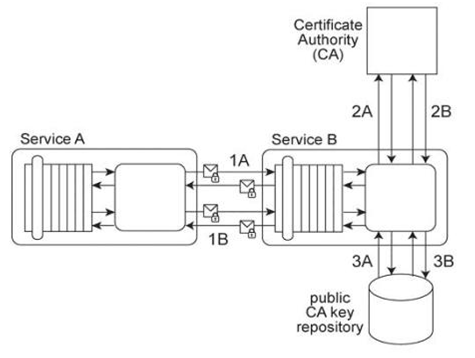
Service A exchanges messages with Service B multiple times during the same runtime service activity. Communication between Services A and B has been secured using transport-layer security. With each service request message sent to Service B (1A .IB), Service A includes an X.509 certificate, signed by an external Certificate Authority (CA). Service B validates the certificate by retrieving the public key of the CA (2A .2B) and verifying the digital signature of the X.509 certificate. Service B then performs a certificate revocation check against a separate external CA repository (3A, 3B). No intermediary service agents reside between Service A and Service B .To fulfill a new security requirement, Service A needs to be able to verify that the response message sent by Service B has not been modified during transit. Secondly, the runtime performance between Services A and B has been unacceptably poor and therefore must be improved without losing the ability to verify Service A's security credentials. It has been determined that the latency is being caused by redundant security processing carried out by Service B .Which of the following statements describes a solution that fulfills these requirements?
A) Apply the Trusted Subsystem pattern to introduce a utility service that performs the security processing instead of Service B .The utility service can verify the security credentials of request messages from Service A and digitally sign messages sent to Service A to enable verification of message integrity. Furthermore, the utility service can perform the verification of security credentials submitted by Service A only once per runtime service activity. After the first message-exchange, it can issue a SAML token to Service A that gets stored within the current session. Service A can then use this session-based token with subsequent message exchange. Because SAML tokens have a very small validity period (in contrast to X.509 certificates), there is no need to perform a revocation check with every message exchange.
B) Service B needs to be redesigned so that it performs the verification of request messages from Service A only for the first message exchange during the runtime service activity. Thereafter, it can issue a SAML token to Service A that gets stored within the current session. Service A then uses this session-based token with subsequent message exchanges. Because SAML tokens have a very small validity period (in contrast to X.509 certificates), there is no need to perform a revocation check with every message exchange.
C) WS-Security-Policy transport binding assertions can be used to improve performance via transport-layer security Tkhe use of symmetric keys can keep the encryption and decryption overhead to a minimum, which will further reduce the latency between Service A and Service B .By encrypting the messages, attackers cannot modify message contents, so no additional actions for integrity verification are needed.
D) The Data Origin Authentication pattern can be applied together with the Service Perimeter Guard pattern to establish a perimeter service that can verify incoming request messages sent to Service B and to filter response messages sent to Service A .The repository containing the verification information about the Certificate Authorities can be replicated in the trust domain of the perimeter service. When access is requested by Service A, the perimeter service evaluates submitted security credentials by checking them against the locally replicated repository. Furthermore, it can encrypt messages sent to Service A by Service B .and attach a signed hash value.

 MENU
MENU
Billy
11 months agoCarylon
11 months agoJustine
11 months agoDusti
11 months agoCordelia
12 months agoTatum
12 months agoLinwood
12 months agoLajuana
12 months agoJerrod
12 months agoHyun
1 year ago