
Free Preparation Discussions
 MENU
MENU
AACE International AACE-PSP Exam Questions
- Topic 1: Basic Planning & Scheduling Knowledge: Fundamental planning and scheduling concepts, terminology, and techniques are sub-topics of this topic. It also discusses sub-topics related to project life cycles, work breakdown structures (WBS), and scheduling methods.
- Topic 2: Practical Exercise: It evaluates your competence in applying planning and scheduling knowledge to real-world scenarios. Questions about identifying critical paths, calculating float, analyzing project schedules, and developing project recovery plans may appear.
- Topic 3: Planning & Scheduling Applications: In this topic, questions about planning and scheduling in different project environments appear.
- Topic 4: Communication: This domain tests your ability of communicating crucial information such as planning and scheduling clearly and concisely. You may have to write a memo assignment on a given scenario.
Free AACE International AACE-PSP Exam Actual Questions
Note: Premium Questions for AACE-PSP were last updated On Aug. 26, 2026 (see below)
Project schedules help control all of the following EXCEPT for_____________________.
Role of Project Schedules:
Schedules primarily control time, cost, and resource allocations.
Quality management is related to design specifications and execution standards, not directly managed by schedules.
PSP Study Guide Reference:
The guide clarifies the limitations of scheduling tools in managing quality aspects.
Conclusion: The correct answer is A, as project schedules do not directly control quality.
What is the workweek period for this project?
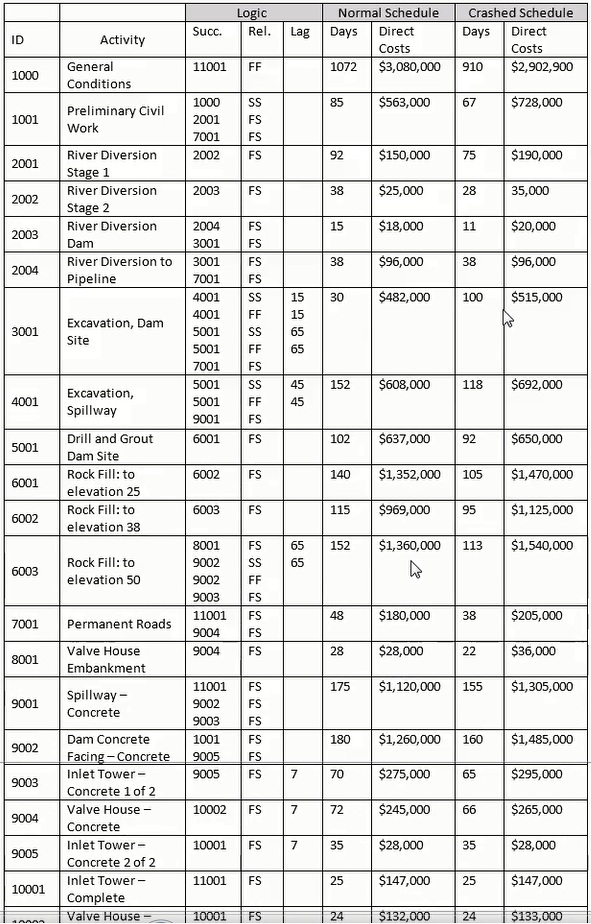
Workweek Period Analysis:
Based on standard construction scheduling practices and project data, the workweek includes six days, with Sunday as a non-working day.
Verification in Project Details:
The PSP Study Guide suggests that assumptions on workweeks must align with labor calendars and schedule configurations (Ref: PSP Study Guide, Chapter 2A: Calendars and Constraints).
Which of the following is NOT a tool or technique used to perform scope planning?
Scope Planning Tools and Techniques:
Tools for scope planning include methods to define and refine the project scope. These involve cost-benefit analysis, expert judgment, and alternatives identification.
Schedule performance indexing is a performance tracking tool used during execution and is unrelated to scope planning.
PSP Study Guide Reference:
Scope planning methods are detailed in the PSP guide, emphasizing tools like expert judgment, alternatives analysis, and structured decision-making techniques.
Analysis for Selection:
Option A: A common method to analyze the costs and benefits of scope components.
Option B: Incorrect. This is a tracking tool, not a scope planning method.
Option C: Expert judgment is a key technique in defining project scope.
Option D: Alternatives identification supports exploring various approaches to project goals.
Conclusion: The correct answer is B, as schedule performance indexing is not a scope planning tool.
Based on the stated costs, what percentage of the total cost comes from the 2000 series of activities?
Cost for 2000 Series Activities:
Activity 2001: $150,000.
Activity 2002: $25,000.
Activity 2003: $18,000.
Activity 2004: $96,000.
Total: 150,000+25,000+18,000+96,000=289,000150,000 + 25,000 + 18,000 + 96,000 = 289,000150,000+25,000+18,000+96,000=289,000.
Total Project Cost:
Total cost: $7,308,000 (sum of all activities in 'normal' schedule).
Percentage Contribution:
289,0007,308,0001003.95%\frac{289,000}{7,308,000} \times 100 \approx 3.95\%7,308,000289,0001003.95%.
Verification with PSP Guidelines: The PSP Study Guide emphasizes accuracy in percentage-based cost contributions as a critical analysis tool in project cost management (Ref: PSP Study Guide, Chapter 1B: Cost Breakdown Structure).
What day would Activity C complete if the duration of Activity B was reduced to zero?
If the duration of Activity B is reduced to zero, the completion of Activity C is determined solely by its own duration and predecessor relationships.
Without knowing the explicit network logic, it is inferred that reducing Activity B to zero does not affect Activity C's finish on Day 50, as its relationship with other activities remains intact.
Reference: PSP Study Guide, Section 2.2.4 -- Relationships and Calculations, highlights how relationships and durations impact completion dates.
- Select Question Types you want
- Set your Desired Pass Percentage
- Allocate Time (Hours : Minutes)
- Create Multiple Practice tests with Limited Questions
- Customer Support
Emma Perez
5 days agoDavid Smith
19 days agoJoseph Harris
1 month agoJason Jones
2 months agoJames Hernandez
2 months agoEdward Nelson
3 months agoEric Edwards
3 months agoAngela Morgan
4 months agoPatricia Carter
4 months agoRichard Turner
4 months agoBarbara Stewart
4 months agoRonald Campbell
4 months agoMichelle Walker
4 months agoMonica Walker
4 months agoLeigha
5 months agoTom
5 months agoPeggie
5 months agoTanja
6 months agoPercy
6 months agoSalena
6 months agoFrederica
7 months agoBillye
7 months agoGary
7 months agoAlonso
7 months agoKatina
8 months agoMonte
8 months agoMatthew
8 months agoMyong
8 months agoLaura
9 months agoSantos
9 months agoFrank
9 months agoMichell
9 months agoJoni
10 months agoMan
10 months agoTherese
10 months agoDanica
10 months agoMabel
11 months agoMichel
11 months agoRemona
11 months agoNakita
11 months agoMarsha
12 months agoArt
12 months agoDetra
1 year agoLilli
1 year agoDanilo
1 year agoChan
1 year agoOmer
2 years agoSimona
2 years agoJohnathon
2 years agoAlex
2 years agoMerri
2 years agoTamra
2 years agoMadonna
2 years agoNovella
2 years agoNelida
2 years agoJamal
2 years agoHassie
2 years agoGlenna
2 years agoMa
2 years agoKeneth
2 years agoMaryln
2 years agoKenny
2 years agoStevie
2 years agoMozelle
2 years agoCharisse
2 years agoMila
2 years agoMozell
2 years agoNakisha
2 years agoShonda
2 years agoGayla
2 years agoScarlet
2 years agoShasta
2 years ago