
Deal of The Day! Hurry Up, Grab the Special Discount - Save 25% - Ends In 00:00:00 Coupon code: SAVE25
Welcome to Pass4Success

- Free Preparation Discussions

WGU Applied Algebra Exam - Topic 3 Question 7 Discussion

The populations, in thousands, of two towns are shown in the graph, where the horizontal axis measures the time in years.Which town's population is growing at a faster rate?
D) Town B, because
A) Town A, because
B) Town B, because
C) Town A, because

WGU Applied Algebra Exam - Topic 3 Question 7 Discussion

Actual exam question for WGU's Applied Algebra exam
Question #: 7
Topic #: 3
[All Applied Algebra Questions]

The populations, in thousands, of two towns are shown in the graph, where the horizontal axis measures the time in years.
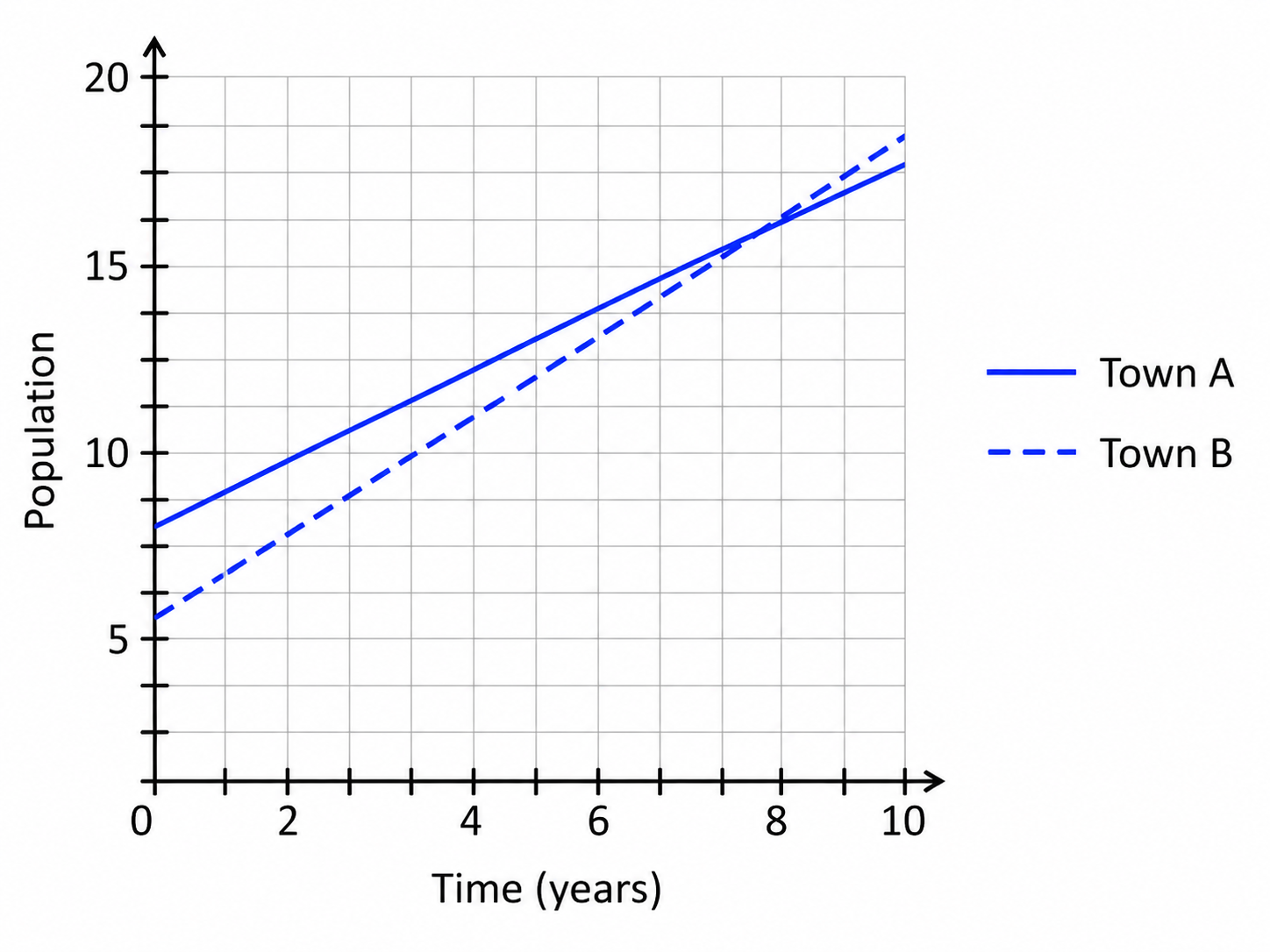
Which town's population is growing at a faster rate?

Show Suggested Answer Hide Answer
Suggested Answer: D

This question asks which town's population is growing at a faster rate.

Since both population graphs are straight lines, we compare their slopes.

The slope of a line represents the rate of change:

From the graph:

Town A starts at about thousand people and increases at a rate of about thousand people per year.

Town B starts at about thousand people and increases at a rate of about thousand people per year.

Even though Town A starts with a larger population, the question asks about the growth rate, not the starting population.

Compare the rates:

So Town B is growing faster than Town A.


Contribute your Thoughts:

0/2000 characters
I remember something about how to calculate the rate of change, but I can't recall if it was about the y-values or the x-values.
upvoted 0 times
...
Selene
5 days ago
I might be confused, but I think Town B had a steeper line in the graph we reviewed last week.
upvoted 0 times
...
Malcolm
10 days ago
I'm not entirely sure, but I feel like we practiced a similar question where we had to compare the steepness of the lines.
upvoted 0 times
...
Orville
15 days ago
I think I remember that we need to look at the slopes of the lines to determine the growth rates.
upvoted 0 times
...

Save Cancel