
Free Preparation Discussions
 MENU
MENU
Salesforce Analytics-DA-201 Exam - Topic 1 Question 21 Discussion
Topic #: 1
You have the Mowing two tables that contains data about the books in a library.

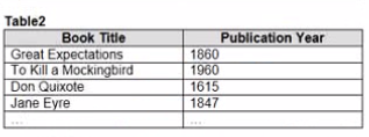
Both tables are incomplete so there are books missing from the tables.
You need to combine the tables. The solution must ensure that all the data is retained
Which type of join should you use?
To combine the two tables that contain data about books in a library and ensure that all the data is retained, you should use a full outer join. A full outer join is a type of join that returns all rows from both tables, regardless of whether there is a match or not. If there is no match, null values are filled in for the missing fields.
To perform a full outer join, you need to do the following steps:
Connect to both tables as your data sources in Tableau. You can use either live or extract connections.
Drag one table to the canvas and drop it on top of another table. This will create a join between them based on a common field.
Click on the join icon between the tables and select Full Outer Join from the drop-down list. This will change the join type to full outer join and show all rows from both tables.
Optionally, you can add or remove join clauses by clicking on Add or Remove buttons next to each clause. You can also change or rename fields by clicking on them.
When combining two datasets that are both incomplete and where it's important to retain all data from both sources, a full outer join is appropriate. This type of join ensures that all records from both tables are included in the combined dataset, even if there are no matching records in the other table.
Kelvin
1 day agoAndra
7 days ago