
Free Preparation Discussions
 MENU
MENU
PECB ISO-9001-Lead-Auditor Exam Questions
- Topic 1: Fundamental principles and concepts of a quality management system: The main objective of this domain is to evaluate your skills of explaining and applying ISO 9001 principles and concepts.
- Topic 2: Quality management system (QMS) requirements: It assesses your abilities to point out and explain different requirements for a quality management system based on ISO 9001.
- Topic 3: Fundamental audit concepts and principles: Questions about interpreting and applying the main concepts and principles related to a QMS audit appear in this topic.
- Topic 4: Preparing an ISO 9001 audit: This topic covers sub-topics related to preparing a quality management system audit.
- Topic 5: Conducting an ISO 9001 audit: It evaluates your skills to conduct a QMS audit.
- Topic 6: Closing an ISO 9001 audit: The topic focuses on concluding a QMS audit and conducting audit follow-up activities.
- Topic 7: Managing an ISO 9001 audit program: This topic evaluates your abilities to establish and managing a QMS audit program.
Free PECB ISO-9001-Lead-Auditor Exam Actual Questions
Note: Premium Questions for ISO-9001-Lead-Auditor were last updated On Sep. 17, 2026 (see below)
Scenario 5: Mechanical-Electro (ME) Audit Stages
Mechanical-Electro, better known as ME, is an American company that provides mechanical and electrical services in Chin
a. Their services range from air-conditioning systems, ventilation systems, plumbing, to installation of electrical equipment in automobile plants, electronic manufacturing facilities, and food processing plants.
Due to the fierce competition from local Chinese companies and failing to meet customer requirements, ME's revenue dropped significantly. In addition, customers' trust and confidence in the company decreased, and the reputation of the company was damaged.
In light of these developments, the top management of ME decided to implement a quality management system (QMS) based on ISO 9001. After having an effective QMS in place for over a year, they applied for a certification audit.
A team of four auditors was appointed for the audit, including Li Na as the audit team leader. Initially, the audit team conducted a general review of ME's documents, including the quality policy, operational procedures, inventory lists, QMS scope, process documentation, training records, and previous audit reports.
Li Na stated that this would allow the team to maintain a systematic and structured approach to gathering documents for all audit stages. While reviewing the documented information, the team observed some minor issues but did not identify any major nonconformities. Therefore, Li Na claimed that it was not necessary to prepare a report or conduct a meeting with ME's representatives at that stage of the audit. She stated that all areas of concern would be discussed in the next phase of the audit.
Following the on-site activities and the opening meeting with ME's top management, the audit team structured an audit test plan to verify whether ME's QMS conformed to Clause 8.2.1 (Customer Communication) of ISO 9001.
To do so, they gathered information through group interviews and sampling. Li Na conducted interviews with departmental managers in the first group and then with top management. In addition, she chose a sampling method that sufficiently represented customer complaints from both areas of ME's operations.
The team members were responsible for the sampling procedure. They selected a sample size of 4 out of 45 customer complaints received weekly for electrical services and 2 out of 10 complaints for mechanical services.
Afterward, the audit team evaluated the evidence against the audit criteria and generated the audit findings.
According to scenario 5, Li Na conducted group interviews with departmental managers and top management by herself. Is this in accordance with audit best practices?
Comprehensive and Detailed In-Depth
According to ISO 19011:2018, Clause 6.4.6 (Conducting Interviews), group interviews should be conducted with at least two auditors to ensure objectivity and accuracy.
This prevents bias or misinterpretation of responses.
It allows for cross-validation of information.
It ensures that the audit results remain objective and impartial.
Since Li Na conducted the group interviews alone, she did not follow audit best practices. The correct approach would have been to have another auditor present during the interviews.
ISO 19011:2018, Clause 6.4.6 (Conducting Interviews)
"A set of interrelated or interlacing elements of an organization to establish policies and objectives, and processes to achieve those objectives" is the definition of a/an:
Comprehensive and Detailed In-Depth
According to ISO 9000:2015, which provides definitions for terms used in ISO 9001:2015, a management system is defined as a set of interrelated or interacting elements of an organization to establish policies, objectives, and processes to achieve those objectives.
A Quality Management System (QMS) is a type of management system that ensures organizations meet customer and regulatory requirements while improving performance.
Clause 3.5.3 of ISO 9000:2015 clearly defines 'management system' and aligns with this question. The other options do not fit the definition:
Standard refers to an established norm or requirement.
Organization scope defines the boundaries of a QMS but is not a system itself.
Quality manual is a document (optional under ISO 9001:2015) that describes a QMS but is not the system itself.
ISO 9000:2015, Clause 3.5.3 -- Management System
ISO 9001:2015, Clause 4.4 -- QMS and its Processes
One of the conflict resolution techniques is toning down. How is the conflict managed in that case?
Comprehensive and Detailed In-Depth
Toning down (or de-escalation) is a conflict resolution technique where:
Common agreements are emphasized to reduce tension.
Disagreements are addressed with a rational and constructive approach.
Option A describes compromise, and Option B describes authoritative resolution, which are different conflict resolution techniques.
ISO 19011:2018, Clause 7.1.3 (Managing Conflict During an Audit)
XYZ Corporation is an organisation that employs 100 people. As audit team leader, you are conducting a
certification audit at Stage 1. When reviewing the quality management system (QMS) documentation, you
find that quality objectives have been set for every employee in the organisation except top management.
The Quality Manager complains that this has created a lot of resistance to the QMS, and the Chief Executive
is asking questions about how much it will cost. He asks for your opinion on whether this is the correct
method of setting objectives.
Three months after Stage 1, you return to XYZ Corporation to conduct a Stage 2 certification audit as Audit
Team Leader with one other auditor. You find that the Quality Manager has cancelled the previous quality
objectives for all employees and replaced them with a single objective for himself. This states that "The
Quality Manager will drive multiple improvements in the QMS in the next year". The Quality Manager indicates
that this gives him the authority to issue instructions to department managers when quality improvement is
needed. He says that this approach has the full backing of senior management. He shows you the latest
Quality Improvement Request that was included in the last management review.
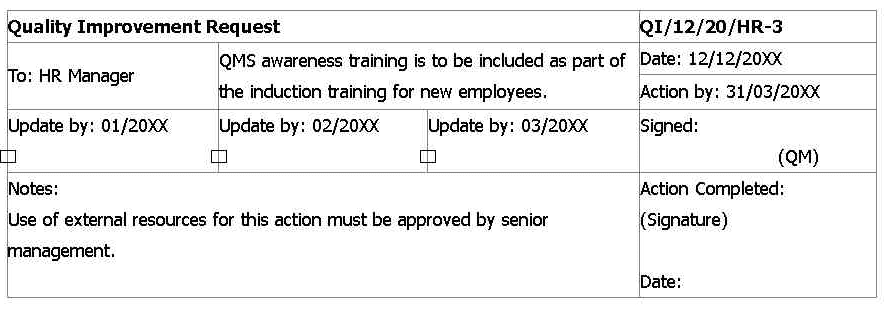
After further auditing, the issues below were found. Select three statements that apply to the term 'audit trail'
Based on the scenario and the concept of an 'audit trail' within the context of ISO 9001, the three statements that apply would likely be:
A . Decisions on improvement action timescales not involving departmental managers. This indicates a lack of involvement and communication with those responsible for implementing the improvements, which is a key part of an effective audit trail1.
B . Evaluation of the results of the improvement action not always documented by the Quality Manager. Proper documentation is essential for an audit trail, as it provides evidence that actions have been evaluated and are effective1.
C . Limited knowledge of the content of Quality Improvement Requests by departmental staff. An audit trail should ensure that all relevant parties are aware of and understand the actions being taken, which is not the case here1.
These points suggest issues with the communication, documentation, and involvement of relevant personnel in the quality management system processes, which are crucial for maintaining an effective audit trail and, by extension, a robust quality management system.
A small cleaning services organisation is about to start work on a hospital cleaning contract for the local Health Trust. You,
as auditor, are conducting a Stage 2 audit to ISO 9001 and review the contract with the Service Manager. The contract
requires that a cleaning plan is produced.
You: "How was the cleaning plan for the contract developed?"
Service Manager: "We have a basic template that covers the materials, labour requirements and cleaning methods to be
employed. Some of that is specified by the customer."
You: "How does the plan deal with locations like the intensive care wards and the operating theatres, which are included
in the contract?"
Service Manager: "The basic plan covers general wards, but we will do more frequent cleaning in those areas if the
hospital requests it."
You: "Are you aware of the regulatory requirements for cleaning standards in hospitals?"
Service Manager: "No. We depend on the hospital to look after that side of things in the contract."
You decide to raise a non-conformity against section 8.2.2.a.1 of ISO 9001.
You decide to raise another non-conformity against section 8.2.4 of ISO 9001 when finding that the
cleaning plan was amended without the agreement of the Health Trust. A different cleaning chemical was
substituted to that specified in the contract. At the follow-up audit, the corrective action proposed was to
"obtain a concession from the Health Trust for use of the new chemical."
Which one of the following options is the reason why you did not accept this action taken?
- Select Question Types you want
- Set your Desired Pass Percentage
- Allocate Time (Hours : Minutes)
- Create Multiple Practice tests with Limited Questions
- Customer Support
Timothy Stewart
14 days agoRachel Thompson
22 days agoChristopher Garcia
1 month agoCrystal Lee
2 months agoPatricia Rogers
3 months agoRobert Thompson
3 months agoTiffany Cook
4 months agoTimothy Cooper
4 months agoLinda Miller
4 months agoMonica Ramirez
5 months agoAndrew Harris
5 months agoJennifer Williams
4 months agoJennifer Clark
4 months agoEric Green
5 months agoRyan Perez
5 months agoDestiny
5 months agoHillary
6 months agoCecilia
6 months agoSena
6 months agoLeslie
6 months agoTanja
7 months agoElena
7 months agoJulie
7 months agoJame
7 months agoCasie
8 months agoWade
8 months agoHelaine
8 months agoElise
8 months agoMuriel
9 months agoArlie
9 months agoMargery
9 months agoCammy
9 months agoMargurite
10 months agoLavonna
10 months agoFiliberto
10 months agoLawrence
10 months agoBeata
11 months agoJerry
11 months agoIvette
11 months agoEzekiel
11 months agoLuis
12 months agoCatarina
12 months agoIra
12 months agoCassie
1 year agoAnnice
1 year agoPamella
1 year agoCherri
1 year agoGeraldine
1 year agoJohana
1 year agoHester
1 year agoIvory
1 year agoEveline
1 year agoTrina
1 year agoJesusita
1 year agoRomana
2 years agoAngelo
2 years agoAvery
2 years agoColette
2 years agoDemetra
2 years agoLashawna
2 years agoGlory
2 years agoShaun
2 years agoAmos
2 years agoStefania
2 years agoIola
2 years agoDesiree
2 years agoSelma
2 years agoRutha
2 years agoLizbeth
2 years agoArdella
2 years agoJenise
2 years agoIvan
2 years agoLavonna
2 years agoWhitley
2 years agoBrandon
2 years agoBernardine
2 years agoLai
2 years agoNoelia
2 years agoSusy
2 years agoVi
2 years agoFlorencia
2 years agoAlecia
2 years agoRory
2 years agoJina
2 years agoMalcolm
2 years agoAudry
2 years agoNada
2 years agoRutha
2 years agoFrancoise
2 years agoCharlene
2 years agoShawnee
2 years agoFernanda
2 years agoLeatha
2 years agoRene
2 years agoAmos
2 years agoLili
2 years ago