
Deal of The Day! Hurry Up, Grab the Special Discount - Save 25% - Ends In 00:00:00 Coupon code: SAVE25
Welcome to Pass4Success

- Free Preparation Discussions

PECB ISO-9001-Lead-Auditor Exam - Topic 7 Question 44 Discussion

XYZ Corporation is an organisation that employs 100 people. As audit team leader, you are conducting acertification audit at Stage 1. When reviewing the quality management system (QMS) documentation, youfind that quality objectives have been set for every employee in the organisation except top management.The Quality Manager complains that this has created a lot of resistance to the QMS, and the Chief Executiveis asking questions about how much it will cost. He asks for your opinion on whether this is the correctmethod of setting objectives.Three months after Stage 1, you return to XYZ Corporation to conduct a Stage 2 certification audit as AuditTeam Leader with one other auditor. You find that the Quality Manager has cancelled the previous qualityobjectives for all employees and replaced them with a single objective for himself. This states that "TheQuality Manager will drive multiple improvements in the QMS in the next year". The Quality Manager indicatesthat this gives him the authority to issue instructions to department managers when quality improvement isneeded. He says that this approach has the full backing of senior management. He shows you the latestQuality Improvement Request that was included in the last management review.After further auditing, the issues below were found. Select three statements that apply to the term 'audit trail'
A) Decisions on improvement action timescales not involving departmental managers. and B) Evaluation of the results of the improvement action not always documented by the Quality Manager. and C) Limited knowledge of the content of Quality Improvement Requests by departmental staff.
D) Quality improvements not aligning with the quality policy.
E) The single quality objective set for the organisation by the Quality Manager.
F) Top management claim not to be aware of the improvement request (QI/12/20/HR-3) initiated by the Quality Manager.

PECB ISO-9001-Lead-Auditor Exam - Topic 7 Question 44 Discussion

Actual exam question for PECB's ISO-9001-Lead-Auditor exam
Question #: 44
Topic #: 7
[All ISO-9001-Lead-Auditor Questions]

XYZ Corporation is an organisation that employs 100 people. As audit team leader, you are conducting a

certification audit at Stage 1. When reviewing the quality management system (QMS) documentation, you

find that quality objectives have been set for every employee in the organisation except top management.

The Quality Manager complains that this has created a lot of resistance to the QMS, and the Chief Executive

is asking questions about how much it will cost. He asks for your opinion on whether this is the correct

method of setting objectives.

Three months after Stage 1, you return to XYZ Corporation to conduct a Stage 2 certification audit as Audit

Team Leader with one other auditor. You find that the Quality Manager has cancelled the previous quality

objectives for all employees and replaced them with a single objective for himself. This states that "The

Quality Manager will drive multiple improvements in the QMS in the next year". The Quality Manager indicates

that this gives him the authority to issue instructions to department managers when quality improvement is

needed. He says that this approach has the full backing of senior management. He shows you the latest

Quality Improvement Request that was included in the last management review.
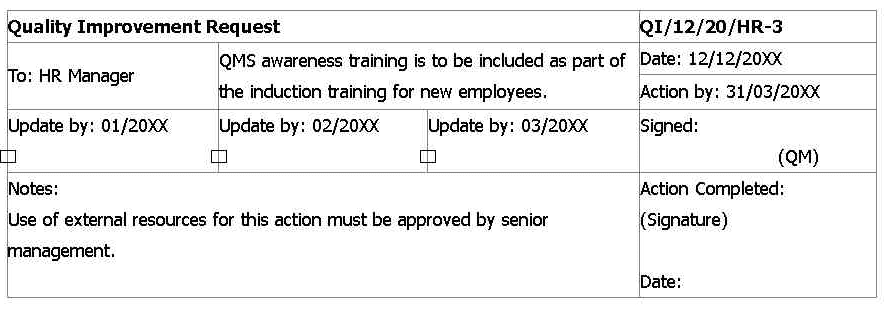
After further auditing, the issues below were found. Select three statements that apply to the term 'audit trail'

Show Suggested Answer Hide Answer
Suggested Answer: A, B, C

Based on the scenario and the concept of an 'audit trail' within the context of ISO 9001, the three statements that apply would likely be:

A . Decisions on improvement action timescales not involving departmental managers. This indicates a lack of involvement and communication with those responsible for implementing the improvements, which is a key part of an effective audit trail1.

B . Evaluation of the results of the improvement action not always documented by the Quality Manager. Proper documentation is essential for an audit trail, as it provides evidence that actions have been evaluated and are effective1.

C . Limited knowledge of the content of Quality Improvement Requests by departmental staff. An audit trail should ensure that all relevant parties are aware of and understand the actions being taken, which is not the case here1.

These points suggest issues with the communication, documentation, and involvement of relevant personnel in the quality management system processes, which are crucial for maintaining an effective audit trail and, by extension, a robust quality management system.


Contribute your Thoughts:

0/2000 characters
I definitely recall that top management should be aware of all improvement requests. The fact that they claim ignorance about QI/12/20/HR-3 seems like a significant oversight.
upvoted 0 times
...
Tula
5 days ago
I feel uncertain about whether the Quality Manager's authority to issue instructions aligns with the audit trail concept. Shouldn't there be more involvement from departmental managers?
upvoted 0 times
...
Juliana
10 days ago
This situation reminds me of a practice question where we had to identify gaps in communication between management and staff. I think the limited knowledge of departmental staff is a key issue here.
upvoted 0 times
...
Tomoko
15 days ago
I remember discussing the importance of having clear objectives for all levels of management, but I'm not sure if the single objective for the Quality Manager is sufficient.
upvoted 0 times
...

Save Cancel