
Free Preparation Discussions
 MENU
MENU
Nokia 4A0-D03 Exam Questions
- Topic 1: EVPN on SR Linux: Covers the fundamentals of EVPN in the data center, including its MP-BGP/VXLAN building blocks, terminology, route types, and basic configuration of BGP and VXLAN tunnels on SR Linux.
- Topic 2: Layer 2 EVPN: Covers configuring and verifying L2 EVPN using MAC-VRFs, including MAC protection, mobility, duplication monitoring, and Proxy-ARP for IP anti-spoofing.
- Topic 3: L3 EVPN: Covers L3 EVPN Asymmetric and Symmetric models using IRB interfaces and anycast gateways, along with PE-CE BGP peering configuration and verification.
- Topic 4: L2 and L3 EVPN Multi-homing: Covers multi-homing concepts such as Ethernet Segments, Designated Forwarder election, Local-Bias, All-Active/Single-Active redundancy, and L3 EVPN IP aliasing.
- Topic 5: DCI And 7750 SR interoperability: Covers data center interconnect options (gateway-less and gateway-based) and interoperability of SR Linux L2/L3 EVPN with 7750 SR MPLS-based EVPN-VPLS and IP-VPN solutions.
Free Nokia 4A0-D03 Exam Actual Questions
Note: Premium Questions for 4A0-D03 were last updated On Sep. 20, 2026 (see below)
Consider the exhibit.
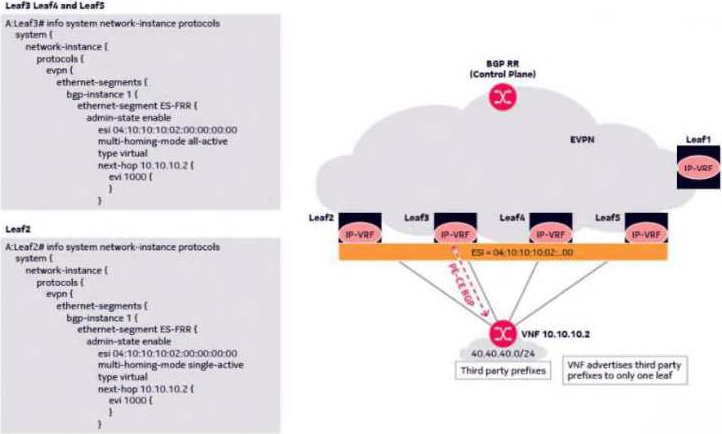
All IP-VRFs are configured properly and are operational.
Which of the following statements is FALSE?
Comprehensive and Detailed 150 to 250 words of Explanation From [SR Linux EVPN and Data Center Interconnect/Course Guide/topics]:
The scenario describes Layer 3 EVPN multi-homing with an IP-VRF service and an external CE VNF advertising the 40.40.40.0/24 prefix through BGP. A DF election can occur among the leaf routers participating in the Ethernet Segment, and the active/primary forwarding node is used for the relevant service behavior. The AD per EVI route can participate in identifying service-level reachability for the Ethernet Segment, and the prefix traffic follows the valid advertised path toward the CE VNF. Because Leaf3 has the BGP connection to the CE VNF, traffic for 40.40.40.0/24 is forwarded through Leaf3. Option B is false because it incorrectly states that all connected leaf routers will use single-active redundancy. The exhibit and answer context indicate a more specific forwarding/primary selection for the service, not a blanket statement that every connected leaf operates using single-active redundancy. In L3 multi-homing, redundancy behavior depends on the ES mode, prefix advertisement, next-hop association, and CE connectivity. The forwarding decision for the customer prefix is tied to the active/valid route advertisement, not to every leaf uniformly acting as single-active. Reference: L3 EVPN multi-homing, DF election, AD per EVI role, PE-CE BGP prefix forwarding.
A host is connected to multiple PEs through multi-homing.
Which of the following is NOT a function of the EVPN route-type 4 route?
Comprehensive and Detailed 150 to 250 words of Explanation From [SR Linux EVPN and Data Center Interconnect/Course Guide/topics]:
EVPN route type 4 is the Ethernet Segment route. Its core role is to advertise Ethernet Segment membership so that PEs attached to the same multi-homed segment can discover each other. This discovery is essential for multi-homing procedures such as DF election, split-horizon behavior, and redundancy handling. When multiple PEs advertise the same ESI, the EVPN control plane can build the candidate set of PEs that participate in that Ethernet Segment. This enables DF election for BUM forwarding and supports the correct interpretation of the segment's redundancy model. The incorrect statement is option C. The election algorithm itself is not the basic function of the route type 4 advertisement in the way the question frames it. The route type is primarily about Ethernet Segment discovery and participation; the algorithmic decision process is derived from configured DF election behavior and candidate information, not from route type 4 acting as a generic algorithm identifier. Therefore, route type 4 enables DF procedures, but it is not described as the mechanism that identifies the election algorithm type. Reference: EVPN RT-4 Ethernet Segment route, DF election, multi-homing discovery.
Consider the exhibit.

dcgw10 is a Nokia 7750SR and is used as the integrated gateway.
Which of the following is NOT configured in VPLS 100 on dcgw10?
Comprehensive and Detailed 150 to 250 words of Explanation From [SR Linux EVPN and Data Center Interconnect/Course Guide/topics]:
For Layer 2 data center interconnect using an integrated gateway, VPLS 100 on the Nokia 7750 SR represents the WAN-side Layer 2 VPN service. The VPLS requires an EVI because EVPN uses the EVI to identify the L2 service instance in the control plane. It also requires BGP EVPN signaling with the appropriate route targets so the local and remote service instances can import the correct EVPN routes. Because the service is transported across the WAN, the BGP/EVPN instance must be associated with the MPLS transport tunnels toward the remote gateway, dcgw20. A VXLAN instance with a VNI is not configured in the 7750 SR VPLS 100 for this integrated WAN gateway service. The VXLAN/VNI mapping is used inside the SR Linux data center fabric where MAC-VRF services are transported over VXLAN. On the WAN side, the VPLS service is carried using MPLS/EVPN mechanisms, not a VXLAN VNI configured directly under the VPLS. Reference: integrated gateway DCI, L2 EVPN/VPLS interworking, EVI and route-target operation.
Which of the following statements about utilizing asymmetric routing in an L3 EVPN network is FALSE?
Comprehensive and Detailed 150 to 250 words of Explanation From [SR Linux EVPN and Data Center Interconnect/Course Guide/topics]:
Asymmetric routing relies heavily on host MAC/IP information because the ingress PE performs routing into the destination subnet and then sends the frame across the overlay using the destination MAC-VRF/VNI. This means PEs require enough ARP and MAC/IP binding information to forward traffic toward remote hosts correctly. If a host has multiple IP addresses on the same interface, separate EVPN route type 2 advertisements may be needed to communicate each IP-to-MAC binding. The ingress and egress PEs participate in MAC and IP forwarding across the end-to-end service path, but the forwarding responsibilities differ by direction and stage. The false statement is option C. The statement says all MAC-VRFs connected to the L3 EVPN network must exist on each PE, but that is not the correct requirement in this question's verified answer set. In practical EVPN designs, the exact MAC-VRF placement depends on whether the service is implemented as asymmetric, symmetric, interface-less, or interface-ful routing. Here, the course answer marks the universal MAC-VRF requirement as false. Reference: asymmetric L3 EVPN routing, RT-2 MAC/IP advertisements, ARP and MAC forwarding behavior.
Which of the following statements about the decoupled gateway-based data center interconnect solution is FALSE?
Comprehensive and Detailed 150 to 250 words of Explanation From [SR Linux EVPN and Data Center Interconnect/Course Guide/topics]:
In a decoupled gateway-based DCI design, the data center border leaf and the WAN PE are separate devices. Traffic between them can be identified using VLAN tags, allowing different data center EVPN services to be mapped to corresponding WAN VPN services. This architecture provides a clean operational boundary: the border leaf remains aligned with the data center EVPN/VXLAN fabric, while the WAN PE handles WAN VPN transport, QoS, security policy, and service interconnection. The separation gives a strong demarcation point for troubleshooting and administrative control. Option D is false because the WAN PE does not maintain an MP-BGP EVPN peering session with the data center route reflector. In the decoupled model, the route reflector remains part of the data center EVPN control plane, while the WAN PE exchanges routing or service information with the border leaf through the local handoff model. Direct WAN PE-to-data-center-RR peering would blur the separation that defines the decoupled design and would make the WAN PE part of the data center EVPN overlay control plane, which is not the intended architecture. Reference: decoupled gateway DCI, VLAN handoff, WAN VPN mapping, security/QoS demarcation, route-reflector separation.
- Select Question Types you want
- Set your Desired Pass Percentage
- Allocate Time (Hours : Minutes)
- Create Multiple Practice tests with Limited Questions
- Customer Support
Ryan Mitchell
3 days agoRuqayyah Mirza
15 days agoIngrid Kristiansen
1 month agoSusan Smith
1 month agoSunita Shah
2 months agoPaul Evans
2 months agoTakashi Hoang
2 months ago