
Free Preparation Discussions
 MENU
MENU
Nokia 4A0-D03 Exam - Topic 3 Question 2 Discussion
Topic #: 3
Consider the exhibit.
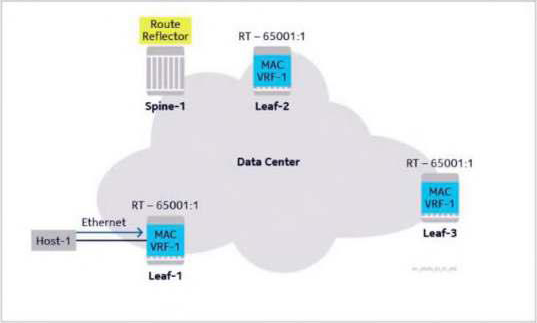
All three of the leafs have a MP-BGP EVPN session to the route-reflector Spine-1. Leaf-1, Leaf-2 and Leaf-3 have existing instances of an L2 EVPN named MAC VRF-1. Host-1 has just sent its first Ethernet frame into MAC VRF-1 on Leaf-1.
Which of the following steps is FALSE?
Comprehensive and Detailed 150 to 250 words of Explanation From [SR Linux EVPN and Data Center Interconnect/Course Guide/topics]:
When Host-1 sends its first Ethernet frame into MAC VRF-1, Leaf-1 performs normal local data-plane MAC learning on the access interface and installs Host-1's MAC address into the MAC forwarding table. In an L2 EVPN MAC-VRF, host MAC reachability is then advertised into the EVPN control plane using EVPN route type 2, the MAC/IP Advertisement route. Route type 5 is not used for host MAC advertisement; RT-5 is used for IP prefix advertisement in Layer 3 EVPN services. Therefore, option B is false because it incorrectly states that Leaf-1 generates an EVPN RT-5 update with the host MAC address. In this topology, Leaf-1 sends the correct EVPN update to the route reflector, Spine-1. The route reflector then reflects the update to Leaf-2 and Leaf-3, and those remote leaves import the route if the route target matches their MAC VRF-1 import policy. The route target controls service membership, ensuring that only PEs participating in the same EVPN instance import the MAC route. Reference: L2 EVPN MAC learning, RT-2 MAC/IP advertisement, route-reflector distribution, route-target import.
Odette
4 days agoPhil
9 days agoTamesha
14 days agoCyril
20 days agoElmer
25 days agoBecky
30 days agoGladys
1 month agoTheola
1 month agoCandida
2 months ago