
 MENU

Click the exhibit.
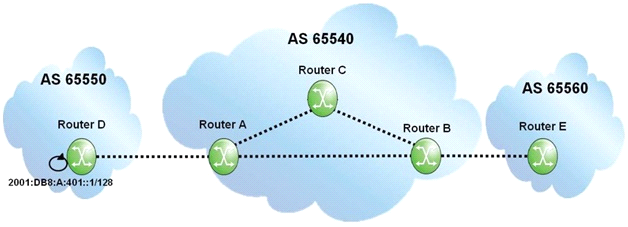
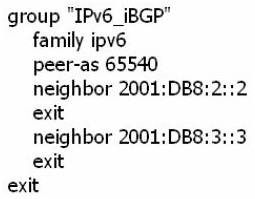
Assume all router-IDs are properly configured, and IPv6 link-local addresses are used to establish all eBGP sessions. Given the following iBGP configuration on router A, what is the Next Hop for prefix 2001:DB8:A:401::1/128 on router B?
Suggested Answer: C
Get Premium 4A0-C04 Questions
as Interactive Web-Based Practice Test or PDF
Real Exam Format
Detailed Explanations
Instant Access
Get Your Practice Test
11 comments · newest first
MI
Millie
12 months ago
I disagree, the link-local is the right choice here.
SH
Sherron
12 months ago
Surprised it's not the global address of D, thought that was the standard.
DE
Denise
12 months ago
No way, it's the link-local for sure!
JE
Jerry
1 year ago
I think it's actually the global address of router A.
KA
Kattie
1 year ago
It's definitely the IPv6 link-local address of router D towards A.
ES
Essie
1 year ago
I’m leaning towards the link-local address of router D, but I could be mixing it up with another scenario I studied.
KE
Keneth
1 year ago
I remember practicing a similar question where the Next Hop was determined by the closest router's address. Could it be router A's link-local address?
AR
Arletta
1 year ago
I think the Next Hop should be the IPv6 link-local address of router D towards router A, but I'm not entirely sure.
SH
Shantay
1 year ago
I feel like the global addresses are usually the answer, but in this case, since it's iBGP, it might be different.
MA
Marshall
1 year ago
Hmm, I'm not entirely sure about the difference between users, groups, and application roles in this context. I'll have to think this through carefully.
EL
Elmira
1 year ago
I think the key here is understanding that a vulnerability is a weakness that can be taken advantage of, while a threat is the thing that actually exploits that weakness. So a threat exploits a vulnerability - that's the relationship between the two. I'm confident that A is the correct answer.