
 MENU
MENU
Exhibit.
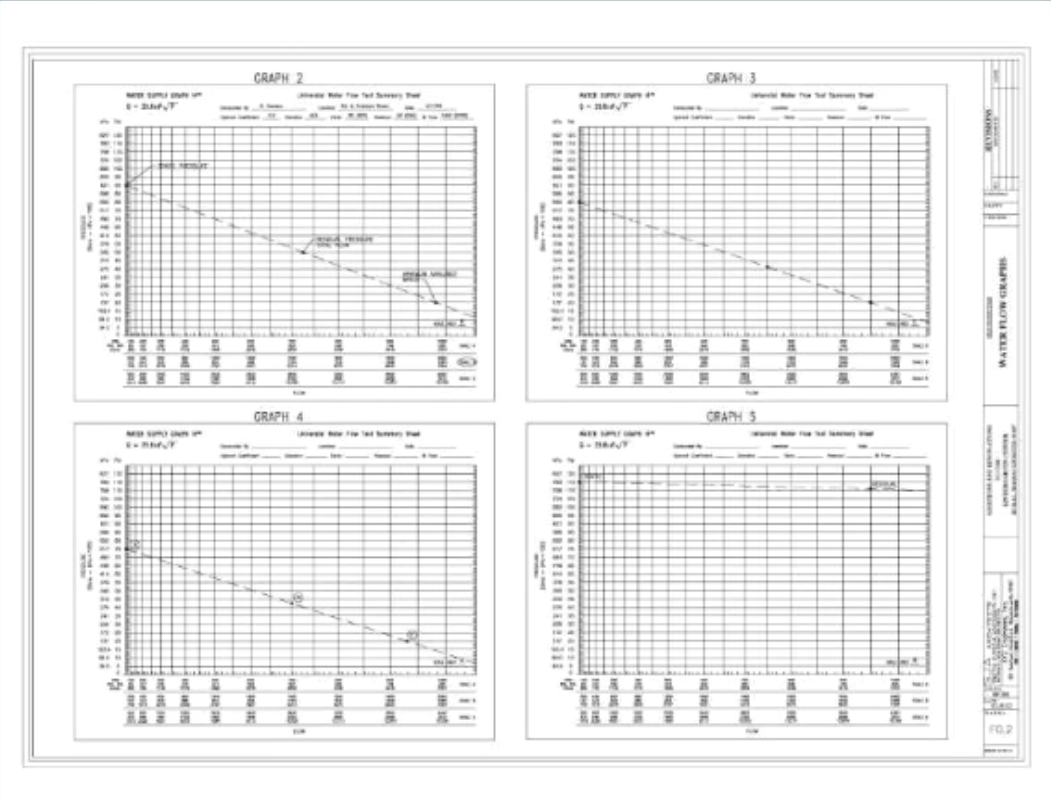
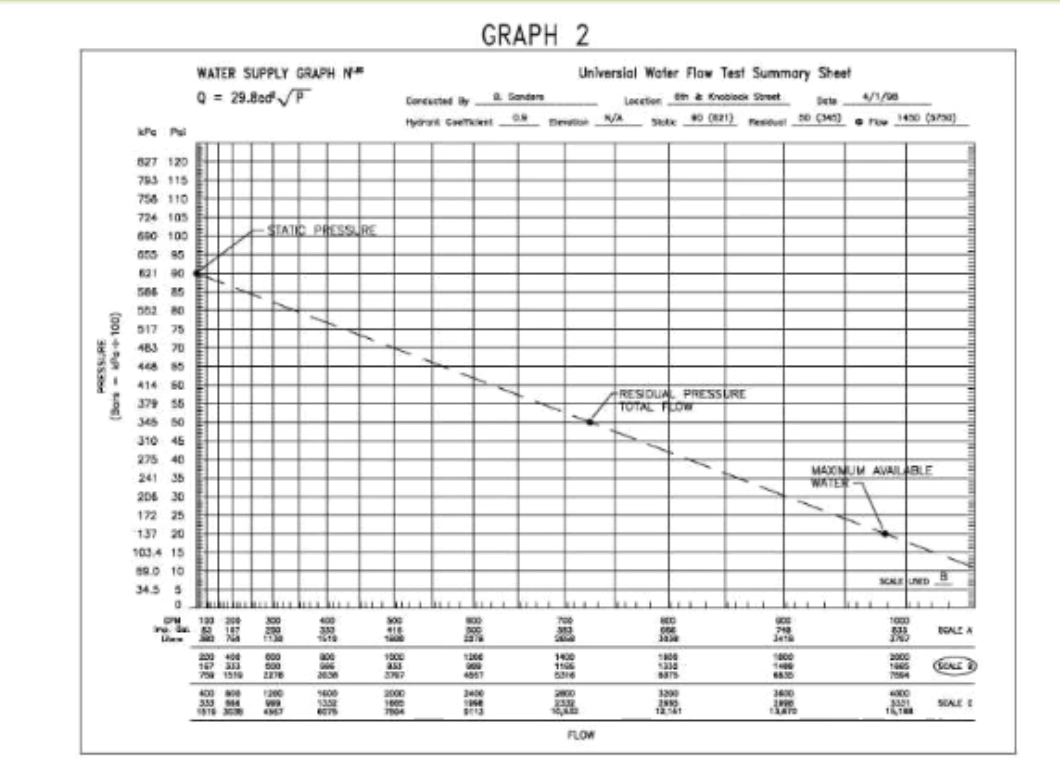
What is the approximate maximum available water indicated on supply graph 2 on plan F0.2?
The graph labeled as 'Water Supply Graph N2' presents a standard water supply flow test summary, which indicates the relationship between pressure (psi or kPa) and flow (gpm or Lpm) for a specific system or hydrant.
How to interpret the graph:
Static Pressure:
This is the pressure measured when there is no water flowing, shown at the highest point on the left side of the graph (indicated as approximately 100 psi or 689 kPa in this case).
Residual Pressure:
This is the pressure available when water is flowing at a specific rate. The residual pressure line decreases as flow increases, indicating that the pressure reduces when water is drawn from the system.
Maximum Available Water:
The maximum available water is the point where the system can deliver the highest possible flow (gpm) before the residual pressure reaches a critical minimum level, indicating the system's limit.
Flow at Maximum Available Water:
In this specific graph, the point marked as Maximum Available Water is where the flow reaches 1,980 gpm (7,495 Lpm). This is derived by following the flow axis (horizontal axis) until it intersects with the Maximum Available Water curve on the graph.
Why the Correct Answer is C (1,980 gpm):
By following the plotted line for residual pressure, the graph shows that the maximum flow attainable from the system is 1,980 gpm (7,495 Lpm) before pressure drops too low. This value represents the system's maximum water supply capacity under normal operating conditions.
This analysis is consistent with the flow rates displayed on the graph and matches the key markers labeled, which indicate the operational limits of the system.
NFPA Relevance:
In fire protection and water supply systems, understanding the maximum available water flow is essential for ensuring that sufficient water can be delivered in the event of a fire. This calculation is particularly relevant in the context of NFPA 20 (Standard for the Installation of Stationary Pumps for Fire Protection) and NFPA 25 (Standard for the Inspection, Testing, and Maintenance of Water-Based Fire Protection Systems), as these standards require that water supply systems are capable of delivering adequate flow to suppression systems under expected fire conditions.