
 MENU
MENU
Refer to the exhibit.
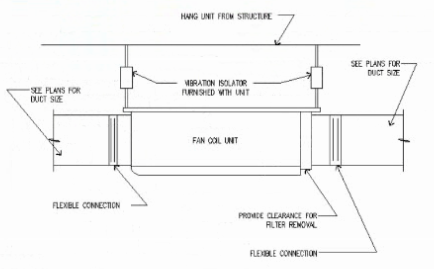
Refer to the exhibit.
What is the purpose of the flexible connection in the fan coil shown?
Understanding the Diagram
The detail shows a fan coil unit suspended from the structure, with:
Vibration isolators at the hanging rods to limit mechanical vibration transfer to the structure.
Flexible duct connections between the fan coil unit and the rigid ductwork.
Purpose of Flexible Duct Connections
Flexible connections in HVAC duct systems are designed to:
Prevent transmission of vibration and sound from the mechanical equipment (fan coil unit) into the rigid ductwork and building.
Compensate for small misalignments between the ductwork and equipment.
Accommodate minor thermal expansion/contraction movements.
Key Function in This Context: Fan coil units contain fans that create vibration and noise. Without a flexible connection, this vibration would travel directly through the rigid ductwork into occupied spaces, increasing noise levels.
Why Other Options Are Incorrect:
A . To provide a field point of connection --- While the flexible connector does connect ducts, its purpose is not just convenience; it is specifically for vibration/sound isolation.
B . To insulate against heat transfer --- This is done with thermal duct insulation, not flexible connectors.
D . To transition from flange to desired duct size --- Transitions are made using sheet metal fittings, not flexible connectors.
NCARB ARE 5.0 PDD Study Guide Reference:
Content Area: Integration of Building Materials & Systems --- Mechanical Systems and Acoustics
Sources:
Mechanical and Electrical Equipment for Buildings (MEEB) --- Vibration Control in Mechanical Systems
Architectural Graphic Standards --- Flexible Duct Connections for Noise and Vibration Isolation
ASHRAE Handbook --- HVAC Applications, Chapter on Sound and Vibration Control
Key Point: Flexible connectors in ductwork break the direct mechanical path for vibration and sound, reducing noise transfer from fans to occupied areas.