
 MENU
MENU
You have an Azure Subscription that contains the virtual networks Shown in the following table.
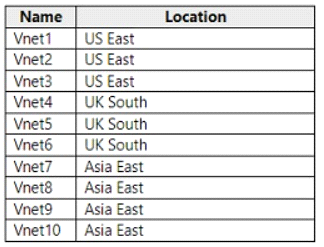
All the virtual networks are peered. Each virtual network contains nine virtual machines.
You need to configure secure RDP corrections to the virtual machines by using Azure Boston.
Whit is the minimum number of Bastion nests required?
Suggested Answer: C
Get Premium AZ-104 Questions
as Interactive Web-Based Practice Test or PDF
Real Exam Format
Detailed Explanations
Instant Access
Get Your Practice Test
13 comments · newest first
CA
Carlee
11 months ago
Nah, 9 seems excessive for just RDP access!
SH
Sherita
11 months ago
I think 3 is a safe bet, just to be cautious.
MA
Marguerita
12 months ago
Wait, are you sure? What if they need separate access?
SO
Socorro
12 months ago
Totally agree, one Bastion can handle it!
JA
Jacklyn
1 year ago
You only need 1 Bastion host for all the VMs.
SE
Sena
1 year ago
I thought it was nine because each virtual machine needs its own Bastion, but that seems too high. Maybe I misread the question?
SE
Selma
1 year ago
I practiced a similar question, and I feel like the answer might be one, but I’m not completely confident about the peering aspect.
KE
Kerrie
1 year ago
I'm not entirely sure, but I remember something about needing a Bastion host for each virtual network. Could it be three?
JE
Jestine
1 year ago
I think we only need one Bastion host for all the virtual networks since they are peered, right?
TA
Tammara
1 year ago
This looks like a straightforward NVMe configuration question. I'll need to remember the key NVMe objects and how they relate to storage access.
RO
Rosalind
1 year ago
Ah, I see. Using a struct is the cheaper option compared to deploying a new contract. That's a good point to keep in mind for efficiency.
GE
German
1 year ago
I'm confident the answer is a firewall. That's the best hardware-based solution to restrict unauthorized access to the network.
SA
Sam Boutros
4 years ago
https://learn.microsoft.com/en-us/azure/bastion/vnet-peering:
• “If you have an Azure Bastion host configured in one virtual network (VNet), it can be used to connect to VMs deployed in a peered VNet without deploying an additional bastion host”
• “Global virtual network peering: Connecting virtual networks across Azure regions.”
https://learn.microsoft.com/en-us/azure/bastion/configuration-settings#instance:
• “Each instance can support 20 concurrent RDP connections and 40 concurrent SSH connections for medium workloads”
So, 50 instances X 20 RDP connections each == 1,000 RDP connections per Bastion.
Conclusion: a single Bastion can be configured to support RDP access to 90 VMs across 10 VNets in 3 regions when they’re all peered via “global peering”
So, Answer should be A. 1 IMHO