
 MENU
MENU
Exhibit.
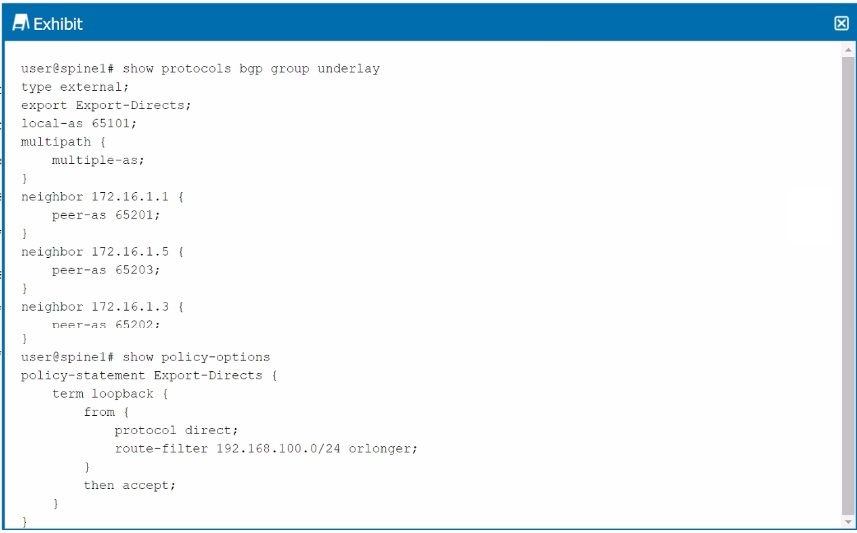
Referring to the exhibit, the spinel device has an underlay BGP group that is configured to peer with its neighbors' directly connected interfaces. Which two statements are true in this scenario? (Choose two.)
Understanding BGP Configuration in the Exhibit:
The exhibit shows a BGP configuration on spine1 with a group named underlay, configured to peer with directly connected interfaces of other devices in the network.
Multipath multiple-as: This statement allows the router to install multiple paths in the routing table for routes learned from different ASes, facilitating load balancing.
Key Statements:
A . The multihop statement is not required to establish the underlay BGP sessions: In this case, the BGP peers are directly connected (as indicated by their neighbor IP addresses), so the multihop statement is unnecessary. Multihop is typically used when BGP peers are not directly connected and packets need to traverse multiple hops.
D . Load balancing for the underlay is configured correctly: The multipath { multiple-as; } statement in the configuration enables load balancing across multiple paths from different autonomous systems, which is appropriate for underlay networks in data center fabrics.
Incorrect Statements:
C . The multihop statement is required to establish the underlay BGP sessions: This is incorrect because the peers are directly connected, making the multihop statement unnecessary.
B . Load balancing for the underlay is not configured correctly: This is incorrect because the configuration includes the necessary multipath settings for load balancing.
Data Center Reference:
BGP configurations in EVPN-VXLAN underlay networks are crucial for ensuring redundancy, load balancing, and efficient route propagation across the data center fabric.