
Deal of The Day! Hurry Up, Grab the Special Discount - Save 25% - Ends In 00:00:00 Coupon code: SAVE25
Welcome to Pass4Success

- Free Preparation Discussions

Juniper JN0-481 Exam - Topic 1 Question 8 Discussion

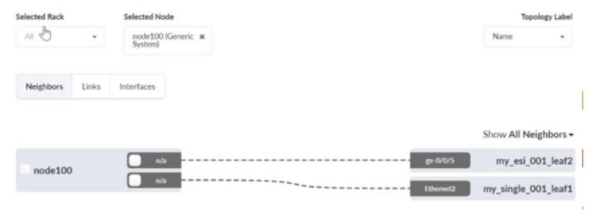
What is correct about the selected device shown in the exhibit?
C) It is an internal generic system.
A) It is a peer switch.
B) It is an external generic system.
D) It is an access switch.

Juniper JN0-481 Exam - Topic 1 Question 8 Discussion

Actual exam question for Juniper's JN0-481 exam
Question #: 8
Topic #: 1
[All JN0-481 Questions]

What is correct about the selected device shown in the exhibit?

Show Suggested Answer Hide Answer
Suggested Answer: C

The exhibit shows node100 (Generic System) selected, with links from that generic system to two fabric leaf switches (for example, a leaf participating in an ESI pair and another leaf node). In Apstra 5.1, a Generic System represents an endpoint that is not managed as a network device by Apstra (such as a server, appliance, or host), but it is still modeled so Apstra can apply interface intent (LAG vs single link), connectivity templates, and virtual network attachments.

Because the device is shown as a generic system connected on leaf-facing ports inside the fabric topology, this aligns with an internal generic system. Internal generic systems are used for servers or endpoints that reside ''inside'' the rack/fabric context and consume leaf switch ports as access-facing connections. This is the common representation for endpoints in EVPN-VXLAN data center designs, where the leaf switches provide the VLAN/VNI mapping and, if required, IRB gateway services within the tenant VRF (routing zone).

An external generic system is typically used for devices outside the fabric boundary---most commonly external routers, firewalls, or upstream networks attached at border leafs---where the intent is external connectivity rather than server access. The selected node is neither a peer switch nor an access switch (those are network infrastructure roles), and the UI explicitly labels it as a Generic System, confirming the correct classification as an internal generic system.


Contribute your Thoughts:

0/2000 characters
Ressie
3 days ago
I agree, access switch makes sense. Supports end devices.
upvoted 0 times
...
Twana
8 days ago
I think it's an access switch. Looks like it connects users.
upvoted 0 times
...
Onita
14 days ago
Not so sure about that, looks like a generic system to me.
upvoted 0 times
...
Derrick
19 days ago
100% agree, it's an access switch.
upvoted 0 times
...
Ma
24 days ago
Wait, is it really a peer switch?
upvoted 0 times
...
Dell
2 months ago
I thought it was an internal generic system.
upvoted 0 times
...
Thora
3 months ago
Definitely an access switch!
upvoted 0 times
...
Leonida
3 months ago
I’m leaning towards option D, but I wish I had more clarity on what makes an access switch distinct from the others.
upvoted 0 times
...
Jesusita
3 months ago
I feel like I studied about internal and external systems, but I’m confused about how to identify them just from the image.
upvoted 0 times
...
Rolland
3 months ago
This looks similar to a practice question I did about access switches, but I can't recall the specific features that differentiate them.
upvoted 0 times
...
Marleen
4 months ago
I think I remember that a peer switch connects to other switches, but I'm not entirely sure if that's what this device is.
upvoted 0 times
...

Save Cancel