
 MENU

[Exhibit]
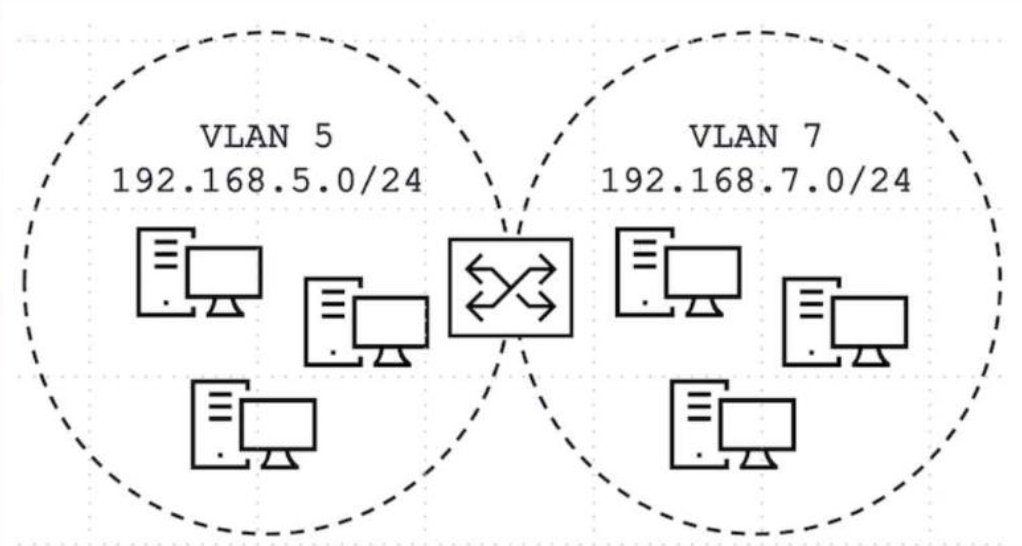
Click the Exhibit button.
Devices on VLAN 5 and VLAN 7 need to communicate with each other.
Referring to the exhibit, what will satisfy this requirement?
VLAN 5 and VLAN 7 are two entirely separate Layer 2 broadcast domains, each with its own distinct IP subnet, and devices in one VLAN can never reach devices in the other through switching alone --- Layer 3 routing between the two subnets is mandatory for any inter-VLAN communication to occur, regardless of how the VLANs are configured at Layer 2. On a single EX Series switch, the correct and standard mechanism for enabling this routing without an external router is to create one integrated routing and bridging (IRB) logical interface for each VLAN, assign each IRB the appropriate gateway IP address for its respective subnet (192.168.5.1 for VLAN 5's irb.5 and 192.168.7.1 for VLAN 7's irb.7, for example), and ensure routing is active on the switch so that traffic arriving at one IRB's gateway address destined for the other VLAN's subnet is routed internally between the two IRB interfaces. Attempting to bind a single family inet interface with two distinct subnet addresses via secondary addressing conflates two separate broadcast domains onto one Layer 3 interface incorrectly and is not how VLAN routing is architected in Junos. Spanning tree exists purely to prevent Layer 2 loops and has no routing function whatsoever, so configuring it cannot enable inter-VLAN reachability. Placing both VLANs on a single trunk with Multiple VLAN Registration Protocol (MVRP) only automates VLAN membership propagation across trunk links; it does not provide any Layer 3 routing capability between the VLANs either. Reference topics: Junos Enterprise Switching -- Routing VLANs, Configuring IRB Interfaces for Inter-VLAN Routing.
Currently there are no comments in this discussion, be the first to comment!