Deal of The Day! Hurry Up, Grab the Special Discount - Save 25% - Ends In 00:00:00 Coupon code: SAVE25
Welcome to Pass4Success

- Free Preparation Discussions

Juniper JN0-351 Exam - Topic 1 Question 54 Discussion

Actual exam question for Juniper's JN0-351 exam
Question #: 54
Topic #: 1
[All JN0-351 Questions]

Exhibit

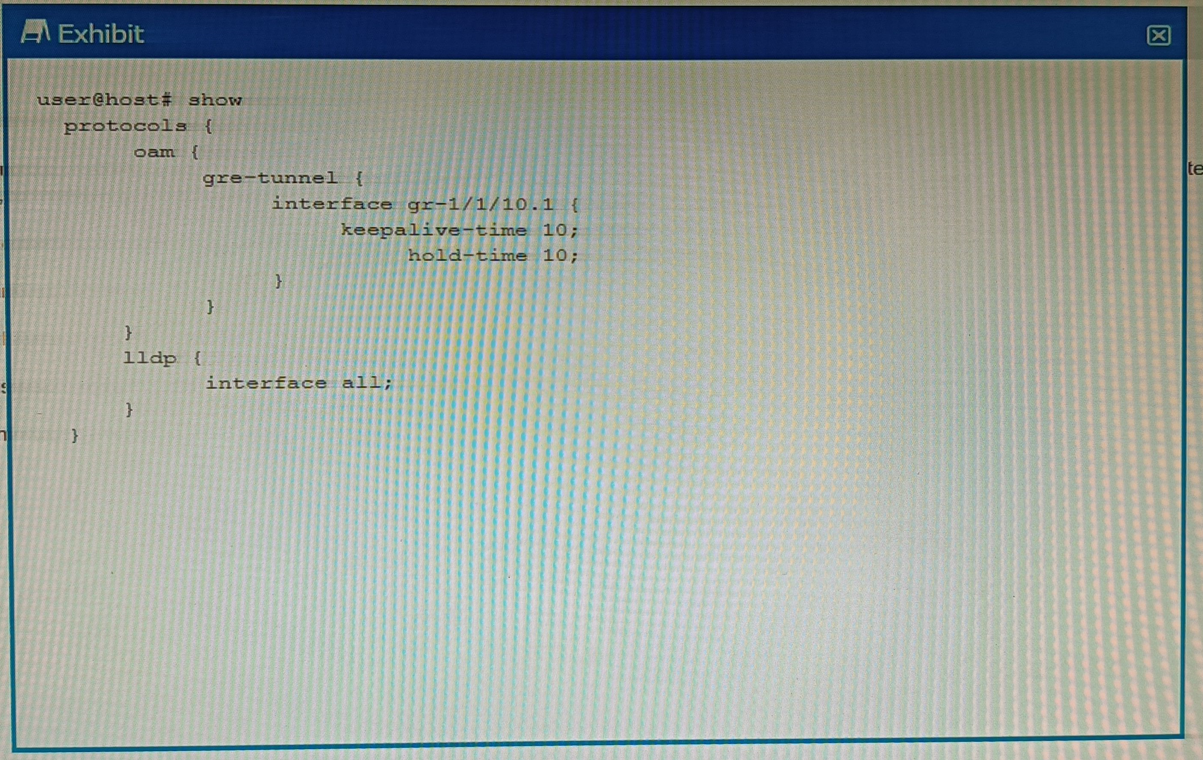
You have configured a GRE tunnel. To reduce the risk of dropping traffic, you have configured a keepalive OAM probe to monitor the state of the tunnel; however, traffic drops are still occurring.

Referring to the exhibit, what is the problem?

Show Suggested Answer Hide Answer
Suggested Answer: D

A keepalive OAM probe is a mechanism that can be used to monitor the state of a GRE tunnel and detect any failures in the tunnel path. A keepalive OAM probe consists of sending periodic packets from one end of the tunnel to the other and expecting a reply.If no reply is received within a specified time, the tunnel is considered down and the line protocol of the tunnel interface is changed to down1.

To configure a keepalive OAM probe for a GRE tunnel, you need to specify two parameters: the keepalive-time and the hold-time. The keepalive-time is the interval between each keepalive packet sent by the local router.The hold-time is the maximum time that the local router waits for a reply from the remote router before declaring the tunnel down2.

According to the Juniper Networks documentation, the hold-time value must be two times the keepalive-time value for a GRE tunnel2. This is because the hold-time value must account for both the round-trip time of the keepalive packet and the processing time of the remote router. If the hold-time value is too small, it may cause false positives and unnecessary tunnel flaps.

In the exhibit, the configuration shows that the keepalive-time is set to 10 seconds and the hold-time is set to 15 seconds for the gr-1/1/10.1 interface. This means that the local router will send a keepalive packet every 10 seconds and will wait for 15 seconds for a reply from the remote router. However, this hold-time value is not two times the keepalive-time value, which violates the recommended configuration. This may cause traffic drops if the remote router takes longer than 15 seconds to reply.

Therefore, option D is correct, because the hold-time value must be two times the keepalive-time value for a GRE tunnel.Option A is incorrect, because BFD is not required for GRE tunnels; BFD is another protocol that can be used to monitor tunnels, but it is not compatible with GRE keepalives3.Option B is incorrect, because the ''event link-adjacency-loss'' option is not related to GRE tunnels; it is an option that can be used to trigger an action when a link goes down4.Option C is incorrect, because LLDP does not need to be removed from the gr-1/1/10.1 interface; LLDP is a protocol that can be used to discover neighboring devices and their capabilities, but it does not interfere with GRE tunnels5.


1:Configuring Keepalive Time and Hold time for a GRE Tunnel Interface2: keepalive | Junos OS | Juniper Networks3: Configuring Bidirectional Forwarding Detection4: event link-adjacency-loss | Junos OS | Juniper Networks5: Understanding Link Layer Discovery Protocol

Contribute your Thoughts:

0/2000 characters

Currently there are no comments in this discussion, be the first to comment!


Save Cancel