
New Year Sale 2026! Hurry Up, Grab the Special Discount - Save 25% - Ends In 00:00:00 Coupon code: SAVE25
Welcome to Pass4Success

- Free Preparation Discussions

ISTQB ATM Exam - Topic 1 Question 2 Discussion

Actual exam question for ISTQB's ATM exam
Question #: 2
Topic #: 1
[All ATM Questions]

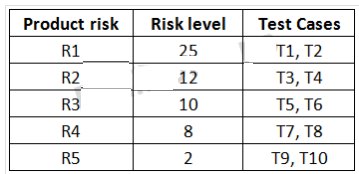
Assume that you are the Test Manager for a small insurance application development project. You have decided to adopt a risk-based testing strategy: 5 product risks (R1, R2, R3, R4, R5)

have been identified and their levels of risk have been assessed. 10 test cases (T1, ..., T10) have been designed to cover all the product risks.

The following table shows the risk level and the test cases associated to the identified product risks (higher risk level means higher risk):

You are not confident with the assessment of the risk level and you suspect that it will be possible to find high-priority bugs in low-risk areas.
Furthermore the period for test execution is very short. Your goal is to test all the product risks in a risk-based way, while assuring that each product risk gets at least some amount of testing. Which of the following answers describes the best test execution schedule in this scenario? K3 2 credits

Show Suggested Answer Hide Answer
Suggested Answer: B

Contribute your Thoughts:

0/2000 characters
Alex
4 months ago
I’d go with option B for a balanced approach.
upvoted 0 times
...
Leonida
4 months ago
Gotta cover all risks, but I’d focus on T1, T2, T3 first.
upvoted 0 times
...
Jerry
4 months ago
Surprised that we’re not considering exploratory testing too!
upvoted 0 times
...
Alecia
4 months ago
I disagree, sometimes low-risk areas have hidden bugs.
upvoted 0 times
...
Jenifer
5 months ago
I think prioritizing high-risk tests first makes sense.
upvoted 0 times
...
Pete
5 months ago
I think option D might be interesting because it starts with some low-risk tests, which could help uncover unexpected issues, but I'm not completely confident in that approach.
upvoted 0 times
...
Laurel
5 months ago
I feel like we should definitely test all product risks, but I'm worried that just going through them in order might miss some critical bugs in lower-risk areas.
upvoted 0 times
...
Justine
5 months ago
I'm not entirely sure about the best order for the test cases, but I think prioritizing higher risk areas first makes sense.
upvoted 0 times
...
Matt
5 months ago
I remember a practice question where we had to balance risk and time constraints. Maybe option B could work since it mixes high and low-risk tests?
upvoted 0 times
...
Jovita
5 months ago
This is a good question. I'm going to eliminate the options that don't seem relevant and then decide between the remaining ones.
upvoted 0 times
...
Alexis
5 months ago
I'm a bit confused on the specifics of how MongoDB handles empty inserts. I'll need to review the documentation to make sure I understand this properly.
upvoted 0 times
...
Graham
5 months ago
Okay, let's see. Modifying the account kind or replication settings could help with resiliency, but I'm not sure if that alone would meet the performance needs. Implementing Azure Site Recovery or configuring Cloud Cache might be better options to consider.
upvoted 0 times
...
Jules
5 months ago
I'm feeling pretty confident about this one. The scenario describes an assessment where the candidate is asked to demonstrate their skills in a specific software program, which is directly related to the job requirements. This would be an example of criterion-related validity, where the assessment is evaluating the candidate's performance on a task that is predictive of their future job performance.
upvoted 0 times
...
Alishia
5 months ago
Okay, let me think this through step-by-step. I believe the correct answer is to use the [Huawei-ospf-1] area 0 command to enter the OSPF area 0 view.
upvoted 0 times
...

Save Cancel