
 MENU
MENU
After the presentation, you are asked to explain the chart. Assume you have applied a full risk-based testing strategy.
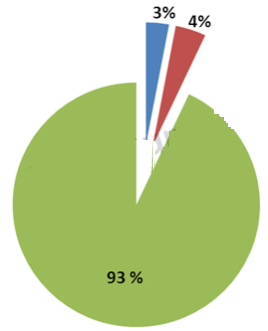
Which of the following answers would you expect to best describe the pie chart?
K4 3 credits
Suggested Answer: C
Get Premium CTAL-TM_Syll2012 Questions
as Interactive Web-Based Practice Test or PDF
Real Exam Format
Detailed Explanations
Instant Access
Get Your Practice Test
12 comments · newest first
VE
Vesta
11 months ago
I think C is misleading; we can't just ignore the higher risks!
MI
Micaela
12 months ago
Option A is definitely not right; there's always something left to test.
HI
Hildred
12 months ago
Wait, how can only 3% of risk items be left? That seems too good to be true.
JO
Josphine
12 months ago
I totally agree, releasing now seems risky!
AL
Alex
1 year ago
Looks like option B is the most accurate.
TA
Tammara
1 year ago
I feel like option C is too optimistic. We learned that even low-risk items can still pose issues if not properly tested.
RE
Rebbecca
1 year ago
I think option B sounds familiar from our practice questions. It highlights that high-risk items might still be untested, which is a concern.
LE
Leandro
1 year ago
I remember discussing risk-based testing in class, but I'm not sure if all risk items can truly be covered.
JO
Josue
1 year ago
I’m a bit confused about the percentages in option D. Did we cover how to interpret those figures in relation to risk?
AR
Ariel
1 year ago
I think the key here is to focus on the transparency aspect. That makes me think it might be the "Develop iteratively" principle, since that involves regularly reviewing progress with stakeholders.
TI
Timmy
1 year ago
The Brocade and Cisco SAN Manager option seems like a distractor. OneView is focused on HPE hardware, not third-party storage management.
SK
Skye
1 year ago
I'm pretty sure that if Ms. Stanley agrees to the generic, it should have the same active ingredients as the original, but I recall some concerns about the efficacy being not fully proven in some cases.