
 MENU

SR-MPLS is enabled on all routers. The label information encapsulated by R1 into a data packet is shown in the figure.
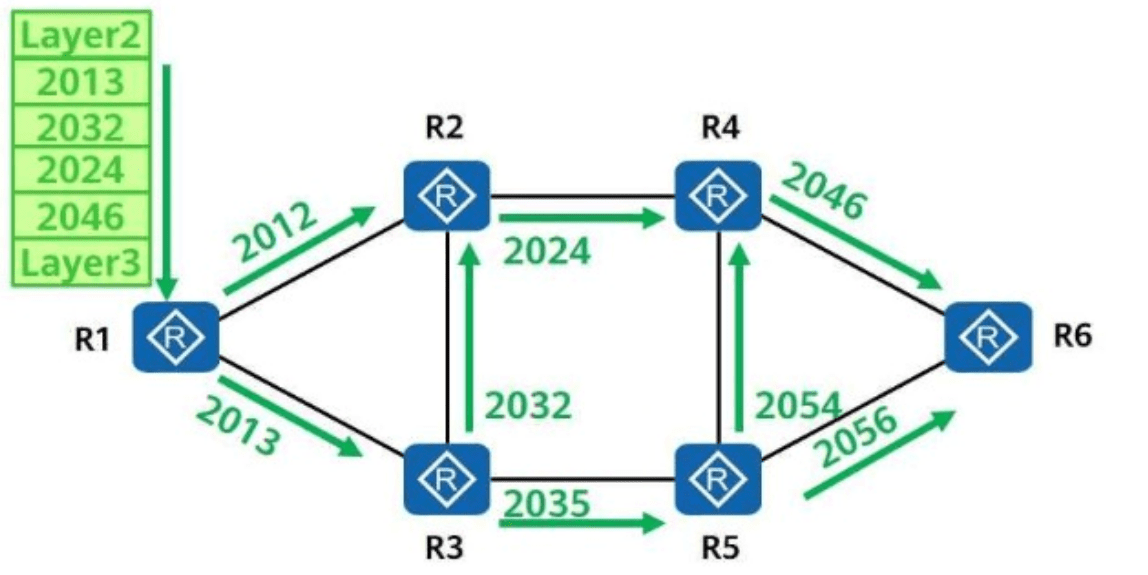
Which of the following is the forwarding path of the data packet?
Comprehensive and Detailed In-Depth
1. Understanding SR-MPLS (Segment Routing with MPLS):
Segment Routing (SR) leverages MPLS labels to define paths through the network.
The labels represent segments (nodes or specific paths) rather than traditional LDP or RSVP-TE labels.
The label stack determines the forwarding path through the network.
Top Label: Determines the next hop.
Next Label: After label pop, it indicates the subsequent hop.
2. Analyzing the Given Label Stack:
The label stack encapsulated by R1 is as follows:
Layer2: 2046
2013
2032
2024
2046
Layer3
The top label (2046) indicates that the next-hop router is R4.
After R4 pops the top label, the next label (2046) directs the packet to R6.
3. Forwarding Path Analysis:
Step 1: R1 sends the packet to R2 based on internal routing.
Step 2: R2 forwards the packet directly to R4 as dictated by the top label (2046).
Step 3: R4 pops the top label (2046) and checks the next label (again 2046), directing the packet to R6.
Step 4: R6 receives the packet as the final destination.
4. Why Option B is Correct:
The path R1-R2-R4-R6 matches the label stack processing in SR-MPLS.
The labels indicate the shortest path chosen by SR policies, which is R1 R2 R4 R6.
The SR-MPLS label stack efficiently guides the packet through the optimal path without complex signaling.
Why Other Options Are Incorrect:
Option A (R1-R2-R3-R5-R6):
This path does not match the label sequence as the labels clearly indicate a direct path via R4, not through R3 and R5.
Option C (R1-R3-R2-R4-R6):
This path is longer and unnecessary, as the label stack indicates a more direct path via R2 and R4.
Huawei HCIE-Datacom V1.0 Training Materials
Huawei Official Documentation: SR-MPLS Configuration Guide
RFC 8660 - Segment Routing with MPLS Data Plane
HCIE-Datacom Knowledge Base: Segment Routing and MPLS
Currently there are no comments in this discussion, be the first to comment!