
Free Preparation Discussions
 MENU
MENU
Huawei H12-891_V1.0 Exam - Topic 1 Question 82 Discussion
Topic #: 1
OSPF is deployed on a campus network to implement network interconnection. The LSDB of R2 is shown in the figure.
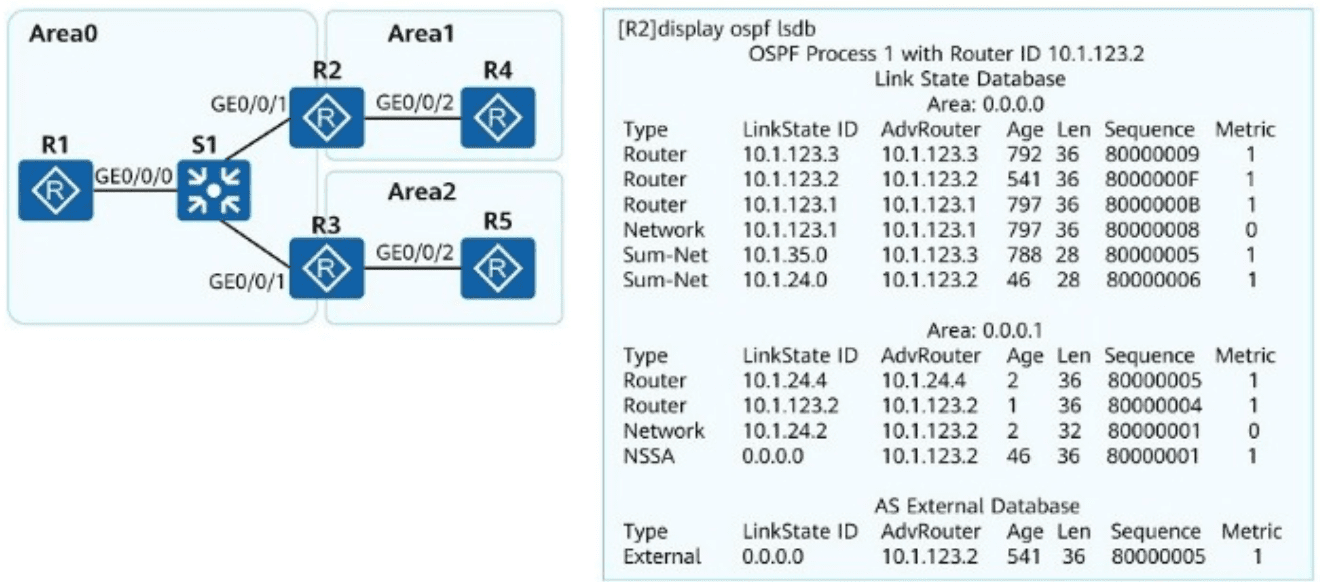
What can be determined from the LSDB?
To analyze this question, let's break down the key concepts and the given LSDB (Link State Database) information from the figure:
Understanding the LSDB Output:
The output shows the OSPF LSDB on R2 with Router ID 10.1.123.2.
Area 0.0.0.0 (Area 0) is displayed along with several Link State Advertisements (LSAs) including Router LSAs, Network LSAs, and Summary LSAs.
Area 0.0.0.1 (Area 1) also displays Router LSAs and a Type 7 LSA (NSSA LSA) with Link-State ID 0.0.0.0.
An External LSA (Type 5) with Link-State ID 0.0.0.0 and AdvRouter 10.1.123.2 is also present.
Analysis of Each Option:
Option A: Area 1 is an NSSA.
Correct.
The presence of a Type 7 LSA (NSSA LSA) in the database indicates that Area 1 is configured as an NSSA (Not-So-Stubby Area).
NSSA allows the injection of Type 7 LSAs for external routes while blocking Type 5 LSAs from entering the area.
Option B: R2 translates Type 7 default route into Type 5 default route.
Correct.
In an NSSA, if an ABR (like R2) has the NSSA ASBR capability, it will convert Type 7 LSAs to Type 5 LSAs before injecting them into the backbone area (Area 0).
In the LSDB, we see both a Type 7 LSA (NSSA) and a corresponding Type 5 External LSA, confirming that R2 performs this translation.
Option C: R2 advertises the default route in the OSPF process.
Incorrect.
There is no indication that R2 itself is originating the default route.
The Type 7 LSA in Area 1 and the Type 5 LSA in Area 0 only indicate translation from another source, not R2 advertising it directly.
Option D: Area 1 does not have Type 3 LSAs. The possible cause is that R2 filters Type 3 LSAs in the outbound direction of Area 1.
Incorrect.
In an NSSA area, Type 3 LSAs (Inter-Area Prefix LSAs) are typically not generated for external routes.
The absence of Type 3 LSAs in Area 1 is due to the nature of NSSA itself rather than any filtering configured on R2.
Huawei HCIE-Datacom V1.0 Training Materials
Huawei Official Documentation: OSPF Configuration Guide
Huawei OSPFv3 Configuration Guide
RFC 3101 - The OSPF Not-So-Stubby Area (NSSA) Option
HCIE-Datacom Knowledge Base: OSPF Advanced Concepts
===========
Rex
7 days agoCordelia
12 days agoSanjuana
17 days agoRodrigo
23 days agoKirk
28 days agoElizabeth
1 month agoTamar
1 month agoFrancesco
1 month agoRonna
2 months agoLonna
2 months agoGiuseppe
2 months agoEladia
2 months agoEmily
2 months agoJesusita
2 months agoSharee
3 months agoDaniela
3 months agoAdolph
3 months ago