
Free Preparation Discussions
 MENU
MENU
Huawei H12-831_V1.0 Exam - Topic 8 Question 86 Discussion
Topic #: 8
Refer to the exhibit.
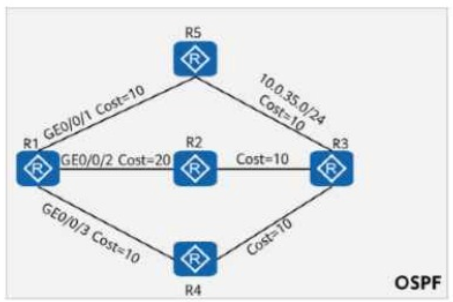
On the OSPF network shown in the figure, the cost values of links are marked. OSPF IP FRR is enabled on R1, and the maximum load-balancing 8 command is configured in the OSPF process. Which of the following is the cost value of the route 10.0.35.0/24 in the routing table of R1?
Comprehensive and Detailed In-Depth
To determine the cost value of the route 10.0.35.0/24 in the routing table of R1, let's analyze the possible shortest paths from R1 to R3 (which owns the 10.0.35.0/24 network) based on the given OSPF link costs:
Path 1: R1 R2 R3
R1 to R2: Cost = 20
R2 to R3: Cost = 10
Total Cost = 20 + 10 = 30
Path 2: R1 R4 R3
R1 to R4: Cost = 10
R4 to R3: Cost = 10
Total Cost = 10 + 10 = 20 (Lowest cost path)
Path 3: R1 R5 R3
R1 to R5: Cost = 10
R5 to R3: Cost = 10
Total Cost = 10 + 10 = 20 (Equal-cost path)
Final Calculation:
The two best equal-cost paths (R1 R4 R3 and R1 R5 R3) have a cost of 20.
Since OSPF supports equal-cost multi-path (ECMP) routing and maximum load-balancing 8 is enabled, OSPF will install both routes into the routing table with the same cost of 20.
The path R1 R2 R3 has a higher cost (30) and will not be chosen.
Final Answer: 20 (Option C)
HCIP-Datacom-Advanced Routing & Switching Technology V1.0 -- OSPF Route Calculation & Load Balancing
OSPF Equal-Cost Multi-Path (ECMP) and Route Selection
OSPF Fast Reroute (FRR) Mechanism
Tuyet
3 days agoCecily
8 days agoHildegarde
13 days agoNikita
19 days agoJacob
24 days agoCarolann
29 days agoAleta
1 month agoFreeman
1 month agoJade
1 month agoBerry
2 months agoTandra
2 months agoBrandon
2 months ago