
Free Preparation Discussions
 MENU
MENU
HPE7-A06 Exam Questions
- HPE Aruba Networking Certified Expert Certifications
- HP Campus Access Switching Certifications
- Topic 1: Network Stack: This domain covers analyzing customer issues within the network stack and troubleshooting them to reach a resolution.
- Topic 2: Connectivity: This domain covers developing configurations from customer requirements, applying advanced networking architectures, identifying design flaws, and troubleshooting device deployment.
- Topic 3: Network Resiliency and Virtualization: This domain covers designing and troubleshooting mechanisms that ensure resiliency, redundancy, and fault tolerance in the network.
- Topic 4: Switching: This domain covers implementing, troubleshooting, and remediating Layer 2/3 switching, including broadcast domains and interconnection technologies.
- Topic 5: WLAN: This domain covers designing and troubleshooting RF attributes and wireless functions, building configurations to customer requirements, and handling Layer 2 broadcast domains and interconnections.
- Topic 6: Routing: This domain covers designing and troubleshooting routing topologies and their associated functions.
- Topic 7: Security: This domain covers designing and troubleshooting security implementations, wired 802.1X with EAP-TLS scenarios, and building/troubleshooting GBP.
- Topic 8: Authentication/Authorization: This domain covers designing and troubleshooting AAA configurations along with creating and analyzing ClearPass integration.
- Topic 9: Troubleshooting: This domain covers performing advanced troubleshooting and remediation across campus networks.
- Topic 10: Performance Optimization: This domain covers analyzing and remediating performance-related issues in the network.
Free HP HPE7-A06 Exam Actual Questions
Note: Premium Questions for HPE7-A06 were last updated On Sep. 02, 2026 (see below)
Network administrators are reporting that switches arc taking a very long time to execute commands. Based on the configuration below, what is the most likely cause of the issue?
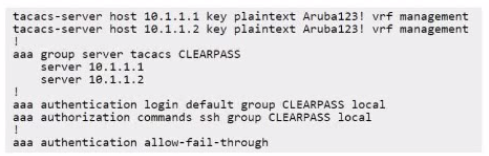
The issue is that switches are taking a very long time to execute commands. The question points towards the AAA configuration as the context (though the specific configuration is missing).
AAA and Command Latency: When AAA servers (like TACACS+ or RADIUS) are used for authentication, authorization, or accounting, the switch must communicate with these servers.
Impact of Unreachable Servers: If the primary AAA server configured on the switch becomes unreachable (due to network issues, server downtime, or firewall rules), the switch will attempt to connect, wait for a configured timeout period (often several seconds), and only then potentially try a secondary server or fall back to local credentials (if configured). This connection attempt and timeout period occurring before command execution (if command authorization is enabled) or during login introduces significant delays.
Analysis of Options:
A: Too many administrators might strain resources, but AAA timeouts cause more predictable, long delays per action.
B: Authentication fail-through only comes into play after the primary server times out. The timeout itself causes the delay.
C: An unreachable primary TACACS+ (or RADIUS) server is a classic cause of slow logins and command execution delays due to connection timeouts.
D: A DoS attack might cause general slowness but isn't specifically linked to the AAA configuration context provided.
Conclusion: The most likely cause, given the context of AAA configuration and the symptom of slow command execution, is that the primary configured AAA server (like TACACS+) is unreachable, causing the switch to wait for timeouts.
You have recently configured a switch for 802.IX authentication with HPE Aruba Networking ClearPass. A security admin is seeing events with the following description in ClearPass Event Viewer.
RADIUS authentication attempt from unknown NAD (10.10.1.10:1812)'
Which command should you us to identify the configuration issue?
The ClearPass Event Viewer message 'RADIUS authentication attempt from unknown NAD (10.10.1.10:1812)' indicates that ClearPass received a RADIUS request from the IP address 10.10.1.10, but this IP is not configured as a trusted Network Access Device (NAD) in ClearPass's network device list, or the shared secret doesn't match. The first step in troubleshooting on the switch side is to verify which source IP address the switch is actually using to send these RADIUS requests.
RADIUS Source IP: AOS-CX switches can be configured to use a specific source IP address for RADIUS packets, often using the ip source-interface radius [vrf <vrf-name>] command. This is important if the switch has multiple IP interfaces or uses VRFs.
Analysis of Commands:
A . show ip source-interface radius: This command directly displays the configured source interface and IP address used for RADIUS communications, allowing comparison with the IP configured in ClearPass.
B . show aaa authentication-server radius: Shows server group configuration, not the source IP used by the switch.
C . show radius-server shared-secret: Not a standard command; secrets are usually masked in other commands.
D . show radius-server detail: Shows configured RADIUS server details but doesn't explicitly show the source IP the switch is using to originate packets.
Conclusion: To identify why ClearPass sees requests from an 'unknown NAD' IP (10.10.1.10), the first step on the switch is to confirm which source IP it's using. show ip source-interface radius provides this crucial information.
What is the best practice for using Dynamic Segmentation?
The question asks for the best practice for using Dynamic Segmentation.
Dynamic Segmentation Overview: It's an architecture that provides unified policy and segmentation for wired and wireless clients by combining role-based access control, traffic tunneling (like UBT), and overlay technologies (like VXLAN/GRE). Policies are enforced centrally, typically at an Aruba Gateway.
Analysis of Options:
A: UBT is a component, but Dynamic Segmentation encompasses more than just creating isolated networks with UBT.
B: Correctly describes the core principle: using a combination of role-based access (for defining who gets what policy) and overlay technologies (for transporting traffic to the policy enforcement point and providing segmentation). This creates a layered security approach.
C: Incorrect. A key benefit is unified policy across both wired and wireless access.
D: LUR and DUR are role types, but how they are assigned isn't the fundamental description of Dynamic Segmentation itself.
Conclusion: Option B accurately captures the essence of Dynamic Segmentation as a best practice approach, integrating role-based policies with overlay networking for secure, unified access control.
A customer has sot a requirement for VLAN 151 to be an isolated VLAN. A colleague has copied and pasted a partial configuration, but you do not achieve the desired outcome. This is the code that was added:
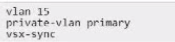
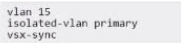
What should be added to the configuration before this code to achieve the desired result?
A)
B)
C)
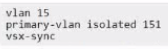
D)
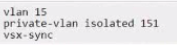
The customer requires VLAN 151 to be configured as an isolated Private VLAN. A partial configuration was added, but the desired outcome wasn't achieved. We need to determine which configuration snippet should be added before the (unspecified) partial configuration to correctly set up the Private VLAN structure.
Private VLAN Configuration Fundamentals:
A Primary VLAN must be defined. This VLAN carries traffic between promiscuous ports and ports in associated secondary VLANs.
Secondary VLANs (either isolated or community) are associated with the primary VLAN.
Ports are then mapped to either the primary VLAN (promiscuous ports, typically router/firewall connections) or a secondary VLAN (host ports). Isolated ports within the same isolated VLAN cannot communicate with each other.
Analyzing the Options (Assuming VLAN 15 is the intended Primary):
A)
vlan 15
private-vlan primary
vsx-sync
This correctly defines VLAN 15 as the Primary Private VLAN. The vsx-sync command ensures this configuration is synchronized across a VSX pair (relevant if applicable). This is the necessary prerequisite before defining VLAN 151 as an isolated secondary VLAN and associating it with VLAN 15.
B) isolated-vlan primary is incorrect syntax. The command is private-vlan primary.
C) primary-vlan isolated 151 is incorrect syntax for defining either the primary or secondary VLAN type/association within the primary VLAN context.
D) private-vlan isolated 151 within the vlan 15 context is incorrect syntax. The private-vlan isolated command belongs under the configuration of the secondary VLAN (VLAN 151 in this case).
Conclusion: Before configuring VLAN 151 as private-vlan isolated and associating it, the primary VLAN must be defined. Option A correctly shows the command (private-vlan primary) under the intended primary VLAN's configuration (vlan 15) to establish it as the primary VLAN.
The client would like to automate the process of troubleshooting issues to have better visibility. Which solution would you recommend for your client?
The client wants to automate troubleshooting processes and gain better visibility into their network. We need to identify the recommended Aruba solution.
Analysis of Options:
A . HPE Aruba Networking Fabric Composer: A tool primarily for data center fabric provisioning and management, not general campus troubleshooting automation.
B . HPE Aruba Networking Switch Multi-Edit Software: Likely refers to configuration management features (e.g., in Central or NetEdit) for applying changes to multiple switches, not primarily focused on automated troubleshooting or visibility.
C . Automate processes with scripting like Python: AOS-CX supports on-box scripting (NAE) and REST APIs, enabling custom automation for monitoring and troubleshooting. While powerful, it requires development effort.
D . AIOps integrated into HPE Aruba Networking Central: Aruba Central's AIOps capabilities are specifically designed to enhance visibility and automate aspects of troubleshooting. It uses AI/ML to analyze network data, detect anomalies, provide insights into potential issues, correlate events, and offer prescriptive recommendations, directly addressing the client's need for better visibility and automated assistance with troubleshooting.
Conclusion: While custom scripting (C) allows automation, Aruba Central AIOps (D) is the platform-integrated solution specifically marketed and designed by HPE Aruba Networking to provide enhanced visibility and automated insights for troubleshooting campus networks. It is the most direct and recommended solution among the options for achieving these goals within the Aruba ecosystem.
- Select Question Types you want
- Set your Desired Pass Percentage
- Allocate Time (Hours : Minutes)
- Create Multiple Practice tests with Limited Questions
- Customer Support
Currently there are no comments in this discussion, be the first to comment!