
Free Preparation Discussions
 MENU
MENU
Google Professional Security Operations Engineer Exam - Topic 2 Question 14 Discussion
Topic #: 2
You are implementing Google Security Operations (SecOps) for your organization. Your organization has their own threat intelligence feed that has been ingested to Google SecOps by using a native integration with a Malware Information Sharing Platform (MISP). You are working on the following detection rule to leverage the command and control (C2) indicators that were ingested into the entity graph.
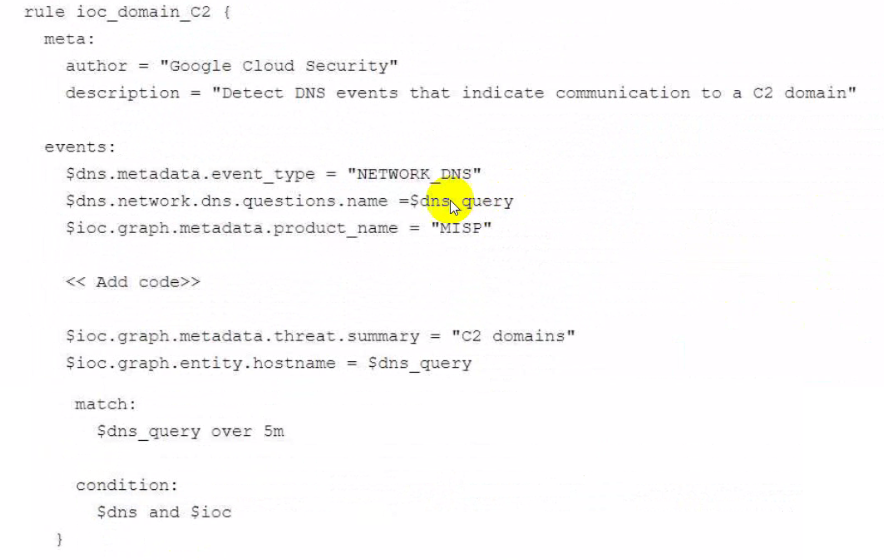
What code should you add in the detection rule to filter for the domain IOCS?
This YARA-L rule is designed to correlate a real-time event (a DNS query, $dns) with known-bad indicators stored in the Google SecOps entity graph ($ioc). The code must correctly filter the entity graph to find the specific indicators from the custom MISP feed.
Two filters are required:
$ioc.graph.metadata.entity_type = 'DOMAIN_NAME': This line is essential to filter the entity graph for IoCs that are domains. The rule is trying to match a DNS query ($dns_query) to a known C2 domain, so the entity type must be DOMAIN_NAME.
$ioc.graph.metadata.source_type = 'ENTITY_CONTEXT': This is the key differentiator. The Google SecOps entity graph has multiple context sources. GLOBAL_CONTEXT (Option B) is for threat intelligence provided by Google (e.g., Google Threat Intelligence, Mandiant). DERIVED_CONTEXT (Option C) is for context inferred from UDM events. The prompt explicitly states the IoC feed is the organization's own 'threat intelligence feed... ingested... with... MISP.' This type of customer-provided, third-party intelligence is classified as ENTITY_CONTEXT. Adding this line ensures the rule only uses the custom MISP feed for its IoC data, as intended.
The other lines in the $ioc block, such as product_name = 'MISP', further refine this ENTITY_CONTEXT search.
(Reference: Google Cloud documentation, 'YARA-L 2.0 language syntax'; 'Context-aware detections with entity graph'; 'Populate the entity graph')
Natalya
4 days agoLorean
9 days agoDesmond
14 days agoJacqueline
19 days agoTandra
24 days agoMarcelle
29 days agoMagdalene
1 month agoJin
1 month agoWinifred
1 month agoChantell
2 months agoRoxanne
2 months agoArthur
2 months agoLeandro
4 months ago