
Deal of The Day! Hurry Up, Grab the Special Discount - Save 25% - Ends In 00:00:00 Coupon code: SAVE25
Welcome to Pass4Success

- Free Preparation Discussions

Google Professional Cloud Architect (PR000213) Exam - Topic 1 Question 122 Discussion

One of the developers on your team deployed their application in Google Container Engine with the Dockerfile below. They report that their application deployments are taking too long.You want to optimize this Dockerfile for faster deployment times without adversely affecting the app's functionality.Which two actions should you take? Choose 2 answers.
C) Use a slimmed-down base image like Alpine linux. and E) Copy the source after the package dependencies (Python and pip) are installed.
A) Remove Python after running pip.
B) Remove dependencies from requirements.txt.
D) Use larger machine types for your Google Container Engine node pools.

Google Professional Cloud Architect (PR000213) Exam - Topic 1 Question 122 Discussion

Actual exam question for Google's Professional Cloud Architect (PR000213) exam
Question #: 122
Topic #: 1
[All Professional Cloud Architect (PR000213) Questions]

One of the developers on your team deployed their application in Google Container Engine with the Dockerfile below. They report that their application deployments are taking too long.
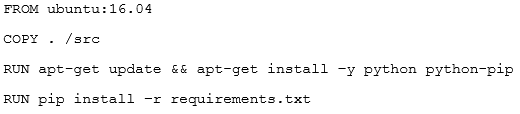
You want to optimize this Dockerfile for faster deployment times without adversely affecting the app's functionality.

Which two actions should you take? Choose 2 answers.

Show Suggested Answer Hide Answer
Suggested Answer: C, E

The speed of deployment can be changed by limiting the size of the uploaded app, limiting the complexity of the build necessary in the Dockerfile, if present, and by ensuring a fast and reliable internet connection.

Note: Alpine Linux is built around musl libc and busybox. This makes it smaller and more resource efficient than traditional GNU/Linux distributions. A container requires no more than 8 MB and a minimal installation to disk requires around 130 MB of storage. Not only do you get a fully-fledged Linux environment but a large selection of packages from the repository.


https://www.alpinelinux.org/about/

Contribute your Thoughts:

0/2000 characters
Johnetta
4 days ago
Removing Python after pip seems unnecessary. It could break things.
upvoted 0 times
...
Oren
9 days ago
Agreed! It reduces the image size significantly.
upvoted 0 times
...
Dalene
14 days ago
I think using a slimmed-down base image like Alpine is a smart move.
upvoted 0 times
...
Candida
19 days ago
Larger machine types? Seems like overkill for just speed.
upvoted 0 times
...
Wilson
24 days ago
E makes sense, it can speed up the build process!
upvoted 0 times
...
Louvenia
29 days ago
I’m not sure about B, removing dependencies could break things.
upvoted 0 times
...
Eugene
1 month ago
A is a good idea too, less bloat after install.
upvoted 0 times
...
Delmy
1 month ago
Definitely go with C, Alpine is way lighter!
upvoted 0 times
...
Chanel
1 month ago
I practiced a similar question, and I think using larger machine types might not really solve the deployment time issue, so I would avoid option D.
upvoted 0 times
...
Emilio
2 months ago
I feel like copying the source after installing dependencies is a common practice to optimize builds. So maybe option E is also a good pick.
upvoted 0 times
...
Tamala
2 months ago
I'm not entirely sure, but I think removing Python after running pip might help reduce the image size. That could be option A?
upvoted 0 times
...
Marsha
2 months ago
I remember that using a slimmed-down base image can really help with deployment times, so I think option C is a good choice.
upvoted 0 times
...

Save Cancel